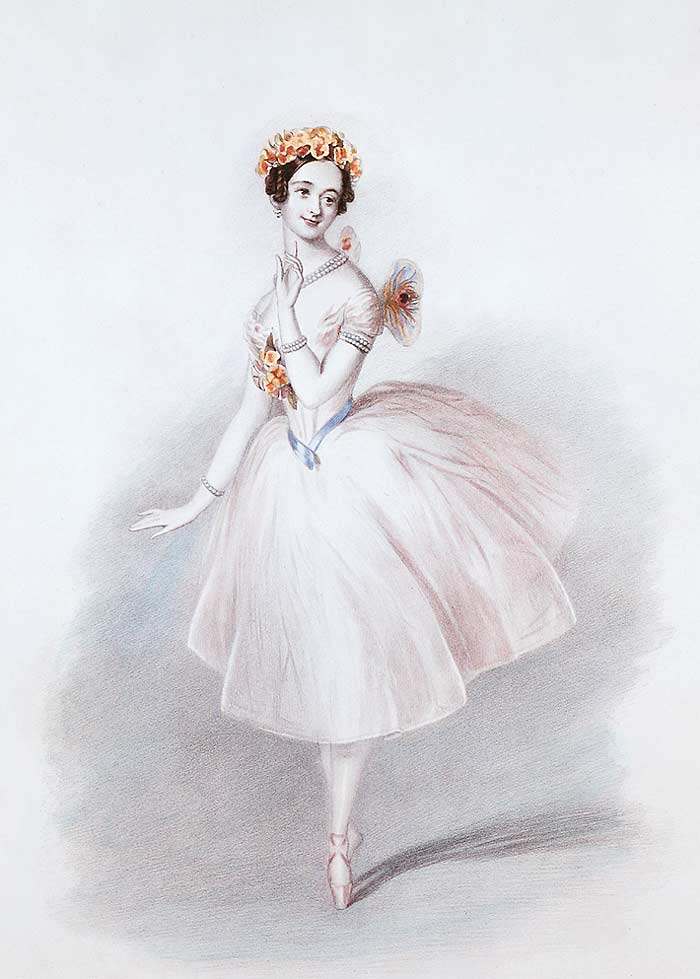
originally uploaded by Mrlopez2681 at en.wikipedia.org — [1] · CC BY-SA 3.0
La Sylphide is a two-act Romantic ballet first staged at the Paris Opéra on 12 March 1832, with choreography by Filippo Taglioni, a libretto by the tenor Adolphe Nourrit (after Charles Nodier's tale Trilby), and a score by Jean-Madeleine Schneitzhoeffer. Taglioni built the ballet specifically to showcase his daughter Marie in the title role of an ethereal woodland spirit who lures a Scottish farmer away from his wedding day. The article notes that this original Taglioni choreography does not survive; the version now performed worldwide is a separate 1836 production by August Bournonville, made to different music (Løvenskiold) after the Paris Opéra priced Schneitzhoeffer's score out of reach — so 'La Sylphide' names two related but choreographically distinct stage works.
What it contains
- Romantic Ballet · The whole ballet, both acts — Sustained aestheticized pointe work for the title role used to signify weightlessness and otherworldliness, contrasted with grotesque, earthbound character dance for the witches and an airy corps divertissement for the Sylph's sisters — the pointe-versus-grotesque contrast structures the whole piece. Source: "is a romantic ballet in two acts"
What is danced
The article credits La Sylphide with a specific technical turning point: it describes it as the first ballet in which dancing en pointe carried an aesthetic rationale rather than being 'merely an acrobatic stunt, often involving ungraceful arm movements and exertions' — pointe work here is used to suggest weightlessness and otherworldliness rather than to display strength. Marie Taglioni's shortened skirt was designed expressly to expose this pointe work to the audience, which the article records as scandalous at the time.
Beyond the title role's sustained pointe technique, the synopsis describes two other distinct danced episodes: a grotesque group dance for Old Madge and her fellow witches around a cauldron that opens Act II, and an 'airy' divertissement for the Sylph's ethereal sisters, summoned to entertain James in the forest glade. The ballet also calls for character/mime-driven sections — the fortune-telling scene, the interrupted bridal procession, the final funeral-like lifting of the dead Sylph by her sisters — which sit alongside the pure-dance passages and are typical of how Romantic ballet mixed pantomime with virtuosic female solo and corps work.
The article gives no step-by-step choreographic notation (Taglioni's original is lost), so specifics of exact enchainements cannot be drawn from it; what can be stated with confidence is the aesthetic programme — ethereal female pointe work contrasted with grotesque character dance for the witches — that structures the piece.
Context
The 1832 premiere is treated by dance history as inaugurating the Romantic ballet era: pointe work stops being a stunt and becomes a device for representing the supernatural and the unattainable, a shift the article attributes directly to this production and to Marie Taglioni's performance. The ballet's witches'-cauldron scene is traced in the article to earlier sources — Paganini's Le Streghe and Viganò's 1812 ballet Il Noce di Benevento — showing the production absorbing an existing theatrical vocabulary of stage witchcraft into ballet.
Staging history
According to the article, Taglioni's original choreography is irretrievably lost. Notable revivals and derivatives include Emma Livry's 1858 Paris Opera debut as the Sylph (coached by the retired Marie Taglioni), Marius Petipa's 1892 revival for the Imperial Ballet with additional music by Riccardo Drigo, and Pierre Lacotte's 1972 reconstruction for the Paris Opera Ballet built from period prints, notes and drawings rather than surviving steps — a reconstruction some have criticised as inauthentic. Separately, August Bournonville's own 1836 version, made for the Royal Danish Ballet with music by Løvenskiold because the Paris Opéra would not license Schneitzhoeffer's score cheaply, has been performed by that company in its original form ever since and is described as one of the oldest surviving ballets; Johan Kobborg staged a version of it with new interpolated numbers at the Royal Opera House in 2005.
How to watch it
Watch how the Sylph's pointe work is used to suggest floating and evasion rather than force — she appears, touches James, and vanishes, and the choreography treats her literal untouchability as its subject. Contrast this with Old Madge's grotesque, earthbound witches' dance around the cauldron, which is built as the visual and technical opposite of the Sylph's airborne vocabulary. The tragic ending relies on stage convention as much as steps: the Sylph's wings are removed, she dies, and her sisters lift and carry her body offstage as a piece of pictorial staging rather than a danced solo.
Structure
- Act IIn a Scottish farmhouse, a Sylph appears to and kisses the sleeping James; later, during his interrupted wedding preparations, she reappears, he embraces her, and she steals the wedding ring and lures him into the forest as guests dance around the bridal procession.
- Act IIOld Madge and her fellow witches dance grotesquely around a cauldron, brewing a magic scarf before the fog lifts to reveal the forest glade.
- Act IIThe Sylph shows James her woodland realm and summons her ethereal sisters, who perform airy dances to entertain him.
- Act IIJames binds the Sylph with Madge's scarf; her wings fall off and she dies, and her sisters lift her lifeless body as James collapses.
Structure read from an encyclopaedia article, not from a libretto or score we hold. Confirm against a programme before treating the numbering as authoritative.
Credits
- composer: Jean Schneitzhoeffer
More from Filippo Taglioni
Other staged works in the register connected to this one by author or lineage.
- La fille du DanubeBalletTaglioni · video
 Ballet of the NunsBallet · 1831Taglioni · video
 Leda, the Swiss MilkmaidBallet · 1821Taglioni · video
 GiselleBallet · 1841Same lineage · video
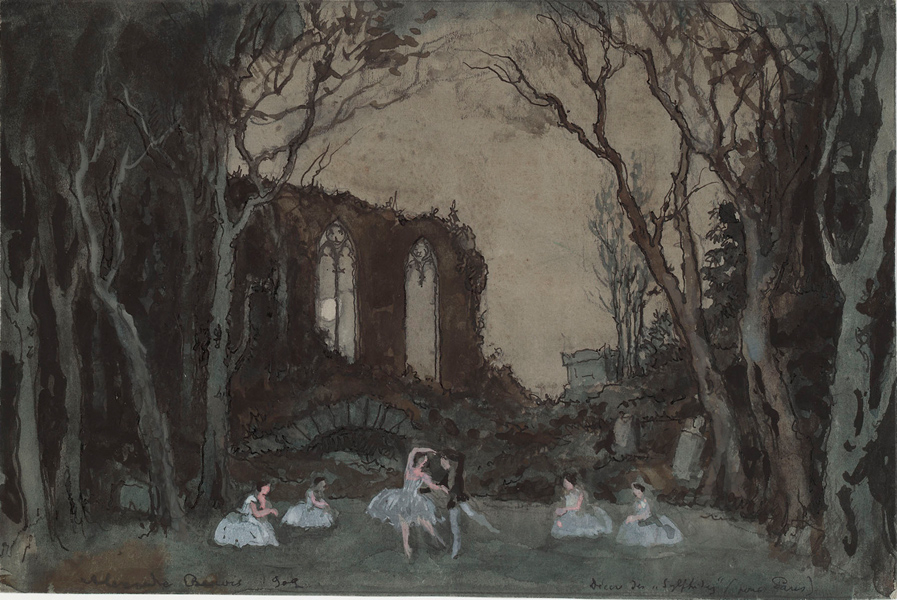 Les SylphidesBallet · 1908Same lineage · video
 La fille mal gardéeBallet · 1789Same lineage · video
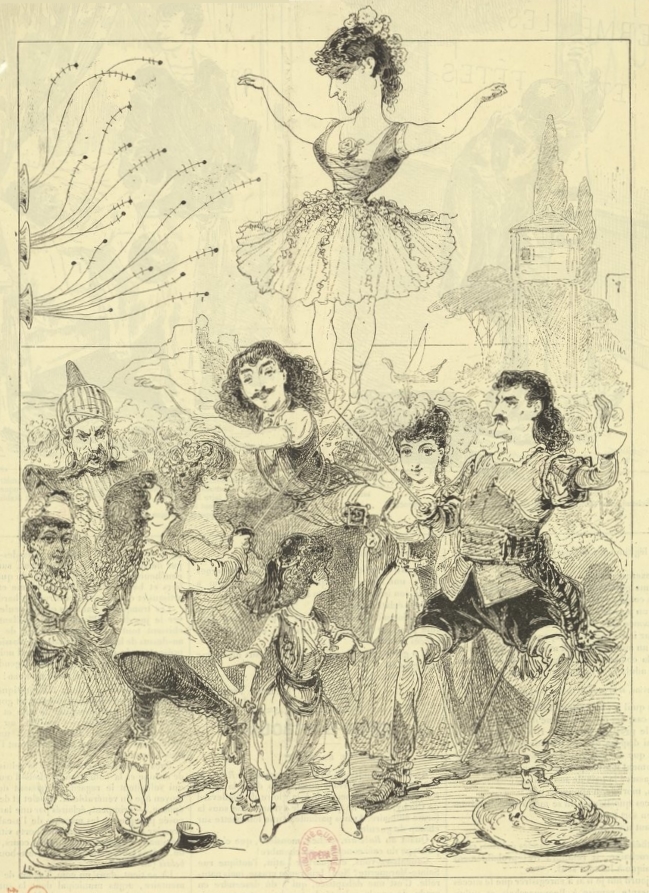 NamounaBallet · 1882Same lineage · video
 L'Île EnchantéeBallet · 1864Same lineage
