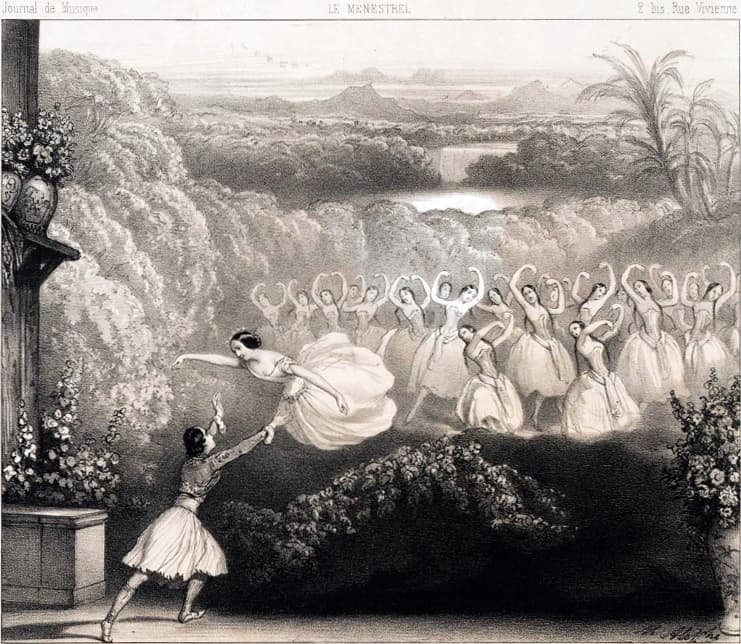
Alophe, Marie-Alexandre (1812-1883). Lithographe — bnf · Public domain
La Péri is a Romantic-era fantastic ballet created for the Paris Opera in 1843, with choreography by Jean Coralli, music by Friedrich Burgmüller, and a scenario by Théophile Gautier and Coralli built around the Orientalist fashions of the day: a jaded sultan, an opium dream, and a fairy who tests his love by taking human form as a runaway slave. It belongs to the same generation and milieu as Coralli's Giselle, made to showcase a specific star, Carlotta Grisi, rather than to advance a plot for its own sake.
What it contains
- Romantic Ballet · The pas de songe and pas d'abeille solos created for Carlotta Grisi as the Péri — A dream-dance ending in a jump from a six-foot platform caught by the partner, and a solo mimed around an imaginary bee sting described as a decorous striptease — both built as star display vehicles typical of Romantic ballerina roles. Source: "a pas de songe that culminated in her daring leap from a six-foot-high platform into her partner's arms, and a pas d'abeille, a decorous striptease prompted by the invasion of an imaginary bee"
What is danced
The article names two set pieces made for Grisi as the Péri: a pas de songe (dream dance) that ended with her jumping from a six-foot platform into her partner's arms — a partnering feat built around trust and a caught aerial descent rather than sustained supported adagio — and a pas d'abeille, a solo built around the comic-erotic conceit of being invaded by an imaginary bee, described as 'a decorous striptease.' Both are vehicle roles: display pieces engineered to prove a ballerina's daring (the leap) and her charm and mime (the bee dance) rather than passages that develop the plot through ensemble choreography.
Beyond these two named dances the article gives no scene-by-scene breakdown of the choreography, so the wider structure of the two acts and three scenes — corps de ballet passages, any character or divertissement dances tied to the Persian/slave-market setting — cannot be reconstructed from what is here.
Context
The ballet dates from the height of Romantic ballet in Paris, the period that also produced Giselle (1841, also co-choreographed by Coralli), and shares its stock ingredients: a supernatural female lead, a mortal male lover, an exotic or otherworldly setting reached through a dream or vision, and a ballerina-centered structure of solo showpieces. Its immediate success, per the article, revived Grisi's reputation and led to productions across European theatres, which is itself evidence of how quickly a Paris Opera vehicle for a star ballerina could travel and be restaged elsewhere in this period.
Staging history
The article records only one modern staging: Vladimir Malakhov mounted a production for the Staatsballett Berlin in 2010. It also flags that a wholly separate, unrelated ballet also called La Péri exists — a 1911 score by Paul Dukas, first choreographed by Ivan Clustine in 1912 and since restaged by Frederick Ashton, Serge Lifar, and George Skibine — which shares only the title and subject type, not any choreographic or musical lineage with Coralli's version.
How to watch it
Watch for the two signature moments the article singles out: the leap from an elevated platform into the male partner's arms (a test of trust and control in the catch, not just the jump), and the bee-dance, where the comedy and eroticism are carried through mime and reactive, darting steps rather than through story-advancing movement. As with much Romantic ballet, the choreography exists largely to display the ballerina; look for how the corps and the male lead frame rather than share the stage with her.
Credits
- composer: Friedrich Burgmüller
More from Jean Coralli
Other staged works in the register connected to this one by author or lineage.
 GiselleBallet · 1841Coralli · video
 Ballet of the NunsBallet · 1831Coralli · video
 La TarentuleBallet · 1839Coralli
 La SylphideBallet · 1832Same lineage · video
 Les SylphidesBallet · 1908Same lineage · video
 La fille mal gardéeBallet · 1789Same lineage · video
 La sonnambulaBallet · 1946Same lineage · video
 L'Île EnchantéeBallet · 1864Same lineage