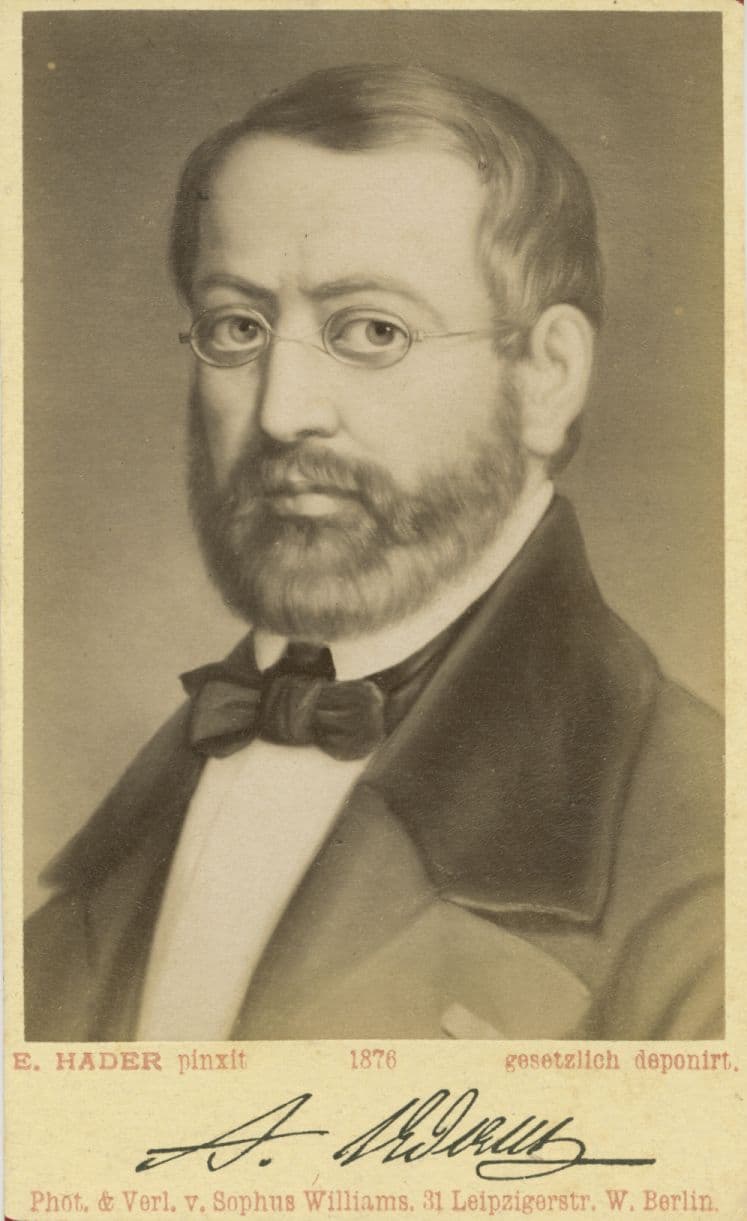
Bergen Public Library Norway from Bergen, Norway — Adolphe Charles Adam portrait · No restrictions
Giselle, or The Wilis (Giselle, ou les Wilis) is a two-act ballet-pantomime with music by Adolphe Adam, first given by the Paris Opera ballet company at the Salle Le Peletier on 28 June 1841 with Carlotta Grisi in the title role. Choreographed by Jean Coralli with Jules Perrot (who devised Grisi's dances uncredited), it dramatises a peasant girl who dies of heartbreak on discovering her lover's true rank and is drawn into the vengeful sisterhood of the Wilis, only to save him with her forgiving love.
It sits in the catalogue as the surviving masterwork of French Romantic ballet, the genre that replaced mythological court spectacle with supernatural, everyday and folkloric subjects after the Revolution. Its Act II 'ballet blanc' of identically dressed spirits became the template that Petipa and later choreographers built on for the rest of the 19th century and beyond.
What it contains
- Romantic Ballet · Both acts — Mime fused with a small classical vocabulary throughout — arabesque, attitude, cabriole, jeté, sissonne, entrechat — with Act I village character dancing giving way to Act II's uniform corps of white-clad Wilis in geometric, synchronized patterning. Source: "is a romantic ballet (ballet-pantomime) in two acts with music by Adolphe Adam"
- Vaganova Method — Pas de deux des jeunes paysans (Peasant pas de deux) · Act I, the Peasant pas de deux — A solo variation, originally made for Emma Bessone in 1887 and unused for decades, was reinstated into the Peasant pas de deux as part of the Kirov Ballet's Vaganova-era staging and has remained there since. Source: "Agrippina Vaganova added it to the Peasant pas de deux for the Kirov Ballet's production of Giselle in 1932."
What is danced
Cyril Beaumont's analysis, cited in the article, describes the ballet as built from two fused elements: mime and dance. Act I alternates short mimed episodes (Albrecht's disguise, Hilarion's suspicion, the flower 'he loves me' test, the unmasking, Giselle's mad scene) with village dancing — a harvest celebration, a peasant pas de deux, and Giselle's own dances as the crowned Harvest Queen — so that mime and step continually interrupt and complete each other. Act II, by contrast, is described as mime completely fused with dance: the Wilis move in synchronized corps patterns that 'control the stage with their long tulle dresses and stoic expressions,' closing in on Albrecht through massed, geometric formation rather than individual pantomime.
Beaumont's inventory of the choreographic vocabulary is deliberately small: développé and grand rond de jambe; arabesque and attitude poses; gliding steps (chassé, glissade, pas de basque, pas de bourrée); hopping steps (ballonné, temps levé); turning steps (pirouette, petit tour, tour en l'air); and leaps both vertical (ballotté, entrechat, sissonne, rond de jambe en l'air sauté) and travelling (cabriole, jeté, grand jeté, soubresaut). Beaumont argues this simplicity was deliberate, chosen to maximise expressiveness rather than display.
The title role and its surrounding numbers accreted virtuoso material long after 1841: a peasant pas de deux was inserted almost immediately for dancer Nathalie Fitz-James; Petipa later added three solo variations (for Adèle Grantzow, Emma Bessone, and Elena Cornalba) to the Act I peasant pas de deux and the Act II grand pas de deux, the last of which — Drigo's 'Pas seul' — is now a standard, widely misattributed passage. Perrot originally planned wire-flown aerial swoops for Giselle in Act II but abandoned them after a stagehand crashed into the scenery during a test.
Context
The article situates Giselle at the end of a decade in which French ballet turned away from Olympian mythology toward the supernatural and the everyday: the 1831 'Ballet of the Nuns' interpolated into Meyerbeer's Robert le diable, and above all Taglioni's La Sylphide (1832), which introduced pointe work used for artistic effect and the white bell-shaped Romantic tutu. Gautier, present at that Sylphide premiere, carried its template of a real setting, an ordinary heroine and a doomed supernatural female into Giselle a decade later.
Staging history
Giselle ran at the Paris Opera from 1841 to 1849 with Grisi in every performance, was revived in 1852–53 and dropped, revived again in 1863 for a Russian ballerina and dropped in 1868, then not staged again in Paris until 1924 for Olga Spessivtzeva, with new Benois designs. It reached London within a year of the Paris premiere (1842, with Grisi and Perrot), Saint Petersburg in December 1842 (staged from memory by Antoine Titus, later reworked by Perrot himself as company ballet master and revised further by Petipa in the 1880s), Milan in 1843 (to different music by Bajetti with different choreography by Cortesi), and the United States in 1846 via Mary Ann Lee, who had studied the role with Coralli in Paris. Nijinsky's 1911 Mariinsky performance in tightless costume caused a scandal that led to his dismissal from the Imperial Ballet; Diaghilev's Ballets Russes staged it the same year in London with Karsavina and Nijinsky, and it became a repertory fixture for Pavlova, Markova and Fonteyn. Frederic Franklin's 1984 'Creole Giselle' for Dance Theatre of Harlem relocated the story to 1840s Louisiana.
How to watch it
Watch the contrast between Act I's mimed storytelling, fused with village and character dancing, and Act II's corps of Wilis, whose power comes from unison patterning and geometric massing rather than individual virtuosity. The peasant pas de deux and the Act II grand pas de deux carry later-added solo variations (by Grantzow, Bessone/Vaganova, and Cornalba/Drigo) that are not from 1841 but are now treated as inseparable from the ballet. Note also how much of Act I is silent mime rather than steps — the flower test, the unmasking, the mad scene — which a purely balletic viewing can miss.
Structure
- Act IIn a Rhineland village, the disguised nobleman Albrecht courts the peasant girl Giselle amid harvest festivities and village dancing; when his rank and betrothal are exposed, Giselle dances herself into a fatal frenzy and dies.
- Act I · Pas de deux des jeunes paysans (Peasant pas de deux)A pas de deux inserted for dancer Nathalie Fitz-James shortly after the première, arranged by Coralli to music including Burgmüller's Souvenirs de Ratisbonne, later given additional solo variations by Petipa and Drigo.
- Act IIAt Giselle's forest grave, the Wilis, led by Myrtha, induct Giselle's spirit and attempt to dance Hilarion and Albrecht to death; Giselle's love shields Albrecht until dawn, after which she is released from the Wilis' power.
- Act II · Grand pas de deuxThe central Act II duet for Giselle and Albrecht, to which Petipa later added a solo variation (Grantzow, 1867, built on Adam's 'he loves me' leitmotif) that has remained in the ballet since.
Structure read from an encyclopaedia article, not from a libretto or score we hold. Confirm against a programme before treating the numbering as authoritative.
Related works
Other staged works in the register connected to this one by author or lineage.
 La EsmeraldaBallet · 1844Perrot · video
 Pas de QuatreBallet · 1845Perrot · video
- Catarina or La Fille du BanditBallet · 1846Perrot
 Ballet of the NunsBallet · 1831Coralli · video
 La PériBallet · 1843Coralli · video
 La TarentuleBallet · 1839Coralli
 NamounaBallet · 1882Same lineage · video
 La sonnambulaBallet · 1946Same lineage · video
