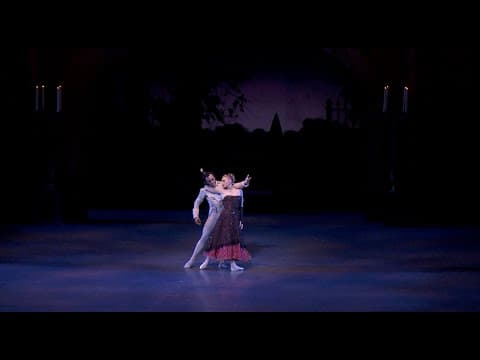
La Sonnambula is a one-act ballet by George Balanchine, first given by the Ballet Russe de Monte Carlo on 27 February 1946 at New York's City Center under the title The Night Shadow, with designs by the surrealist painter Dorothea Tanning and costumes executed by Karinska. It was renamed La Sonnambula in 1961 and entered the New York City Ballet repertory (first NYCB performance 6 January 1960), where it has been revived many times since.
What it contains
- Romantic Ballet · The Sleepwalker's entrance and the ballet's final tableau — The Sleepwalker is described moving without apparent contact or effort, first appearing gliding through the air toward the Poet and later gliding away with him at the close, an ethereal, unseeing quality of movement consistent with the ghostly female figures of Romantic ballet convention. Source: "he sees a lovely white apparition gliding across the roofs toward him"
What is danced
The article's synopsis, drawn from the original 1946 souvenir programme, gives the narrative shape rather than a step-by-step account: a masked ball at which a Poet and a Coquette dance together before the household disperses, followed by the Poet's encounter with the Sleepwalker, a pas de deux built around her trance-like unawareness of him, a confrontation involving the jealous Coquette and the Sleepwalker's husband (the Host), and a final tableau in which the Sleepwalker carries the stabbed Poet away. The recurring textual detail is motion without apparent effort or contact with the ground — the Sleepwalker is twice described as 'gliding': she first appears 'gliding across the roofs' toward the Poet, and at the close the pair 'glide away' together. That imagery signals the piece's central technical demand, an ethereal, seemingly weightless female figure moving through and past the other dancers as though unseeing.
Context
The article does not itself supply broader dance-history framing beyond the production facts: it was made for the Ballet Russe de Monte Carlo, a major touring classical company of the 1940s, using a score assembled by Vittorio Rieti from Bellini's bel canto operas of the 1830s. Its later absorption into the New York City Ballet repertory situates it within Balanchine's institution-building at NYCB, moving from a touring Ballet Russe vehicle to a resident company staple.
Staging history
The work premiered under the title The Night Shadow with the Ballet Russe de Monte Carlo in 1946; the original cast included Alexandra Danilova, Maria Tallchief, Ruthanna Boris, Frederic Franklin, Leon Danielian, Marie-Jeanne, Nicholas Magallanes and Michel Katcharoff. It joined the New York City Ballet repertory on 6 January 1960 and was renamed La Sonnambula in 1961; the article notes it 'has been revived numerous times' since, and cites a New York City Ballet performance and playbill from 2008 as evidence of its continued repertory life.
How to watch it
Watch for the contrast between the social, partnered dancing of the masked-ball scenes (Poet and Coquette) and the Sleepwalker's separate mode of movement, which the programme frames as gliding and dreamlike rather than danced-with; her unawareness of the Poet is the dramatic and physical crux of their pas de deux. The final image — the Sleepwalker bearing the dying Poet away — resolves the ballet's recurring gliding motif rather than building to a conventional grand pas.
More from George Balanchine
Other staged works in the register connected to this one by author or lineage.
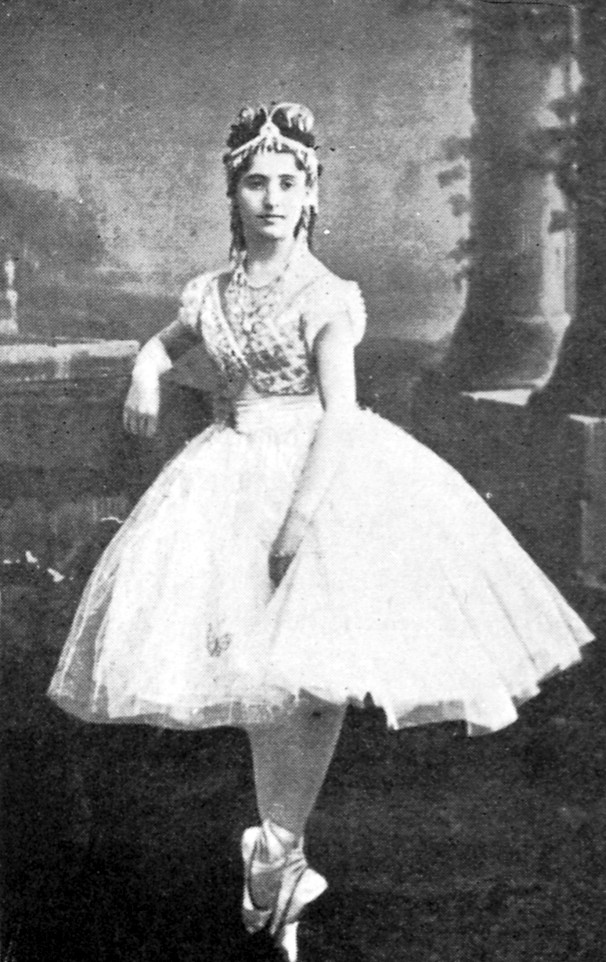 CoppéliaBallet · 1870Balanchine · video
 ApolloBallet · 1928Balanchine · video
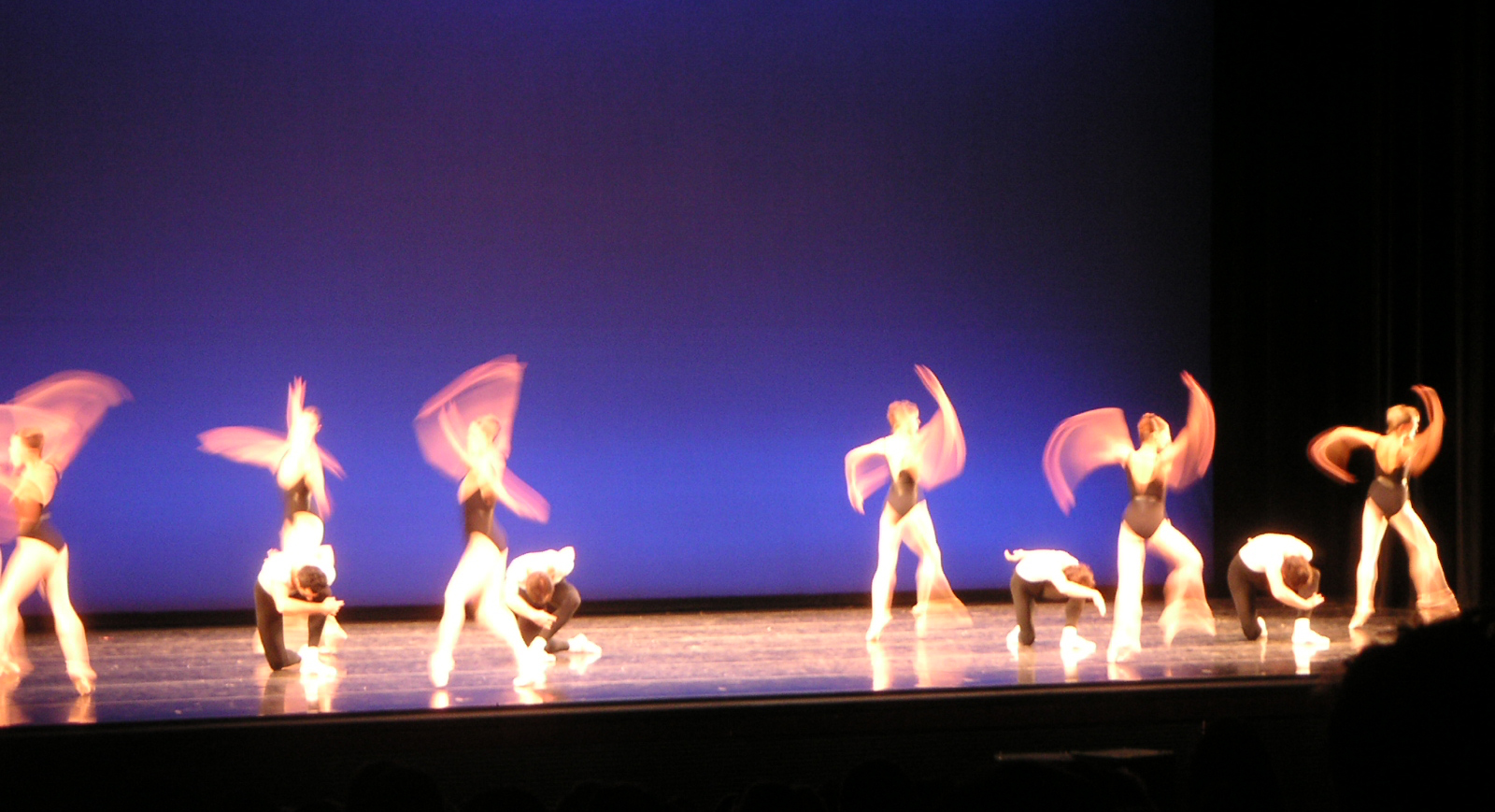 AgonBallet · 1957Balanchine · video
 Le chant du rossignolBallet · 1920Balanchine · video
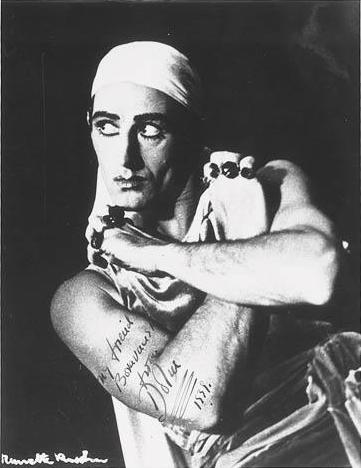 The Prodigal SonBallet · 1929Balanchine · video
 The Seven Deadly SinsBallet · 1933Balanchine · video
 NamounaBallet · 1882Same lineage · video
 The FloodBallet · 1962Balanchine · video