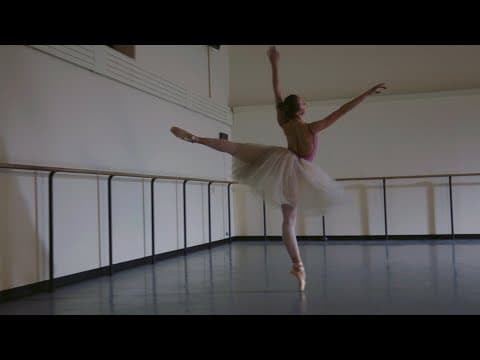
Brahms–Schoenberg Quartet is a plotless, one-act ballet made by George Balanchine for New York City Ballet, set to Johannes Brahms's Piano Quartet No. 1 in the orchestration Arnold Schoenberg completed in 1937. It premiered on April 21, 1966 at the New York State Theater, and is built in four named movements: Allegro, Intermezzo, Andante and Rondo Alla Zingarese.
What is danced
The article does not describe the choreography itself — no synopsis, step vocabulary, or scene-by-scene account survives in the source. What it does establish is structural: the ballet is plotless (i.e., without narrative pantomime, in the mode of Balanchine's abstract, music-driven works) and organized in four movements that follow the Brahms quartet's own movement plan, ending with the 'Rondo Alla Zingarese' finale. The original production used designed costumes, sets and lighting (Karinska, Peter Harvey, Ronald Bates) rather than the bare practice clothes of Balanchine's 'black-and-white' ballets, which suggests a fuller, dressed production, though the article gives no detail on cut, silhouette or period reference of those costumes.
Context
The 1966 premiere places the work in the middle of Balanchine's mature New York City Ballet period, the years in which he was pairing his own choreography with unconventional orchestral treatments of chamber and keyboard repertoire. Reception at the time was cool: Clive Barnes's Times review called it 'careful but tedious,' and later critic Anna Kisselgoff continued to treat it as a lesser, uneven entry in the Balanchine catalogue rather than a landmark.
Staging history
The ballet remained in New York City Ballet's repertory past Balanchine's death in 1983; the company replaced the original Peter Harvey sets with a new design by David Mitchell in 1985, with lighting later redone by Mark Stanley. It travelled beyond NYCB: the Paris Opera Ballet mounted it in 2016 with new sets and costumes by Karl Lagerfeld, and San Francisco Ballet has also performed it.
How to watch it
Because the ballet is plotless, there is no story to track; the four movements correspond directly to the four movements of Brahms's Piano Quartet No. 1, ending with the 'Rondo Alla Zingarese,' so listen for the shift in tempo and character between movements as a cue to what the choreography is responding to. Given the shifting production history, it is also worth noting which design (Harvey's original, Mitchell's 1985 replacement, or Lagerfeld's 2016 version) is in use, since costume and set have changed more than once.
Credits
- composer: Johannes Brahms
More from George Balanchine
Other staged works in the register connected to this one by author or lineage.
 CoppéliaBallet · 1870Balanchine · video
 ApolloBallet · 1928Balanchine · video
 AgonBallet · 1957Balanchine · video
 Le chant du rossignolBallet · 1920Balanchine · video
 The Prodigal SonBallet · 1929Balanchine · video
 The Seven Deadly SinsBallet · 1933Balanchine · video
 Tschaikovsky Suite No. 3Ballet · 1970Balanchine · video
 Robert Schumann's DavidsbündlertänzeBallet · 1980Balanchine · video