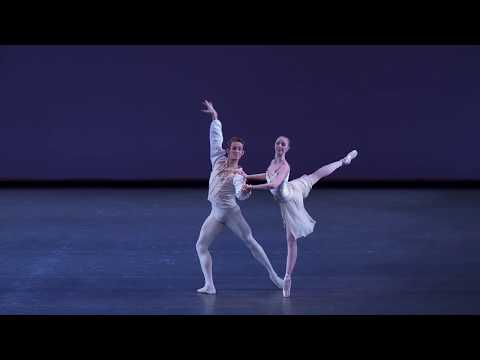
Chaconne is a plotless ballet by George Balanchine set to the concluding chaconne and other dance music from Gluck's opera Orfeo ed Euridice, drawing on choreography he had first made for a 1963 Hamburg staging of the opera itself. It entered the New York City Ballet repertory on 22 January 1976 at the New York State Theater, danced initially in practice clothes before Karinska's costumes were introduced that spring.
What it contains
- Chaconne · The whole ballet, built on Gluck's Orfeo finale — The ballet takes its title and its structure from the Baroque chaconne form itself — variations over a repeating bass phrase used by 17th/18th century opera composers to close a work on a festive note. Source: "The finale to Orfeo ed Euridice is a chaconne, a dance form built on a short bass phrase and often used by 17th and 18th century opera composers to achieve a festive mood at the end."
What is danced
The ballet is built directly on the chaconne, a Baroque dance form constructed over a short repeating bass phrase, which 17th- and 18th-century opera composers used to close an act or a work on a festive note; here it is Gluck's finale to Orfeo ed Euridice. Balanchine's choreography for this music originated in a fully staged opera production (Hamburgische Staatsoper, 1963) rather than as a free-standing ballet, and he reworked it for the concert stage, most significantly reshaping the material for the principal couple. For the 1976 premiere he added a new pas de deux for Suzanne Farrell and Peter Martins, and for the following spring season he added an opening ensemble section set to the 1774 "Dance of the Blessed Spirits." The article does not describe specific steps, holds or technical demands beyond these structural facts, so no further vocabulary claims can be made from it.
Context
The ballet dates from the mid-1970s, a period in which Balanchine, as co-founder and ballet master of New York City Ballet, was repeatedly returning to Gluck's Orfeo ed Euridice: he had staged versions of the opera-ballet for the Metropolitan Opera (1936), the Paris Opera (1973) and Chicago Lyric Opera (1975), with Chaconne drawing together choreography from across those engagements into an independent ballet.
Staging history
The work premiered with New York City Ballet on 22 January 1976, conducted by Robert Irving with lighting by Ronald Bates, and was performed in practice clothes before Karinska's costumes were added for the spring season that year. The added Farrell/Martins pas de deux was filmed in 1978 for the documentary Peter Martins: A Dancer, indicating the duet's separate circulation and visibility outside the full ballet.
How to watch it
Watch for the structural logic of the chaconne itself: variations built over a repeating musical bass, culminating in festive, ensemble-driven writing rather than narrative development. Note the layered production history — the piece was first danced in practice clothes, with the added pas de deux and opening ensemble section changing its shape within its first year, so different stagings may include or omit these later additions.
Structure
- Opening ensemble (Dance of the Blessed Spirits)An ensemble section added for the spring season, set to the 1774 'Dance of the Blessed Spirits' from Gluck's score.
- Pas de deuxA duet for the principal couple, added by Balanchine for the 1976 premiere and originated by Suzanne Farrell and Peter Martins.
Structure read from an encyclopaedia article, not from a libretto or score we hold. Confirm against a programme before treating the numbering as authoritative.
More from George Balanchine
Other staged works in the register connected to this one by author or lineage.
 CoppéliaBallet · 1870Balanchine · video
 ApolloBallet · 1928Balanchine · video
 AgonBallet · 1957Balanchine · video
 Le chant du rossignolBallet · 1920Balanchine · video
 The Prodigal SonBallet · 1929Balanchine · video
 The Seven Deadly SinsBallet · 1933Balanchine · video
 Raymonda VariationsBallet · 1961Balanchine · video
 Stravinsky Violin ConcertoBallet · 1972Balanchine · video