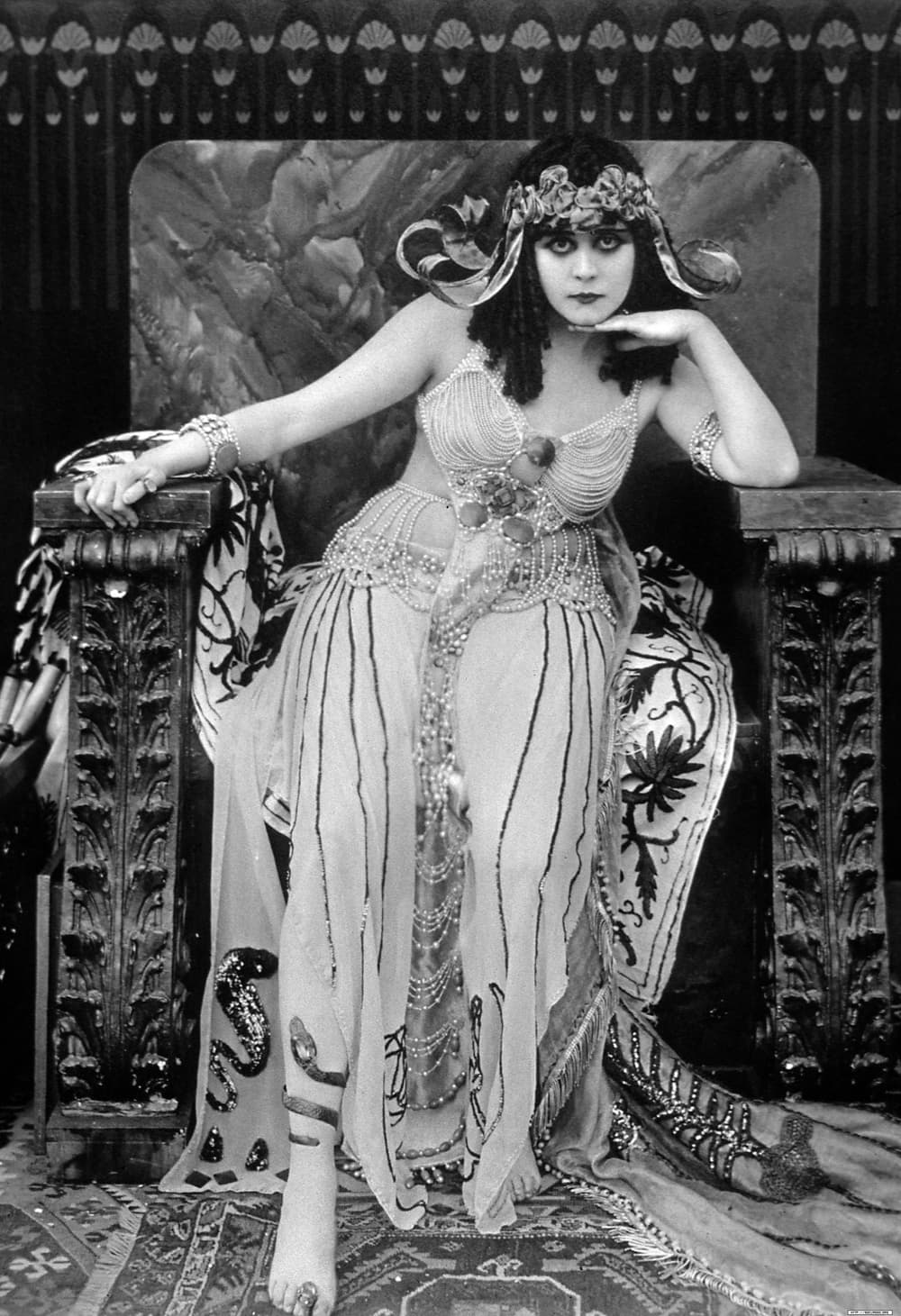
Fox Film Corporation — Cleopatra, 1917 · Public domain
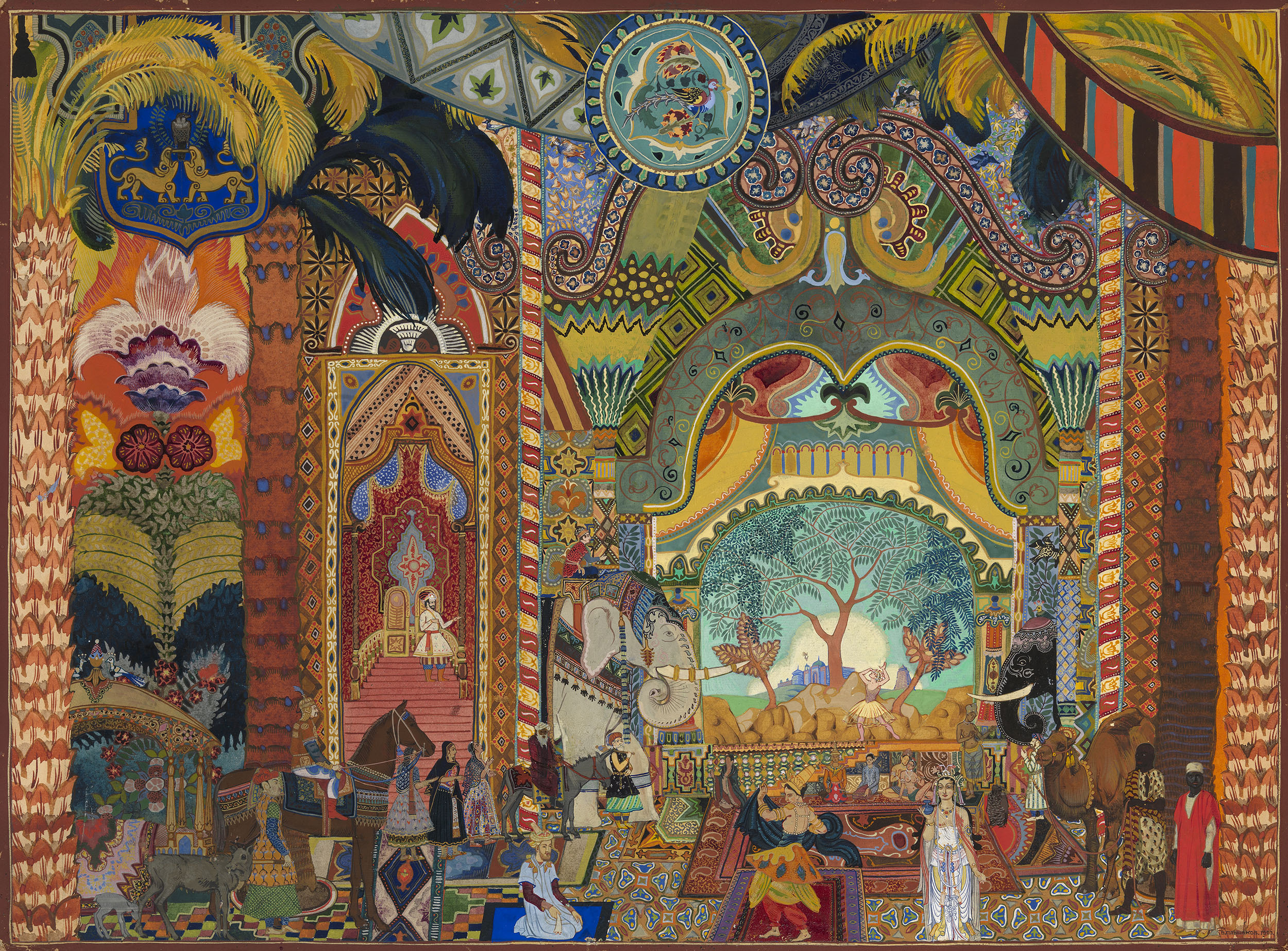
Cléopâtre is a one-act ballet made by Mikhail Fokine for Diaghilev's Ballets Russes, first given in this form at the Théâtre du Châtelet in Paris on 2 June 1909, with designs by Léon Bakst and a score assembled from seven Russian composers. It reworked an earlier Fokine ballet, Une Nuit d'Égypte, made for the Mariinsky Theatre in St Petersburg in 1908, which had used Arensky's music alone and borrowed costumes from other Mariinsky productions.
It belongs in a performance catalogue chiefly as one of the defining Ballets Russes 'exoticist' spectacles of the company's opening Paris seasons, built around a star cast (Ida Rubinstein, Anna Pavlova, Vaslav Nijinsky, Tamara Karsavina, Fokine himself) and around Bakst's sensational, near-nude costume designs rather than around an extended classical dance text.
What is danced
The article gives very little detail on step vocabulary or technique. What it names specifically is a 'veil dance' set to Glinka's 'Danse Orientale' from Ruslan and Lyudmila, and a 'Danse Persane' drawn from Mussorgsky's Khovanshchina — both orientalist interpolations rather than academic classical numbers. Cleopatra's entrance is described as a piece of stage business more than dance: she is carried onstage in a mummy-case and 'sensually unwrapped from the many-colored veils,' a moment built on spectacle, exposure and slow reveal rather than steps.
Beyond this, the surviving description concerns design, not movement: Bakst's costumes were 'reduced' and jewel-coloured, exposing bare sections of the dancers' bodies (covered by flesh-toned 'fleshings' rather than actual nudity), and the sets evoked desert and Egyptian architecture. The named soloist roles — Ta-Hor, Amoun, Cleopatra, and 'the favourite slaves of Cleopatra' — are dramatic and mimetic parts built around a doomed-love narrative (a night with the Queen bought with the promise of drinking poison at dawn), which fits Fokine's programme of expressive, dramatically motivated movement over set classical variations, but the article does not describe the actual choreographic vocabulary used to carry that drama.
Context
The ballet dates from the height of Fokine's reform of Imperial-era ballet and from the opening Paris seasons of Diaghilev's Ballets Russes, when the company was consciously using orientalist and exoticist subject matter (Cléopâtre, and later Scheherazade) to startle Western European audiences. According to the article, Cléopâtre 'together with Scheherazade, started a new mania for exoticism in fashion and interior design,' making it one of the works credited with the broader cultural vogue for orientalism in the years just before the First World War.
Its genesis as Une Nuit d'Égypte at the Mariinsky in 1908, recycling costumes from The Pharaoh's Daughter and Aida, shows the piece emerging directly out of the imperial theatre's existing exoticist repertory before being remade, with new designs and a new star cast, into a vehicle for the Ballets Russes' Paris debut.
Staging history
The work moved from St Petersburg (as Une Nuit d'Égypte, Mariinsky Theatre, 2 March 1908) to Paris (Théâtre du Châtelet, 2 June 1909) with a change of leading cast — Ida Rubinstein replacing the original Cleopatra — and a full redesign by Bakst. After the original scenery was destroyed in a fire during a 1917 tour to Latin America, Diaghilev commissioned new sets from Robert Delaunay and new costumes from Sonia Delaunay for soloists Lubov Tchernicheva and Léonide Massine; this revised production opened at the London Coliseum on 5 September 1918.
How to watch it
There is little fixed choreographic text to watch for in the way one would watch for a classical variation; attention goes instead to the staging of entrances (Cleopatra's mummy-case unveiling), to the orientalist interpolated numbers (the veil dance, the Danse Persane), and to how the design — Bakst's jewel-coloured, body-revealing costumes, later Delaunay's abstract sets — carries the exoticist effect that the choreography alone does not fully supply.
Structure
- Act ITa-Hor and Amoun meet at a temple and are interrupted by the arrival of Cleopatra; Amoun falls for the Queen and she agrees to a night with him in exchange for his death by poison at dawn; the ballet ends with Ta-Hor finding his body.
- Act I · Veil danceA veil dance set to Glinka's 'Danse Orientale', part of the entrance sequence built around Cleopatra's unveiling from the mummy-case.
Structure read from an encyclopaedia article, not from a libretto or score we hold. Confirm against a programme before treating the numbering as authoritative.
More from Michel Fokine
Other staged works in the register connected to this one by author or lineage.