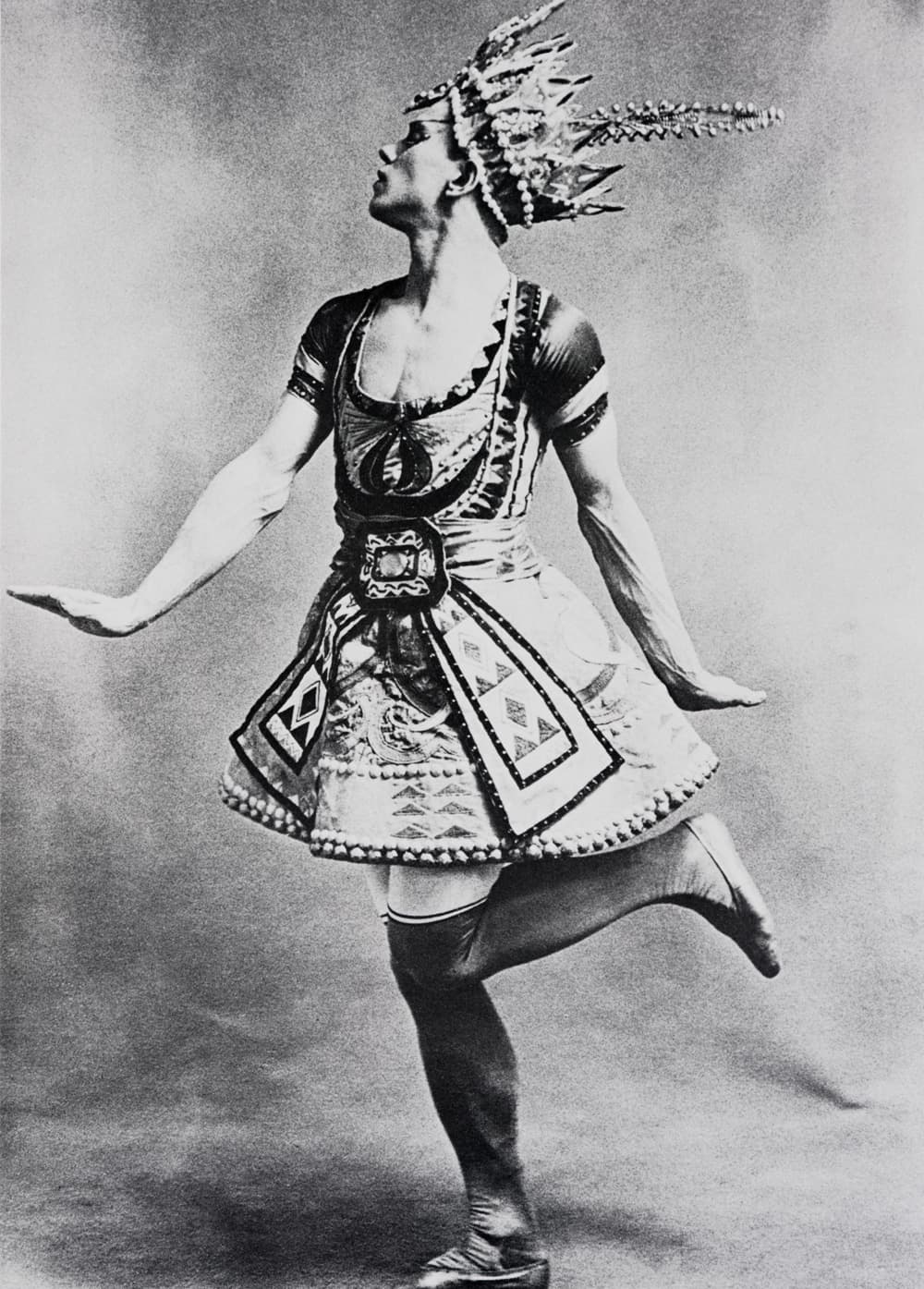
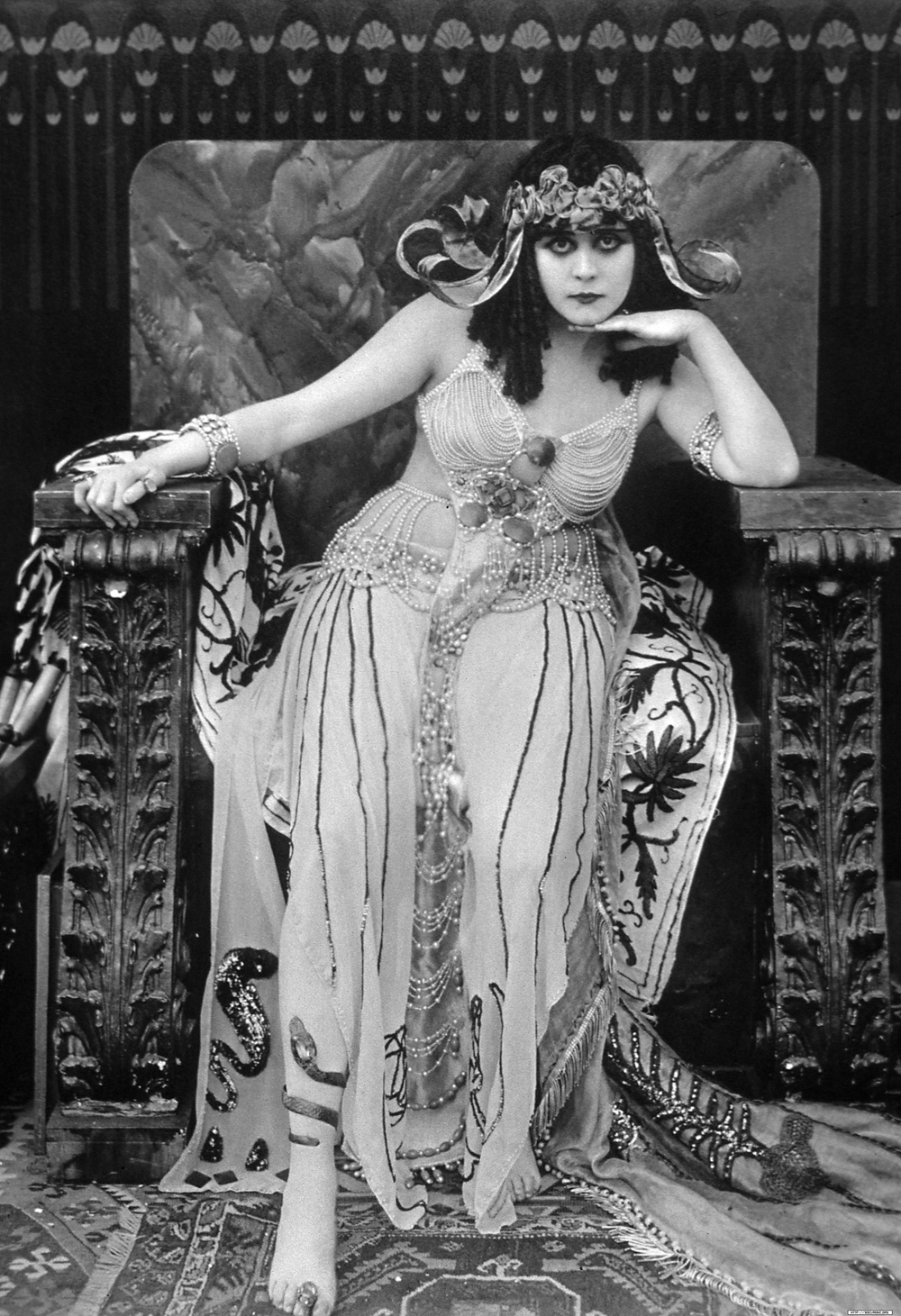
Unknown; Leon Bakst costume — http://www.vam.ac.uk/content/articles/t/20th-century-revolution/ · Public domain
Le Dieu bleu is a one-act ballet made for Diaghilev's Ballets Russes, with choreography by Michel Fokine, a score by Reynaldo Hahn, a libretto by Jean Cocteau and Federico de Madrazo y Ochoa, and sets and costumes by Léon Bakst. It premiered at the Théâtre du Châtelet in Paris on 13 May 1912, paired on the same bill with Fokine's Thamar, and was one of six new works Fokine made for that Ballets Russes season.
What is danced
The article gives almost no description of actual steps or vocabulary. What it does say is about inspiration and reception rather than execution: Fokine drew on the dances of the Royal Siamese Court ballet, which had performed in St Petersburg in 1900, and on his study of 'the arts of India,' but the resulting choreography is described by the source as 'uninspired and dull.' The lead, created for Nijinsky, drew the criticism that he 'posed more than he danced,' suggesting the role leaned on statuesque display and stage picture rather than dance technique. Beyond this, the piece is described mainly through its plot mechanics — a rescue, a rising Goddess, monsters trapped by plants, a Blue God who calms them with a flute and ascends a staircase into the clouds — which is stage spectacle and mime-driven narrative rather than a described dance vocabulary a performer could reconstruct from this source.
Context
The ballet followed two exotic successes for the Ballets Russes, Cléopâtre (1909) and Scheherazade (1910), and Diaghilev intended it to repeat that formula and to make Nijinsky an international star through the lead role. It was one of six new ballets Fokine choreographed for the 1912 season (alongside Prélude à l'après-midi d'un faune, La Péri, Daphnis et Chloé, Thamar, and Sadko), with Bakst designing four of them. By the time Le Dieu bleu reached the stage, Diaghilev had lost enthusiasm for it after Fokine and Bakst took on Ida Rubinstein's Le Martyre de Saint Sébastien, and he felt betrayed; the production nonetheless absorbed heavy spending.
Staging history
The ballet was given three times in Paris in 1912 and three times in London in 1913, then dropped. It was revived in London in April 2011 with new choreography by Wayne Eagling and a score assembled from Scriabin rather than Hahn's music; the revival was, per the source, 'not a success.'
How to watch it
There is little choreographic substance to track from this record — contemporaries already found the dancing thin and the star turn more posed than danced — so the piece is best approached as a design and narrative object: watch for Bakst's temple, pool, and costume imagery drawn from Cambodian Ballet touring material, and for the pantomimic staging of rescue, sacrifice-averted, and apotheosis that structures the plot.
Credits
- composer: Reynaldo Hahn
More from Michel Fokine
Other staged works in the register connected to this one by author or lineage.
 The FirebirdBallet · 1910Fokine · video
 PetrushkaBallet · 1911Fokine · video
 Les SylphidesBallet · 1908Fokine · video
 Le Spectre de la RoseBalletFokine · video
 The Dying SwanBallet · 1905Fokine · video
 JosephslegendeBallet · 1914Fokine
 CléopâtreBallet · 1908Fokine · video
- CarnavalBallet · 1926Fokine · video
