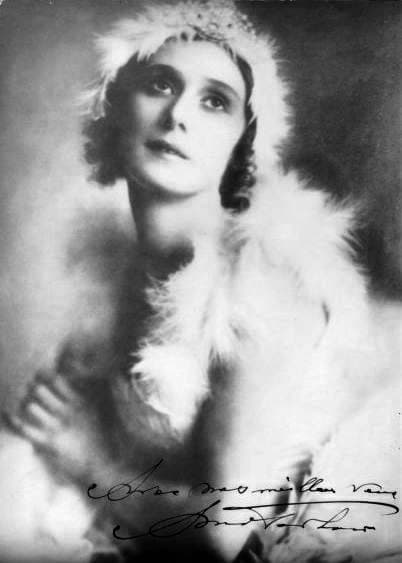
Frans Van Riel (1879-1950) — http://nla.gov.au/nla.pic-an11030051-3 · Public domain
The Dying Swan is a solo ballet made in 1905 by Michel (Mikhail) Fokine as a showpiece for the ballerina Anna Pavlova, set to the cello solo Le Cygne from Saint-Saëns's Le Carnaval des animaux. Running only about four minutes, it depicts a swan's final moments and became so closely tied to Pavlova that she is said to have danced it roughly 4,000 times over her career.
What it contains
- Classical Ballet · The entire four-minute solo — A solo built on continuous traveling steps and a signature rippling port de bras ('Dying Swan arms') representing a swan's wings and decline, performed by a ballerina in the classical Imperial Russian tradition. Source: "is a solo dance choreographed by Mikhail Fokine to Camille Saint-Saëns's Le Cygne from Le Carnaval des animaux as a pièce d'occasion for the ballerina Anna Pavlova"
What is danced
The work is a single female solo built around continuous, unbroken traveling steps across the stage combined with rippling, undulating arm and upper-body movement standing in for a swan's wings and its faltering flight. The article's own further-reading list points to "pas de bourrée" as a reference term, consistent with the piece's reputation for a near-continuous chain of small traveling steps carrying the dancer diagonally and in circles while the arms do the expressive work above.
The article is explicit about one specific vocabulary element that has outlived the piece itself: "Dying Swan arms," a recognizable port de bras used by later ballerinas even outside this work. Beyond the arms and the swan-like traveling pattern, the source gives no notated step sequence, no named sections, and no description of pointe work, lifts, or partnering (there is no partner - it is a solo), so a fuller technical breakdown cannot be built from this article alone.
As a piece made for and shaped around Pavlova's own performing qualities, it demands sustained lyrical control, sustained pianissimo quality of movement rather than bravura steps, and the ability to sustain a single emotional arc (an unbroken decline toward stillness) across four minutes with minimal choreographic incident.
Context
The piece was made in 1905 in St. Petersburg by Fokine, who would shortly become a central reforming choreographic voice of the Ballets Russes years; here he is working within, and against, the conventions of the late Imperial Russian ballet, producing an intimate, mood-driven solo rather than the grand multi-act narrative ballets typical of the period. The article frames it as a deliberate pièce d'occasion - a one-off vehicle piece for a specific star - rather than a mounted repertory ballet, which is itself notable: it entered the standard repertoire through a performer's individual identification with it rather than through a company premiere in the usual sense.
Staging history
The article traces the piece's afterlife mainly through influence and adaptation rather than through formal restagings by named companies. It reports that the choreography has shaped how later ballerinas dance the very different role of Odette in Swan Lake, citing Ashley Bouder (New York City Ballet) and Nina Ananiashvili (American Ballet Theatre, Bolshoi Ballet) as dancers who have folded "Dying Swan arms" into Odette's Act II exit. It also documents two 21st-century adaptations prompted by the COVID-19 pandemic: Carlos Acosta, as artistic director of Birmingham Royal Ballet, reworked Fokine's choreography (having the dancer raise her head at the close) for a solo by Céline Gittens performed with musicians all filming from separate homes; and Misty Copeland of American Ballet Theatre organized a multi-dancer fundraising version involving 31 other dancers.
How to watch it
Watch the arms and torso rather than the footwork: the expressive content is carried almost entirely in the rippling port de bras and the slow physical collapse toward the floor at the close, not in virtuosic steps. Because the piece was built around a single performer's identity, comparing different ballerinas' phrasing of the same short musical cue (rather than looking for choreographic variety) is the traditional way of judging a performance.
Credits
- composer: Camille Saint-Saëns
More from Michel Fokine
Other staged works in the register connected to this one by author or lineage.