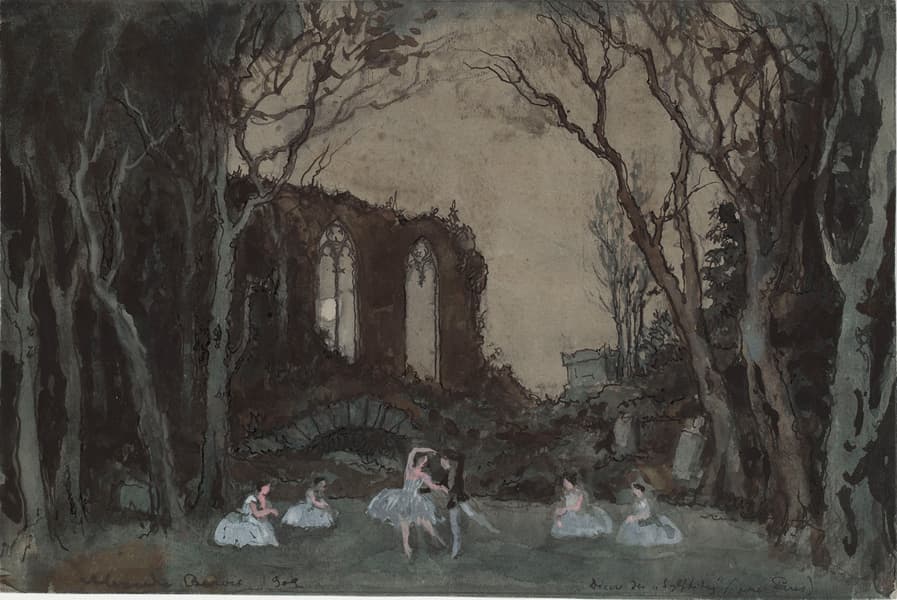
Alexandre Benois — Drawing by Alexandre Benois (1909), reproduced in Ballet Design: Past and Present (C.W. Beaumont, 1946). Digital scan provided by the uploader. · Public domain
Les Sylphides is a short, plotless ballet blanc set to a suite of piano pieces by Frédéric Chopin, orchestrated (in its best-known form) by Glazunov and others. Michel Fokine choreographed it as a deliberate evocation of the Romantic era, staging it with no story beyond a solitary male 'poet' dreaming among a corps of identically white-clad sylphs by moonlight.
What it contains
- Romantic Ballet · the whole work — there is no act or scene division given in the article — An undifferentiated corps of sylphs in identical long white tutus dances in moonlight opposite a single male dreamer figure; the costume and imagery were deliberately modelled on Taglioni's 1832 La Sylphide, signalling a revival of Romantic ballet's ensemble aesthetic rather than character or virtuoso dance. Source: "Les Sylphides has no plot but instead consists of several white-clad sylphs dancing in the moonlight with the "poet" or "young man" dressed in white tights and a black tunic."
What is danced
The ballet has no narrative business, mime, or named characters beyond the archetypal 'poet' or 'young man' and an ensemble of sylphs; the article states plainly that it 'consists of several white-clad sylphs dancing in the moonlight' opposite the poet in white tights and black tunic. The corps de ballet appears in identical long white tutus designed by Bakst, explicitly modelled on lithographs of Marie Taglioni in the 1832 La Sylphide — a costume choice that signals the choreography is meant to read as a revival of Romantic-era balletic imagery (soft arms, long lines, ensemble patterning) rather than as virtuosic display or character dance. The standard musical programme strings together a Polonaise, Nocturne, Waltzes, Mazurkas, a Prelude, and a Grande valse brillante, but the article gives no evidence that these movements are danced as literal polonaise, mazurka, or waltz steps drawn from national or ballroom idiom — they are used as concert numbers under classical/Romantic balletic vocabulary, in keeping with the work's description as being 'simply about mood and dance.'
Context
The article notes the ballet's genealogy runs through an 1907 Mariinsky piece, Rêverie Romantique, and a character-dance compilation called Chopiniana before Fokine reworked it into the plotless form later renamed Les Sylphides for Diaghilev's Ballets Russes. It is presented as a landmark specifically because it abandoned plot and character dance in favour of pure mood and movement — the article calls it 'frequently cited as the first ballet to be simply about mood and dance,' a claim that positions it as a hinge point between nineteenth-century narrative/character ballet and the abstract, plotless ballets that followed in the twentieth century.
Staging history
The Ballets Russes premiere was at the Théâtre du Châtelet in Paris on 2 June 1909, with Tamara Karsavina, Vaslav Nijinsky, Anna Pavlova, and Alexandra Baldina; Diaghilev had the score re-orchestrated for that production by Lyadov, Taneyev, Tcherepnin, and Stravinsky, keeping only Glazunov's waltz. An unauthorized US staging by Gertrude Hoffmann opened in New York in 1911 before the Diaghilev company's own authorized American premiere in 1916, where Nijinsky also paired it with Fokine's Papillons. New York City Ballet later revived the work under its original title, Chopiniana, in a 1972 staging by Alexandra Danilova with Karin von Aroldingen, Susan Hendl, Kay Mazzo, and Peter Martins, omitting the Polonaise. Multiple composers besides Glazunov reorchestrated the Chopin selections over the decades — Ravel (score now lost), Britten (long thought lost, a possible copy resurfaced in 2013), Gretchaninov, Roy Douglas, and Gordon Jacob — with Douglas's 1936 orchestration becoming the version most companies now use.
How to watch it
Watch for uniformity rather than contrast: the corps dances in matching long white tutus with no soloist distinguished by costume, and the male dancer functions as a dreaming observer rather than a partnering hero with a narrative role. There is no mime sequence to decode — the convention being revived is the Romantic ballet blanc atmosphere itself, so the interest lies in ensemble patterning, épaulement, and the moonlit, elegiac tone rather than in steps that advance a story.
Credits
- composer: Frédéric Chopin
More from Michel Fokine
Other staged works in the register connected to this one by author or lineage.
 The FirebirdBallet · 1910Fokine · video
 PetrushkaBallet · 1911Fokine · video
 Le Spectre de la RoseBalletFokine · video
 The Dying SwanBallet · 1905Fokine · video
 JosephslegendeBallet · 1914Fokine
 Le Dieu bleuBallet · 1912Fokine
 NamounaBallet · 1882Same lineage · video
 L'Île EnchantéeBallet · 1864Same lineage