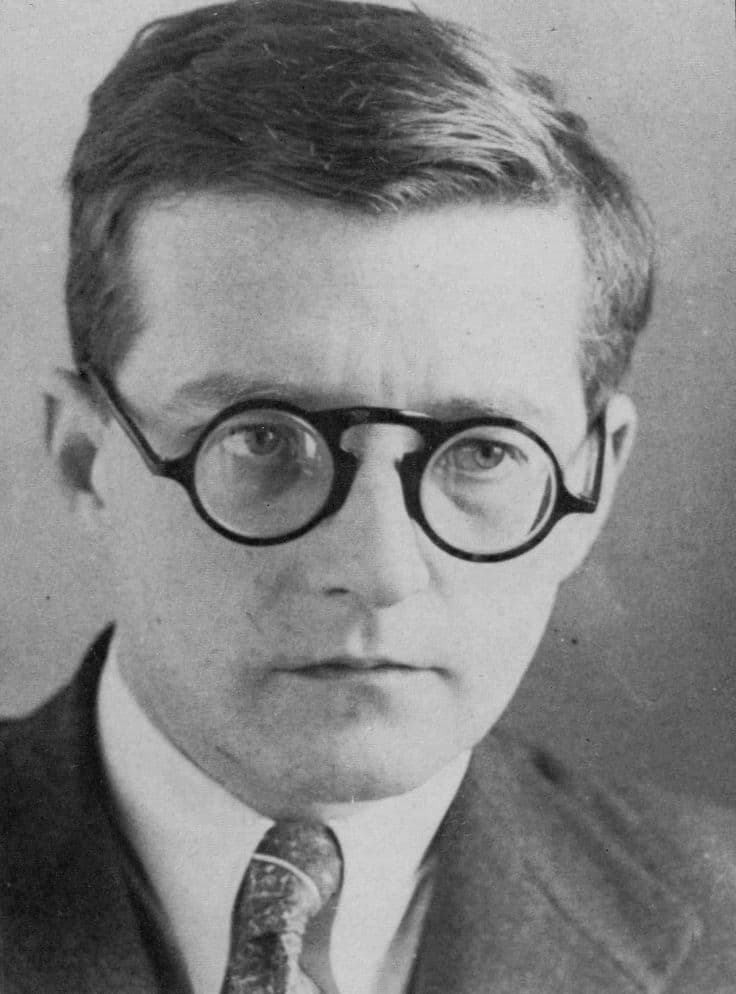
Unknown authorUnknown author — Original publication: Газета «Приуральская правда» (№ 72) 25 марта 1941 года (стр. 2)Immediate source: jpg · Public domain
The Limpid Stream (1935)
The Limpid Stream (Светлый ручей), also known in English as The Bright Stream, is Dmitri Shostakovich's third and last ballet score, Op. 39, written to a libretto by Adrian Piotrovsky and Fyodor Lopukhov, with choreography by Lopukhov himself. It premiered at the Mikhaylovsky Theatre in Leningrad in 1935 as a comedy set on a Soviet collective farm during harvest festival, built around a troupe of visiting ballet dancers who resolve a string of romantic misunderstandings through disguise.
What it contains
- Classical Ballet · Whole work — The narrative's resolution depends on a ballerina and her male dance partner exchanging costumed identities to deceive onlookers, a device that stages the swap through danced performance by named ballet roles (ballerina, dance partner) rather than through mime alone. Source: "is a ballet in 3 acts, 4 scenes, composed by Dmitri Shostakovich on the libretto"
What is danced
The article gives plot mechanics rather than step-level choreographic description, so what can be said with confidence is limited. The comedy turns on the fact that the visiting troupe are themselves dancers: the company's ballerina, her former pupil Zina, Zina's husband Pyotr, and the ballerina's own dance partner. The resolution device is a costumed swap — the ballerina dresses as her male partner, the partner dresses as a female dancer, and Zina dresses as the ballerina — a mistaken-identity trick staged specifically to fool onlookers watching them dance, which implies the plot's climax is carried by pas de deux or variation material performed in disguise rather than mimed narrative alone. The work closes on what the article calls 'a grand celebration,' and in Ratmansky's staging this finale is expanded to include a Grim Reaper figure who is frightened off — an interpolation not present, so far as the article indicates, in Lopukhov's original.
Context
The Limpid Stream was the third of Shostakovich's three ballet scores of the early Soviet period, following The Golden Age (1930) and The Bolt (1931); the article notes all three were banned soon after their premieres, and that this experience left Shostakovich reluctant to write for the stage again. Its 'deliberately simple melodies, harmonies, rhythms, and colors' let it run successfully in both Leningrad and Moscow for roughly eight months (June 1935–February 1936) before an unsigned Pravda editorial, 'Balletic Falsity,' condemned it in February 1936 and it was withdrawn from the repertory.
Staging history
Because Lopukhov's original choreography was never notated, it could not be revived directly; Alexei Ratmansky encountered the full score only through a 1995 Stockholm recording conducted by Gennady Rozhdestvensky and subsequently composed entirely new choreography for a two-act version, staged by the Bolshoi Ballet in Moscow in 2003. That production travelled to the Metropolitan Opera House in New York (July 2005) and the Royal Opera House, London (August 2006), with further Bolshoi runs in Moscow (2017) and London (2019); American Ballet Theatre mounted Ratmansky's version at the Kennedy Center in January 2011.
How to watch it
Watch for the identity-swap sequence at the emotional centre of the piece, where the ballerina and her partner exchange costumes to expose Pyotr's flirtation — this is where the plot asks dance itself to do the work of deception, not mime. Listen for the score's self-conscious echoes of Tchaikovsky and other ballet composers, part of its 'deliberately simple' surface that Soviet critics later attacked as insufficiently serious. In the Ratmansky version, the appearance and banishment of a Grim Reaper figure in the finale is a directorial addition worth noting as distinct from the 1935 original.
Credits
- composer: Dmitri Shostakovich
More from Dmitri Shostakovich
Other staged works in the register connected to this one by author or lineage.
 The Golden AgeBallet · 1930Music by Shostakovich · video
 ConcertoBallet · 1966Music by Shostakovich · video
 Concerto DSCHBallet · 2008Music by Shostakovich · video
 Mercurial ManoeuvresBallet · 2000Music by Shostakovich · video
 Swan LakeBallet · 1877Same lineage · video
 The NutcrackerBallet · 1892Same lineage · video
 Liebeslieder WalzerBallet · 1960Same lineage · video
 The SeasonsBallet · 1899Same lineage