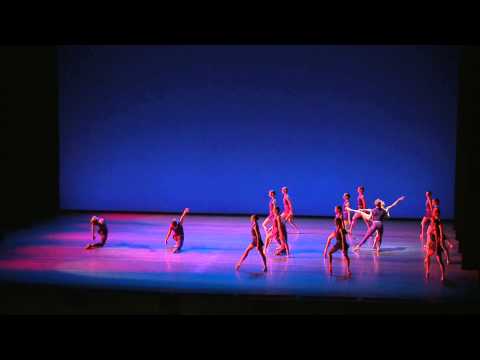
Mercurial Manoeuvres (2000)
Mercurial Manoeuvres is a plotless, three-movement ballet made by Christopher Wheeldon to Shostakovich's Piano Concerto No. 1, created for New York City Ballet's Diamond Project and premiered on April 28, 2000 at the New York State Theater. It belongs to the strand of NYCB repertory that sets a full-length concerto in symphonic-ballet form — soloist, demi-soloists, corps, a central duet, full-cast finale — the structural language Balanchine had made the house style.
What it contains
- Neoclassical Ballet — First movement · First movement — Hierarchical ensemble writing — soloist set against demi-soloist ranks and a twelve-woman corps de ballet — is the classic Balanchine-derived symphonic-ballet structure that organizes plotless concerto ballets by musical form rather than story. Source: "The first movement features a male soloist, two female demi-soloists, four male demi-soloists and a corps de ballet of twelve women."
- Neoclassical Ballet — Second movement (pas de deux) · Second movement — A stand-alone central duet, later excerpted and filmed on its own terms, in the tradition of the concerto ballet's slow-movement pas de deux. Source: "The second movement is a pas de deux."
- Neoclassical Ballet — Final movement · Final movement — Full company reassembly for a tutti finale, the customary closing convention of the multi-movement symphonic ballet. Source: "The entire cast then return to the stage for the final movement."
What is danced
The work is built in three movements that follow the concerto's own architecture rather than a story. The first movement deploys a male soloist against two female and four male demi-soloists, with a corps de ballet of twelve women filling out the ensemble — a hierarchy of roles typical of the plotless symphonic ballet, where formation and counterpoint between soloist, demi-soloist ranks and corps carry the choreographic argument rather than mime or narrative.
Context
The ballet was made in 2000 as part of New York City Ballet's Diamond Project, the company's recurring commissioning initiative for new choreography, at a moment when Wheeldon — then still a company soloist — was moving from dancing into choreography; this piece marked his retirement from performing to choreograph full time. It sits at the point where NYCB's Balanchine-descended neoclassical vocabulary was being handed to a new generation of in-house choreographers, of whom Wheeldon became the most prominent internationally.
Staging history
The article records only two stagings: the 2000 premiere with the original cast, and a 2017 video recording of the second-movement pas de deux, danced by Tiler Peck and Tyler Angle, which New York City Ballet released in 2020 as part of its digital programming during the coronavirus pandemic shutdown of live performance.
How to watch it
Watch for how the choreography maps onto the concerto's own three-part structure: an ensemble first movement organized by rank (soloist, demi-soloists, corps), a central pas de deux extracted often enough to stand alone, and a full-company return for the finale. This is the convention of the plotless symphonic ballet — steps and patterning answer the music's architecture rather than depicting a story.
Structure
- First movementA male soloist dances against two female demi-soloists, four male demi-soloists, and a corps de ballet of twelve women.
- Second movement (pas de deux)The movement is given over entirely to a pas de deux.
- Final movementThe entire cast returns to the stage for the finale.
Structure read from an encyclopaedia article, not from a libretto or score we hold. Confirm against a programme before treating the numbering as authoritative.
Credits
- composer: Dmitri Shostakovich
More from Dmitri Shostakovich
Other staged works in the register connected to this one by author or lineage.
 The Golden AgeBallet · 1930Music by Shostakovich · video
 The Limpid StreamBallet · 1935Music by Shostakovich · video
 ConcertoBallet · 1966Music by Shostakovich · video
 Concerto DSCHBallet · 2008Music by Shostakovich · video
 ApolloBallet · 1928Same lineage · video
 AgonBallet · 1957Same lineage · video
- FanfareFanfareBallet · 1953Same lineage
 Raymonda VariationsBallet · 1961Same lineage · video