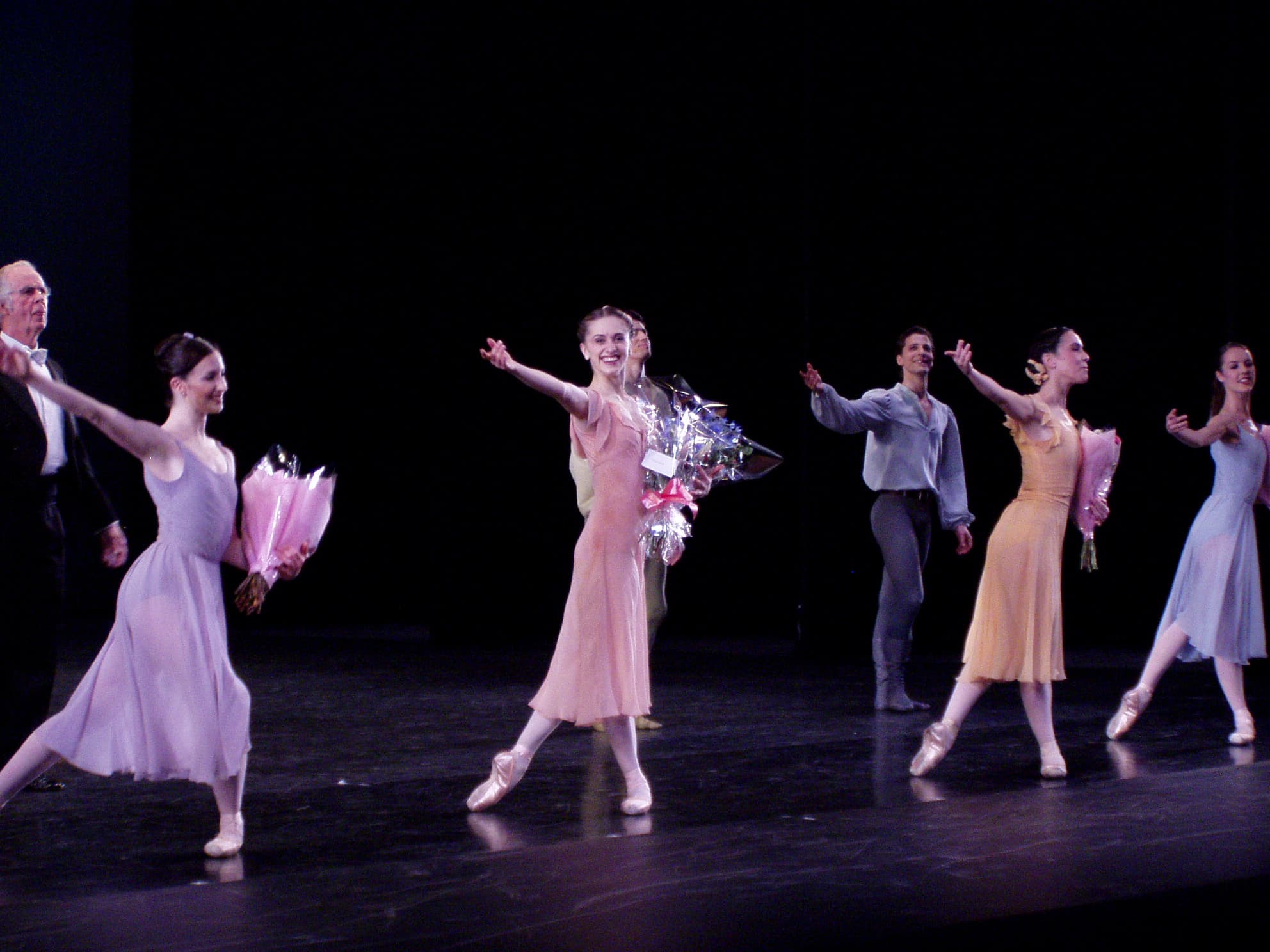
Scillystuff — Own work · CC BY-SA 3.0
Dances at a Gathering (1969)
Dances at a Gathering is a plotless one-act ballet Jerome Robbins made for New York City Ballet in 1969, set entirely to solo piano music by Frédéric Chopin, for a cast of five couples plus costumes by Joe Eula. It was Robbins' first ballet for NYCB after a long stretch working on Broadway, and it re-established him, alongside George Balanchine, as a defining choreographic voice of the company.
What it contains
- Neoclassical Ballet · the whole ballet — Plotless structure of solos, duets and small ensembles danced to Chopin's piano music with no assigned character or story, dancers identified only by costume colour and treated as 'themselves dancing with each other to music' rather than as characters in a plot. Source: "the dancers are merely "themselves dancing with each other to music in that place.""
- Neoclassical Ballet — Pas de deux (Pink Girl and Mauve Boy) · the pas de deux between Pink Girl and Mauve Boy — A lyrical classical pas de deux for one couple, singled out from the surrounding ensemble writing as the ballet's most recognisable and emotionally weighted passage. Source: "The most well-known part of the ballet is a pas de deux between Pink Girl (originally McBride) and Mauve Boy."
What is danced
The ballet is built as a sequence of solos, duets and small ensembles rather than a story: dancers are identified only by the colour of their costume (Brown Boy, Pink Girl, Mauve Boy, and so on), and Robbins insisted in print that they are simply 'themselves dancing with each other to music in that place.' It opens with a solo (created on Edward Villella, the Brown Boy), and later a woman who has not yet appeared gets a solo of her own. A section for three men and three women turns on partnering work in which the women are tossed from partner to partner across the group. The ballet's most celebrated passage is a pas de deux, originally for Patricia McBride and the Mauve Boy, singled out in the article as its best-known section.
Structurally the piece is disciplined about scale: no more than six dancers share the stage at any point until the finale, when the full company of ten appears together for the first time. That progression from soloist to duet to small group to full ensemble is itself the shape of the piece, and a company staging it has to manage entrances and exits as carefully as it manages the steps themselves — the choreography's logic is musical and architectural rather than dramatic.
Beyond these described set-pieces, the article does not itemise specific step vocabulary (no described mazurka or waltz figures, no notated positions), so claims beyond what is quoted above should be treated as inference rather than as reported fact.
Context
The premiere came after Robbins had spent years working in Broadway musical theatre; Dances at a Gathering marked his return to ballet-making for New York City Ballet. According to the company's own account, Balanchine watched an early 25-minute version and told Robbins to 'make more, make it like popcorn,' and Robbins expanded the piece to a full hour — a telling instance of the two choreographers shaping each other's work inside the same company.
Staging history
Robbins staged the ballet himself for the Royal Ballet in London in 1970; teaching Villella's opening role to Rudolf Nureyev, he reportedly tried to make Nureyev unrecognisable to the audience. The Royal Ballet dropped the work after 1976 and did not revive it until 2008, staged by Susan Hendl and Ben Huys. Robbins also staged it for the Paris Opera Ballet (premiered 1991) and it entered the San Francisco Ballet repertory in 2002, again via Hendl and Huys. In 2014 an excerpt was performed by Tiler Peck and Jared Angle at the Kennedy Center Honors, marking original cast member Patricia McBride's tribute.
How to watch it
Watch the population of the stage: Robbins keeps it to six dancers or fewer for almost the entire piece, so the full cast of ten meeting only at the finale functions as the ballet's one structural 'event.' Because roles are named only for costume colour, follow individual dancers by look rather than by character, and listen for how each solo, duet or trio maps onto a discrete piece of Chopin rather than a scene of plot.
Structure
- Opening solo (Brown Boy)The ballet opens with a solo for Brown Boy, created on Edward Villella.
- Pas de deux (Pink Girl and Mauve Boy)The ballet's best-known passage, a pas de deux originally for Patricia McBride and the Mauve Boy.
- FinaleThe full cast assembles on stage together for the first time; up to this point no more than six dancers appear at once.
Structure read from an encyclopaedia article, not from a libretto or score we hold. Confirm against a programme before treating the numbering as authoritative.
Credits
- composer: Frédéric Chopin
More from Frédéric Chopin
Other staged works in the register connected to this one by author or lineage.
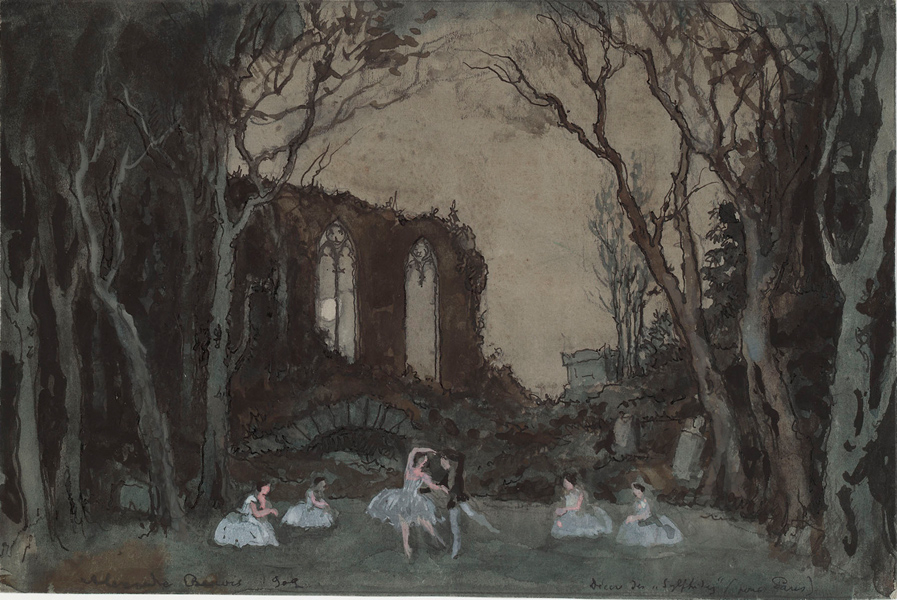 Les SylphidesBallet · 1908Music by Chopin · video
 The ConcertBallet · 1956Music by Chopin · video
 A Month in the CountryBallet · 1976Music by Chopin · video
 In the NightBallet · 1970Music by Chopin · video
 Other DancesBallet · 1976Music by Chopin · video
 ApolloBallet · 1928Same lineage · video
 Divertimento No. 15Ballet · 1956Same lineage · video
 Raymonda VariationsBallet · 1961Same lineage · video