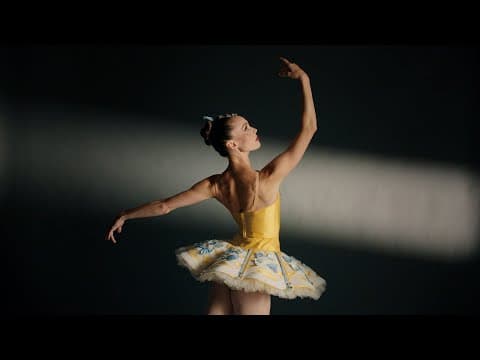
Divertimento No. 15 is a plotless Balanchine ballet set to Mozart's score of the same name, made for New York City Ballet and premiered on 31 May 1956 at the American Shakespeare Theatre in Stratford, Connecticut, as part of a Mozart bicentenary celebration organised by Lincoln Kirstein. It is Balanchine's second treatment of this score: he had first choreographed it in 1952 as Caracole, and when asked to revive that ballet for the 1956 celebration he instead produced substantially new choreography, though several soloists' variations reportedly carried over unchanged and some original cast members considered the two ballets nearly identical.
What it contains
- Balanchine Method · The entire ballet, across all five movements — Choreographed by Balanchine himself as an abstract, score-driven structure of solos and ensembles for a plotless cast of principals and corps, described by a Balanchine scholar as characteristic of his purest work. Source: "Balanchine wrote that Divertimento No. 15 "follows the different movements of the score. There is no story.""
- Neoclassical Ballet · The entire ballet, across all five movements — A plotless, purely musical structure of solos, ensembles and pas de deux with muted emotional overtones and little virtuoso display, danced straight through the movements of the score with no story. Source: "Balanchine's purest dance creations – a string of dancers, solos, ensembles, pas de deux – with muted emotional overtones and little virtuoso display."
What is danced
The ballet is built for five principal women, three men and a corps de ballet of eight women, moving through the five movements of Mozart's score — Allegro, Theme and Variations, Minuet, Andante and Finale — with no narrative attached. Balanchine himself described it as simply following 'the different movements of the score,' and Nancy Reynolds characterised it as one of his purest dance creations: a continuous unfolding of solos, ensembles and pas de deux with muted emotional colour and deliberately little bravura display, rather than a vehicle for technical fireworks.
Context
The article situates the ballet within a wave of large-scale, purely musical Balanchine works built directly on symphonic or divertimento scores rather than dramatic scenarios, produced for occasions such as the 1956 Mozart bicentenary. Its predecessor Caracole (1952) shows Balanchine returning repeatedly to the same score to refine a plotless treatment, discarding one of its two minuets each time; the article notes Caracole received positive reviews but fell out of repertory, while Divertimento No. 15, despite disputed claims about how new its choreography really was, became the work that survived and toured widely.
Staging history
The ballet kept its original 1956 designs — Karinska costumes recycled in part from Mozartiana, and a set originally made by James Stewart Morcom for Symphonie Concertante (1947) — until 1966, when David Hays supplied a new trellised set and Karinska redesigned the costumes; from the mid-1970s it has generally been performed without decor at all, leaving the dancing unadorned. It subsequently entered the repertories of companies including the Vienna State Ballet, Bavarian State Ballet, Dutch National Ballet, Hamburg Ballet, Pacific Northwest Ballet, Pennsylvania Ballet, Royal Danish Ballet, Paris Opera Ballet, San Francisco Ballet, Birmingham Royal Ballet, National Ballet of Canada, Boston Ballet, Miami City Ballet, Dance Theatre of Harlem and others, and has been filmed multiple times, including a 1961 CBC broadcast, a 1977 PBS Dance in America excerpt, a 2016 NYCB archival recording released in 2020, and a 2021 Sofia Coppola film of the Finale for NYCB's virtual gala.
How to watch it
Watch how the five-woman, three-man principal group is deployed against the eight-woman corps across the five Mozart movements — solos, duets and ensembles are handed off in succession rather than organised around a central couple or story. Because the ballet has been performed without any set since the mid-1970s, attention falls entirely on formation, phrasing against the score, and the low-key, non-virtuosic manner Reynolds describes, in contrast to Balanchine's more overtly bravura plotless works.
Structure
- AllegroOpening movement of the five-part plotless suite set to Mozart's score.
- Theme and VariationsA sequence of solo variations for the principal dancers; featured on its own in a 2020 archival release by NYCB.
- MinuetOne of two minuets in Mozart's original score; Balanchine removed the second minuet in both his 1952 and 1956 treatments.
- AndanteSlower movement broadcast on its own by PBS's Dance in America in 1977.
- FinaleClosing ensemble movement, featured on its own in Sofia Coppola's 2021 film for NYCB's virtual gala.
Structure read from an encyclopaedia article, not from a libretto or score we hold. Confirm against a programme before treating the numbering as authoritative.
More from George Balanchine
Other staged works in the register connected to this one by author or lineage.
 CoppéliaBallet · 1870Balanchine · video
 ApolloBallet · 1928Balanchine · video
 AgonBallet · 1957Balanchine · video
 Le chant du rossignolBallet · 1920Balanchine · video
 The Prodigal SonBallet · 1929Balanchine · video
 The Seven Deadly SinsBallet · 1933Balanchine · video
 ChaconneBallet · 1976Balanchine · video
 Monumentum pro GesualdoBallet · 1960Balanchine · video