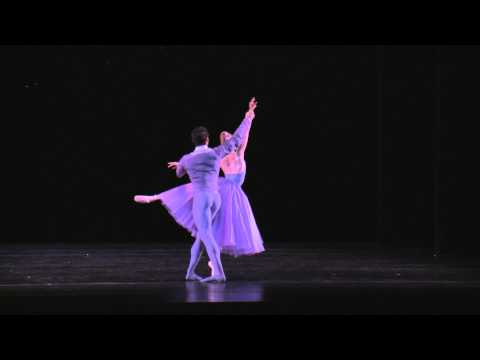
In the Night (1970)
In the Night is a plotless suite of three pas de deux that Jerome Robbins set to four Chopin nocturnes, made for New York City Ballet and first given at the New York State Theater on January 29, 1970. It is the direct successor to Robbins' earlier Dances at a Gathering, using the same Chopin-and-couples formula but compressing the cast to three pairs, each shown at a different stage of a romantic relationship, from first infatuation to marriage to a couple on the edge of breaking up.
What it contains
- Neoclassical Ballet — First pas de deux (Nocturne in C sharp minor, Op. 27, No. 1) · All three pas de deux, from the opening duet through the closing group exit — sustained off-balance partnering built from lifts, deep supported balances, kneeling supports and dramatic carries, used to characterize emotional states rather than display set steps or mime Source: "Over and over he lifts her or twines her through delicate balances; they separate only to rush together."
- Neoclassical Ballet — Second pas de deux (Nocturnes in F minor and E flat major, Op. 55, Nos. 1 and 2) · Second pas de deux, Nocturnes Op. 55 Nos. 1 and 2 — a supported arabesque built from the man kneeling, followed by a lift into a kneeling position on his shoulder as she is carried offstage backward Source: "The pas de deux ends with the man kneel down to support the woman's arabesque, before lifting her up to let her kneel on his shoulder and walk off stage backward."
- Neoclassical Ballet — Third pas de deux (Nocturne in E flat major, Op. 9, No. 2) · Third pas de deux, Nocturne Op. 9 No. 2 — rapid tempestuous lifts alternating with sudden exits, ending in a high lift and a carry-off after the woman sinks to the floor Source: "One minute they are involved in flashy, tempestuous lifts; the next minute one of them rushes offstage."
What is danced
The ballet is built entirely from three extended pas de deux, one couple to a movement, with no corps and almost no unison ensemble work until the closing moments. The first duet (Nocturne in C sharp minor, Op. 27 No. 1) is described as a continuous chain of lifts and 'delicate balances' in which the partners separate only to rush back together, establishing the vocabulary of the whole work: sustained, off-balance partnering rather than set steps. The second duet (Op. 55 Nos. 1 and 2) is calmer and more grounded, with 'a hint of a folk-dance step,' and ends with a specific, quotable sequence: the man kneels to support the woman's arabesque, then lifts her to kneel on his shoulder before she is carried off walking backward. The third duet (Op. 9 No. 2) is the most technically and dramatically extreme, built on 'flashy, tempestuous lifts' interrupted by sudden exits, and closes with the woman sinking to the floor before a high lift and a carry-off.
Throughout, the emphasis is on partnering technique — deep supported balances, off-center lifts, kneeling supports, and dramatic carries — used to characterize emotional states rather than to display virtuosic solo steps. The final image brings all three couples briefly onstage together before they exit separately, the men lifting their partners off, the only moment the piece gestures toward ensemble symmetry.
Context
Robbins made In the Night in late 1969, only months after Dances at a Gathering (1969), and the piece is explicitly a continuation of that ballet's project of setting plotless, character-driven pas de deux to Chopin piano music within a Balanchine-era NYCB otherwise dominated by his own neoclassical, music-visualization style. Where Dances at a Gathering used a larger ensemble in shifting configurations, In the Night narrows the same idiom to three discrete couples, each a compressed portrait of a relationship stage, extending Robbins' interest in intimate, psychologically legible partnering within an abstract, non-narrative ballet frame.
Staging history
The ballet had a rocky start at NYCB: despite good reviews at the premiere, the company did not revive it the following season, and Robbins learned only afterward that Balanchine and co-founder Lincoln Kirstein had considered it 'unworthy.' It was reinstated afterward and has been revived by NYCB regularly since. It has also passed to other companies, including the Paris Opéra Ballet, The Royal Ballet, and San Francisco Ballet; Paris Opéra dancers were invited to perform it in New York during NYCB's 1990 Robbins festival, and the company gave it again at a 1999 Robbins tribute gala after his death, and it was included in NYCB's Robbins centenary programming. The original costumes by fashion illustrator Joe Eula were later replaced by designs from Royal Ballet artistic director Anthony Dowell, giving the current production its long tulle dresses for the women and waistcoats for the men.
How to watch it
Watch the shape of each partnering sequence rather than individual steps: the piece is structured as three escalating case studies in how a lift or a balance can signal a stage of intimacy, from the rushing embraces of the first couple to the kneeling supports of the second to the interrupted, tempestuous lifts of the third. The closing moment, where all three couples appear together only to separate again, is the only ensemble gesture in an otherwise duet-by-duet structure, and is worth watching for how it retroactively frames the three relationships as variations on a single theme.
Structure
- First pas de deux (Nocturne in C sharp minor, Op. 27, No. 1)A pair of young lovers, danced as a continuous sequence of lifts and delicate balances, separating only to rush back together.
- Second pas de deux (Nocturnes in F minor and E flat major, Op. 55, Nos. 1 and 2)A settled, married couple with a hint of folk-dance stepping; ends with the man kneeling to support the woman's arabesque before lifting her to kneel on his shoulder and carrying her off.
- Third pas de deux (Nocturne in E flat major, Op. 9, No. 2)A couple on the verge of breaking up, danced with tempestuous, flashy lifts and sudden exits, ending with the woman sinking to the floor before being lifted and carried away.
Structure read from an encyclopaedia article, not from a libretto or score we hold. Confirm against a programme before treating the numbering as authoritative.
Credits
- composer: Frédéric Chopin
More from Frédéric Chopin
Other staged works in the register connected to this one by author or lineage.
 Les SylphidesBallet · 1908Music by Chopin · video
 Dances at a GatheringBallet · 1969Music by Chopin · video
 The ConcertBallet · 1956Music by Chopin · video
 A Month in the CountryBallet · 1976Music by Chopin · video
 Other DancesBallet · 1976Music by Chopin · video
 ApolloBallet · 1928Same lineage · video
 Kammermusik No. 2Ballet · 1978Same lineage · video
 Symphony in Three MovementsBallet · 1972Same lineage · video