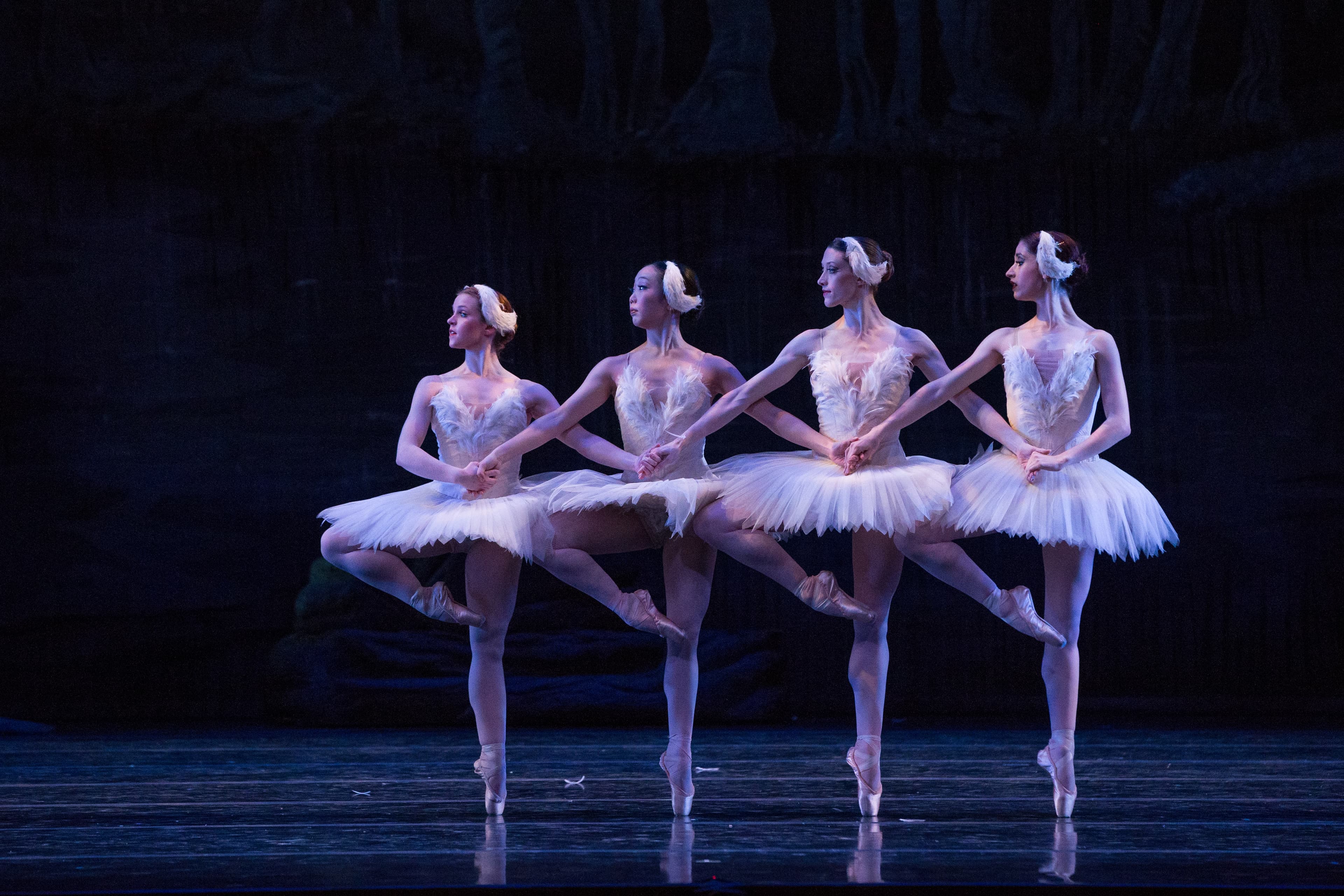
Danse des petits cygnes ("Dance of the Little Swans," also called the Dance of the Cygnets) is the fourth movement of No. 13 in Act II of Tchaikovsky's Swan Lake, set in F♯ minor. It is a short, self-contained quartet rather than a full ballet in its own right, but it is one of the most widely recognised passages in the classical repertory and is frequently excerpted, taught, and parodied on its own terms.
What it contains
- Classical Ballet · The entire number: four dancers performing the linked pas de quatre within Act II, No. 13 of Swan Lake — Four dancers move sideways in a linked chain performing sixteen pas de chat in strict unison, arms crossed and hands held, ending with a broken-chain fall to the ground. Source: "They move sideways, doing sixteen pas de chat."
What is danced
Four dancers enter in a line with arms crossed in front of one another, each holding the next dancer's hand, forming a linked chain. Moving sideways across the stage, they perform sixteen pas de chat in strict unison — the technical crux of the piece, since the linked arms remove the option of individually correcting timing or spacing. At the close the dancers break the chain and attempt to "fly," then drop to the ground, a final unison gesture that punctuates the number. The choreography, made by Lev Ivanov for the 1895 revival, is explicitly built to evoke cygnets huddling together for protection rather than to display individual virtuosity.
The demand on the dancers is coordination, not amplitude: identical leg height, identical timing of the pas de chat, and identical arm tension through the held-hands chain, all while covering ground sideways. Any deviation is immediately visible to the audience because the four bodies are physically linked, which is why the number functions as an informal audition piece within a company — a corps or junior dancer who can hold the unison is noticed.
Context
The dance belongs to the 1895 Petersburg revival of Swan Lake, where Lev Ivanov choreographed the "white acts" (including this one) working alongside Marius Petipa, who staged the rest of the ballet. This placed the number within the high classical repertory of the Imperial Ballet in the late 19th century, a period defined by symmetrical corps patterning, strict unison, and character-driven divertissements built from academic vocabulary rather than pantomime alone.
Staging history
The article does not describe subsequent stagings or revivals of the number as a discrete entity; it is transmitted as part of standard productions of Swan Lake Act II. It notes only that the choreography as commonly performed originates with Ivanov's 1895 version.
How to watch it
Watch the four dancers' arms and hips for exact simultaneity through all sixteen pas de chat — the choreography leaves no cover for a dancer out of time. Notice how the crossed-arm hold physically compels uniform spacing, and watch the final broken-chain "flight" and drop as the release of that constraint. The comic and parodic versions referenced in popular culture work precisely by breaking this unison, which is what makes the original demanding.
Credits
- composer: Pyotr Ilyich Tchaikovsky
More from Pyotr Ilyich Tchaikovsky
Other staged works in the register connected to this one by author or lineage.
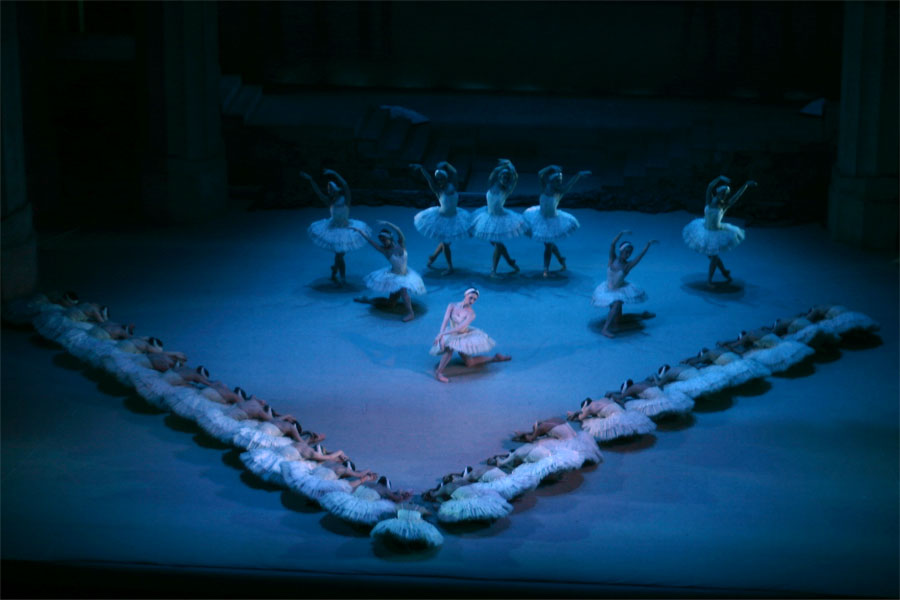 Swan LakeBallet · 1877Music by Tchaikovsky · video
 The NutcrackerBallet · 1892Music by Tchaikovsky · video
 OneginBallet · 1965Music by Tchaikovsky · video
 JewelsBallet · 1967Music by Tchaikovsky · video
 SerenadeBallet · 1934Music by Tchaikovsky · video
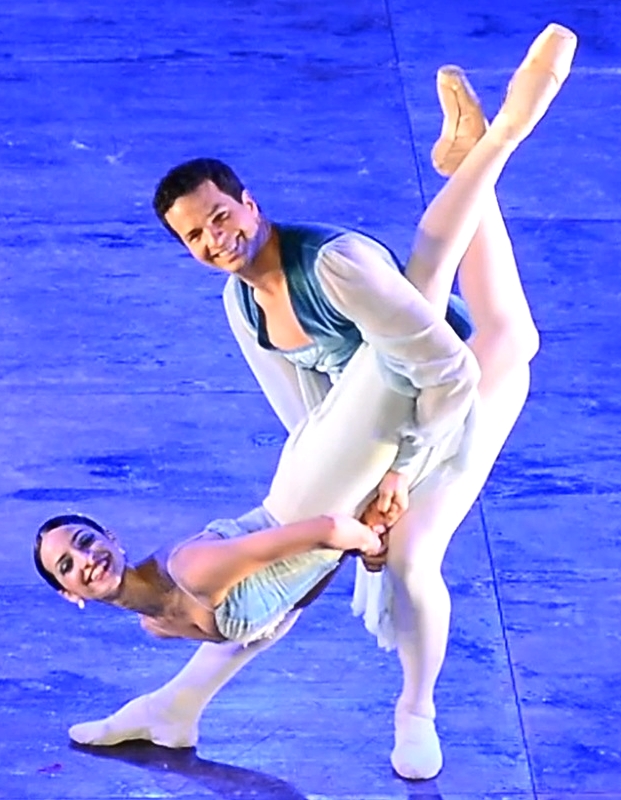 Tschaikovsky Pas de DeuxBallet · 1960Music by Tchaikovsky · video
 Raymonda VariationsBallet · 1961Same lineage · video
 ZenobiaBallet · 1936Same lineage · video