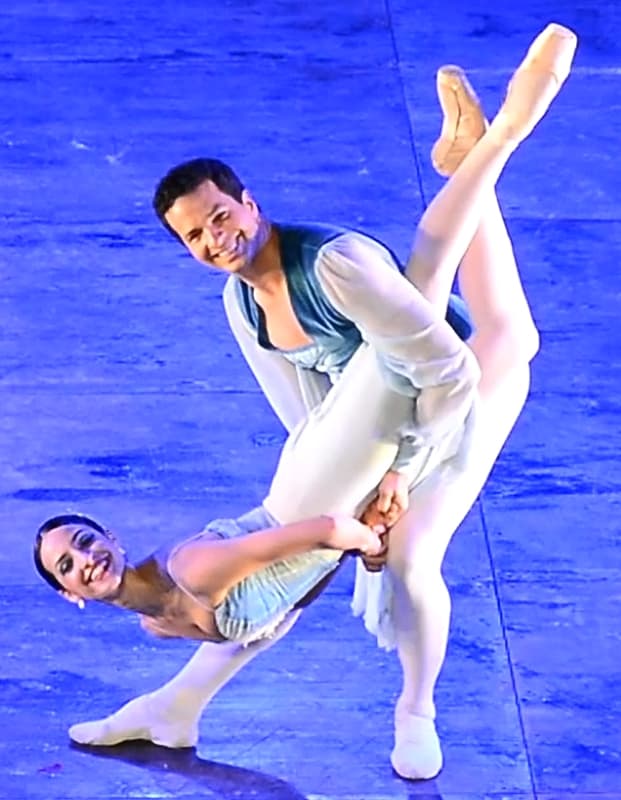
Ravello Festival — 08 20 - Cubanía en el ballet on Vimeo · CC0
Tchaikovsky Pas de Deux is a plotless bravura showpiece Balanchine built for New York City Ballet in 1960 around a piece of music Tchaikovsky wrote in 1877 for the Bolshoi's Anna Sobeshchanskaya, meant to replace a Petipa/Minkus pas de deux in Act III of Swan Lake but never published and presumed lost until 1953. Balanchine took the rediscovered score, still shaped to Sobeshchanskaya's original commission (she insisted the new music match the Minkus piece's structure so Petipa's steps would not have to change), and set an entirely independent eight-minute pas de deux classique on it, with no narrative link to Swan Lake at all.
It sits in the catalogue as one of the clearest small-form demonstrations of Balanchine's choreographic voice: entrée, grand adage, danseur variation, ballerina variation and coda, the full nineteenth-century grand pas de deux skeleton, danced at a speed and attack particular to his New York City Ballet dancers. It has become a repertory staple and a competition/gala excerpt precisely because it is short, self-contained, and built to display virtuosity rather than to tell a story.
What it contains
- Balanchine Method · The entire pas de deux — Fast attack, sharp footwork and expanded amplitude in lifts and jumps characteristic of Balanchine's choreography for New York City Ballet dancers, as described through the variations and coda. Source: "Tschaikovsky Pas de Deux opens with an expectant, lyrical entrée, as the dancers discover each other on stage, join hands, and take an opening pose."
- Classical Ballet · The entire pas de deux — Built on the nineteenth-century grand pas de deux skeleton - entrée, adage, solo variations, coda - with fish-dive lift, high overhead carries and a virtuosic solo built on big jumps and turns. Source: "It was a standard pas de deux classique, with a short entrée, a grand adage, a variation for the danseur, a variation for the ballerina, and a coda."
- Neoclassical Ballet · The entire pas de deux — A plotless display piece stripped of narrative, driven purely by musicality, speed and virtuosic display - darting footwork, big jumps, high lifts - rather than mime or story. Source: "an eight-minute display of ballet bravura and technique"
What is danced
The piece follows the standard pas de deux classique form exactly: 'a short entrée, a grand adage, a variation for the danseur, a variation for the ballerina, and a coda.' The entrée is understated - the couple discover each other, join hands, take an opening pose - before the grand adage builds through 'balances, turns, and lifts' to an ardent climax and subsides into the ballet's signature image, an exaggerated fish dive with the ballerina held low at the hips, legs crossed at the ankle, face close to the floor, her head turning up at the final count to look at her partner.
The male variation is built for scale and attack - 'big jumps and double tours en l'air' - and is explicitly not fixed: the article notes it 'was originally much longer' and that its exact content 'varies from performer to performer' even though the sequence of steps stays broadly the same, giving dancers real latitude to shape it to their own strengths. The ballerina's variation, by contrast, is 'rigorously maintained,' demanding 'a darting attack and flashing footwork' that tracks the melodic line closely - this is the harder-to-fake technical test of the piece, precision phrasing rather than raw amplitude. The coda escalates into 'high lifts, dazzling turns, and breathtaking leaps,' with the ballerina flying across the stage into her partner's arms, and ends with her carried off overhead, one leg extended, arms and head thrown back.
A dancer approaching this piece should know that the outer sections (entrée and closing) were fixed early, on Diana Adams and Jacques d'Amboise, while the variations and connecting material were developed later on and for Violette Verdy and Conrad Ludlow - so the piece as most companies teach it carries two casts' fingerprints, not one.
Context
The piece was made in 1960, a decade into Balanchine's tenure building New York City Ballet's identity around speed, musicality and plotless display rather than mime and narrative - the same impulse that produced Agon and Symphony in C. Using a piece of orphaned Tchaikovsky, written eighty years earlier for a specific Bolshoi ballerina's grievance with Petipa's original choreography, and setting wholly new steps to it rather than any historical reconstruction, is characteristic of how Balanchine treated the nineteenth-century Russian repertory as raw musical material rather than as texts to restore.
Staging history
The premiere cast was Violette Verdy and Conrad Ludlow at City Center of Music and Drama on 29 March 1960, with Robert Irving conducting, costumes by Barbara Karinska and lighting by Jack Owen Brown; Balanchine had begun working out the choreography earlier on Diana Adams and Jacques d'Amboise. It has since been filmed and performed repeatedly outside NYCB's home stage, including a complete recording with Patricia McBride and Mikhail Baryshnikov (1978), later performances by McBride with Reid Olsen (1984), Melissa Hayden with Edward Villella, Darcey Bussell with Zoltan Solymosi at a Tchaikovsky gala (1994), and archival coaching sessions by Verdy herself with dancers including Margaret Illmann/Vladimir Malakov, Jennie Somogyi/Peter Boal, and Tiler Peck/Joaquin De Luz - the last three explicitly preserved as Verdy's own coaching of the role for the George Balanchine Foundation and related archives.
How to watch it
Watch for the contrast Balanchine builds into the two variations - the male variation is meant to be personalized and expanded (big jumps, double tours), the female variation is meant to be exact, tracking the music's melodic detail rather than showing individual flourish. The closing fish dive is the piece's signature image and traditionally carries a small acting beat - the original ballerina's upward glance at her partner - that later casts have kept or varied. There is no narrative to follow: the piece should be read purely as a display structure (entrée/adage/variations/coda), and its relationship to Swan Lake is historical rather than dramatic.
Structure
- EntréeThe dancers discover each other on stage, join hands and take an opening pose in a lyrical opening.
- Grand adageA romantic adagio of balances, turns and lifts builds to a climax and closes in the fish-dive pose.
- Variation for the danseurA bravura solo of big jumps and double tours en l'air, variable in length and detail between performers.
- Variation for the ballerinaA fixed, technically exacting solo of rapid footwork tracking the melodic line closely.
- CodaThe pair build through high lifts and leaps to a final flight of the ballerina into her partner's arms and an overhead exit carry.
Structure read from an encyclopaedia article, not from a libretto or score we hold. Confirm against a programme before treating the numbering as authoritative.
Credits
- composer: Pyotr Ilyich Tchaikovsky
More from George Balanchine
Other staged works in the register connected to this one by author or lineage.
 CoppéliaBallet · 1870Balanchine · video
 ApolloBallet · 1928Balanchine · video
 AgonBallet · 1957Balanchine · video
 Le chant du rossignolBallet · 1920Balanchine · video
 The Prodigal SonBallet · 1929Balanchine · video
 The Seven Deadly SinsBallet · 1933Balanchine · video
 The SeasonsBallet · 1899Same lineage
 The VestalBallet · 1888Same lineage