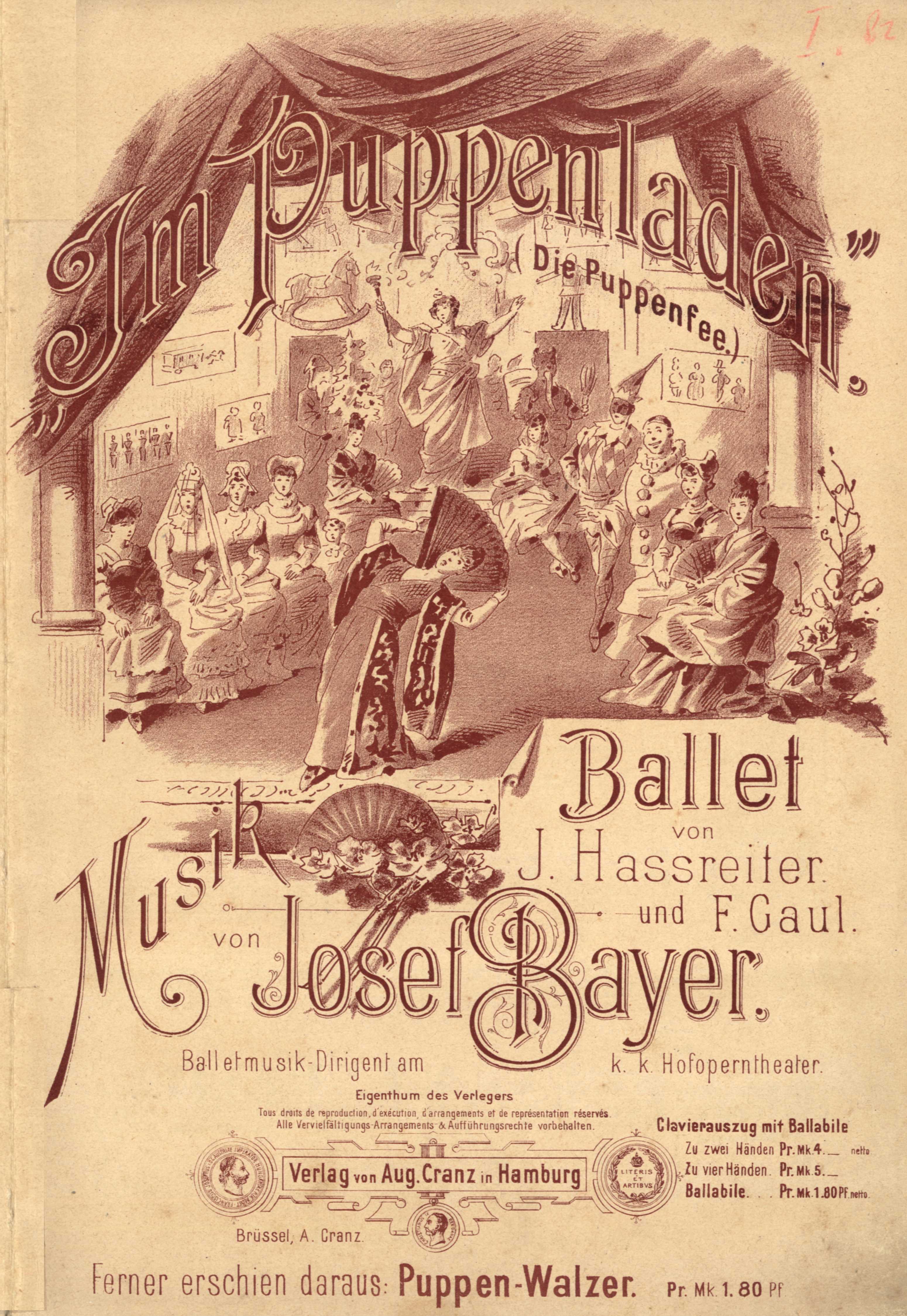
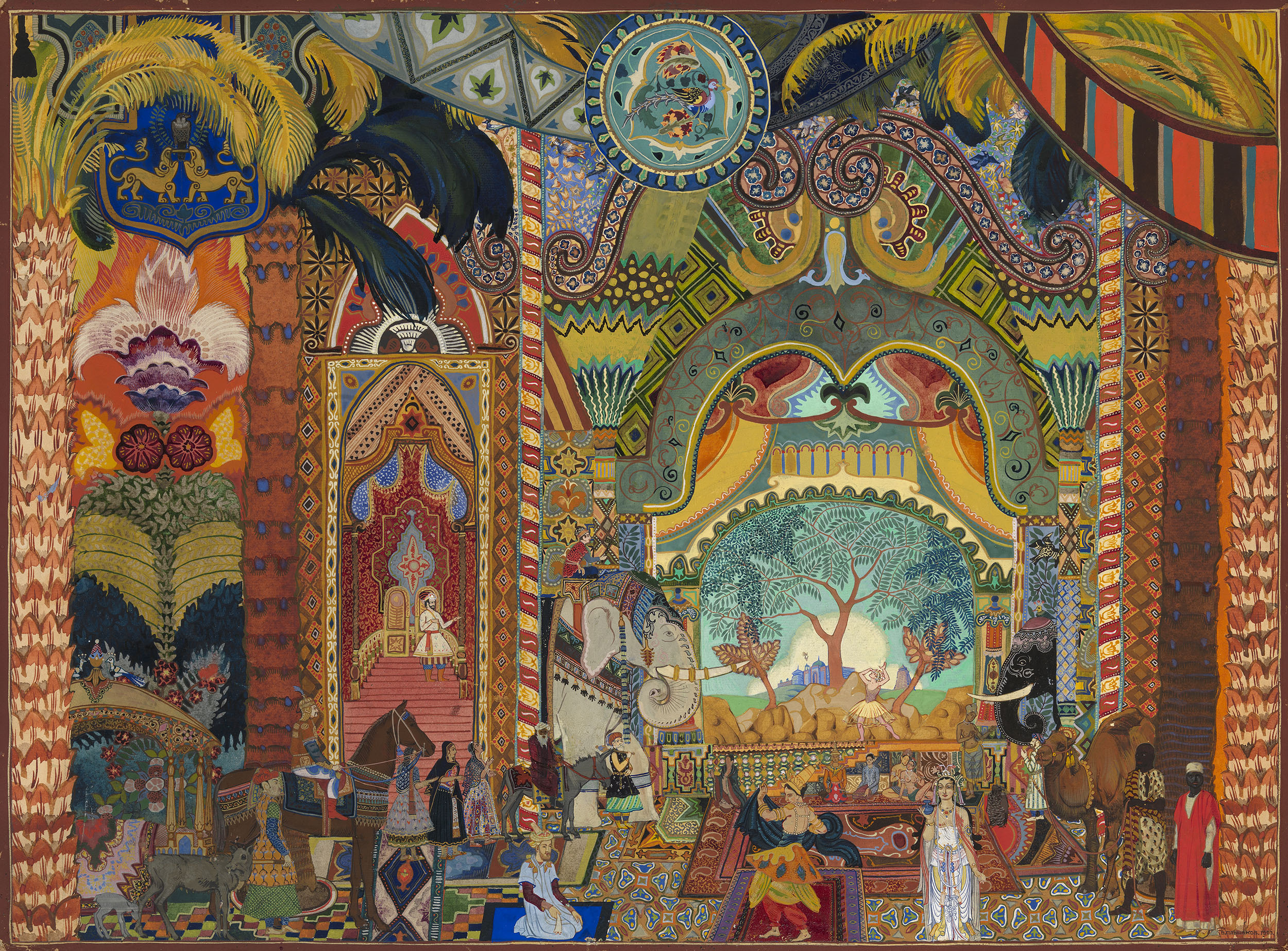
designer unknown — collections Walter Anton · Public domain
Die Puppenfee (The Fairy Doll) is a one-act, two-scene ballet first given at the Vienna Imperial Court Opera (now the Vienna State Opera) on 4 October 1888, with choreography by Joseph Haßreiter and music by Josef Bayer, from a libretto Haßreiter wrote with the painter Franz Xaver Gaul. It belongs to the late-Habsburg tradition of the divertissement ballet: a slight, comic frame story — a Viennese/Parisian toy shop whose dolls come to life at midnight — built to carry a string of national character dances and a showpiece solo for the doll-heroine.
What it contains
- Viennese Waltz — Divertissement of national dolls (Ländler, Polka, Spanish Dance, Mazurka, Tarantella, Fairy Doll's waltz) · Scene 1, the Fairy Doll's solo — the Fairy Doll's solo, the showpiece of the divertissement, is danced as a waltz that wins over the buying Englishman Source: "The highlight is the Fairy Doll, who performs a waltz."
- Classical Ballet · the added Fairy Doll Pas de Trois (1903 Mariinsky staging) — a formal classical pas de trois for the Fairy Doll and two Pierrots, composed by Drigo and first danced by the Legat brothers, later detached as independent repertory Source: "who composed music for a new pas de trois for the ballet, for the Fairy Doll and two Pierrots"
- Laendler — Divertissement of national dolls (Ländler, Polka, Spanish Dance, Mazurka, Tarantella, Fairy Doll's waltz) · Scene 1, the sequence of national character-doll dances — a doll costumed as Tirolean performs a Ländler as one of the shop's showcase national dances Source: "Tirolean Ländler, Chinese Polka, Spanish Dance, Japanese Mazurka and the Harlequin"
- Mazurka — Divertissement of national dolls (Ländler, Polka, Spanish Dance, Mazurka, Tarantella, Fairy Doll's waltz) · Scene 1, the sequence of national character-doll dances — a doll in Japanese costume performs a mazurka among the toy shop's national character dances Source: "Japanese Mazurka and the Harlequin"
- Polka — Divertissement of national dolls (Ländler, Polka, Spanish Dance, Mazurka, Tarantella, Fairy Doll's waltz) · Scene 1, the sequence of national character-doll dances — a doll in Chinese costume performs a polka as part of the shop's display of national dolls Source: "Chinese Polka, Spanish Dance, Japanese Mazurka"
What is danced
The ballet's structure is that of a display piece rather than a dramatic narrative: Scene 1 is built around a sequence of character dolls performing dances tied to national costume — a Tirolean Ländler, a Chinese Polka, a Spanish Dance, a Japanese Mazurka and a Harlequin's Tarantella — culminating in a waltz solo for the Fairy Doll herself, which is singled out as 'the highlight' and is the number that persuades the visiting Englishman to buy her. This is squarely divertissement choreography: a run of contrasting, costume-driven set-pieces rather than continuous dramatic dance, and later stagings preserved that structure even as they varied the guest dances (the article notes the ballet 'is structured as a divertissement' with additional character dolls added at will).
Scene 2 shifts to mime-led ensemble work — the shop coming alive at midnight, the dolls' 'festivities' honouring the Fairy Doll as queen, and their scramble back into frozen doll-poses when the shopkeeper returns — material that depends on comic timing and stillness-to-movement contrast rather than technical display.
The one addition documented after the premiere is choreographically significant: for the 1903 Mariinsky staging, Riccardo Drigo composed a new pas de trois for the Fairy Doll and two Pierrots, first danced by Nikolai and Sergei Legat, which became detachable repertory in its own right (the 'Fairy Doll Pas de Trois') and still turns up in galas and school graduation programmes independent of the full ballet.
Context
1888 sits at the high point of the divertissement ballet in the Austro-Hungarian and Russian imperial theatres — narrative kept thin, national and character dances stacked for variety and spectacle, much as in Coppélia (which drew on the same Hoffmann source) or the guest-dance suites of Petipa's full-length ballets. Die Puppenfee was Haßreiter and Bayer's contribution to that vogue at the Vienna court theatre, and it quickly crossed into the Russian imperial system: it reached the Bolshoi in 1897 and the Mariinsky in 1903, the latter staged by Nikolai and Sergei Legat with designs by Léon Bakst and a Drigo-composed addition, placing it in direct company with the leading names of the late Imperial Ballet.
Staging history
The work had an earlier, aristocrats-only tryout in April 1888 under the title Im Puppenladen at the Vienna palace of Prince Johann Liechtenstein before its public premiere that October, with Camilla Pagliero as the first Fairy Doll. It travelled widely in the following decades — Warsaw (1891), Stuttgart (1891), the Bolshoi in Moscow (1897, revived 1900 under Ivan Khlyustin), the Mariinsky (1903, Legat brothers/Bakst/Drigo), London's Empire Theatre (1905, Katti Lanner), Anna Pavlova's touring company (1914, Ivan Clustine) and La Scala (1930, G. Kröller). Kschessinska, Pavlova, Karsavina and Vaganova all danced the title role across these productions. The Vienna State Opera still performs the original Haßreiter version (its 750th company performance came in 1973), and separately the Legat/Drigo pas de trois survives as an independent Mariinsky excerpt used in galas and graduation showings; Richard Slaughter also reconstructed a Pavlova-derived version for British companies in 1989–92.
How to watch it
Watch Scene 1 as a costume-and-character catalogue: each doll's nationality is announced through its dance idiom (Ländler, polka, mazurka, Spanish and tarantella steps) before the Fairy Doll's waltz solo, which functions as the evening's technical peak. In Scene 2, attention shifts to comic mime — dolls freezing back into shop-window poses whenever a human enters — which is a Romantic-pantomime device rather than a virtuosic one, so the pleasure there is in ensemble timing rather than steps.
Structure
- Act I · Scene 1 · Divertissement of national dolls (Ländler, Polka, Spanish Dance, Mazurka, Tarantella, Fairy Doll's waltz)In the toy shop, a visiting English family is shown a sequence of character dolls in national costume performing their signature dances, ending with the Fairy Doll's waltz, after which she is bought.
- Act I · Scene 2At midnight the Fairy Doll wakes the shop's dolls, who dance and celebrate her as their queen before freezing back into position at dawn.
Structure read from an encyclopaedia article, not from a libretto or score we hold. Confirm against a programme before treating the numbering as authoritative.
Credits
- composer: Josef Bayer
More from Josef Bayer
Other staged works in the register connected to this one by author or lineage.
 AschenbrödelBallet · 1901Music by Bayer · video
 Swan LakeBallet · 1877Same lineage · video
 The NutcrackerBallet · 1892Same lineage · video
 CoppéliaBallet · 1870Same lineage · video
 The Sleeping BeautyBallet · 1890Same lineage · video
 The FirebirdBallet · 1910Same lineage · video
 Les RendezvousBallet · 1933Same lineage · video
 L'Île EnchantéeBallet · 1864Same lineage