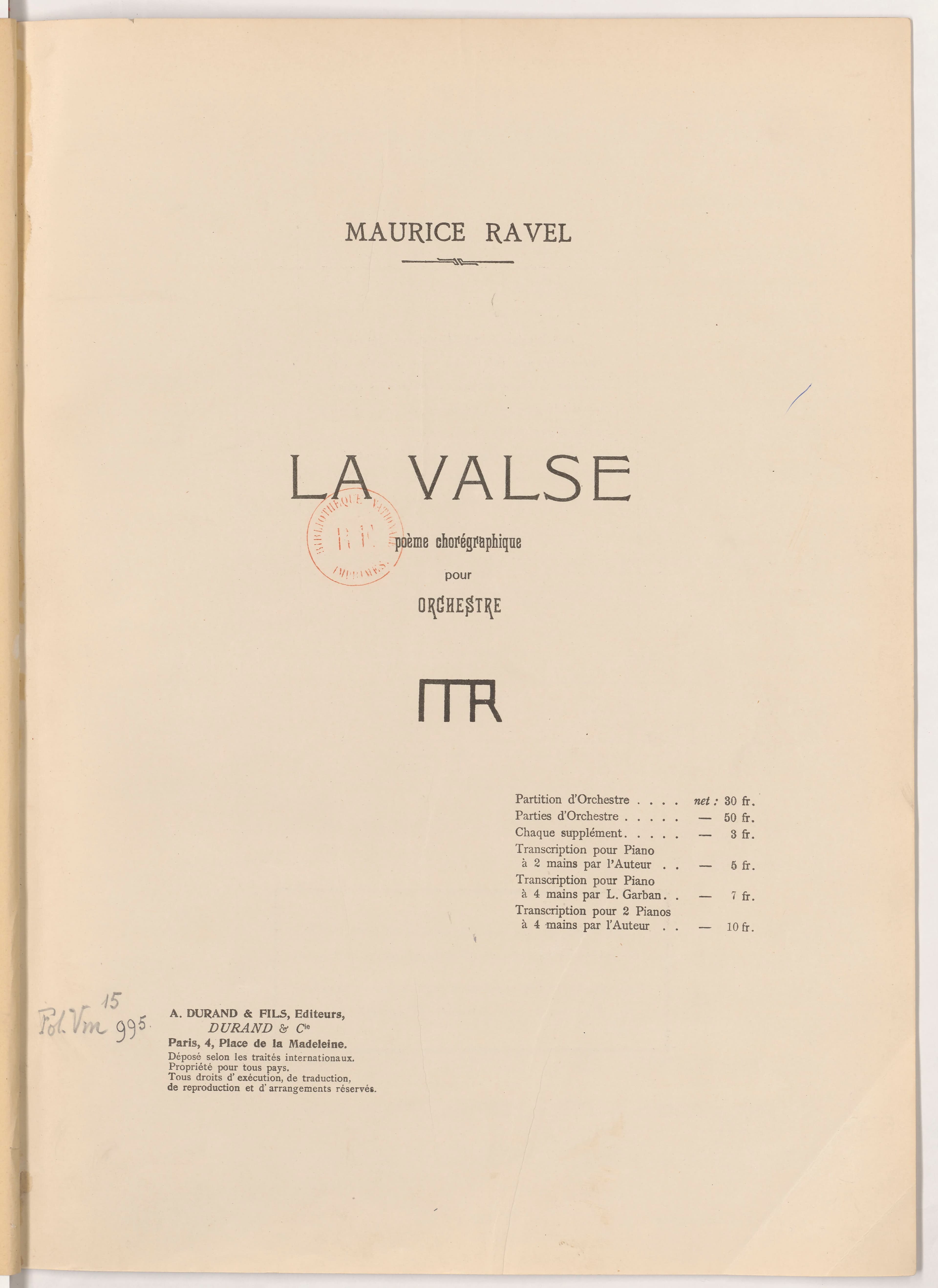
Ravel, Maurice (1875-1937). Compositeur — Bibliothèque nationale de France · Public domain
La valse (1920)
La valse is an orchestral score by Maurice Ravel, written 1919–1920 and subtitled a "poème chorégraphique pour orchestre" (choreographic poem for orchestra). Ravel began it under commission from Serge Diaghilev as a ballet, but the version that premiered on 12 December 1920 in Paris was a concert performance, not a staged dance work; Diaghilev, after hearing it, judged it "not a ballet" but "a portrait of ballet" and refused to produce it, which ended their working relationship permanently.
What it contains
- Viennese Waltz · The whole piece, as set out in Ravel's own preface to the score — Ravel's programme describes a ballroom of waltzing couples whirling together under chandeliers at an imperial court c.1855 — the social couple-waltz that the music's successive waltz themes are built to accompany, before the final section abandons the triple-time waltz rhythm altogether. Source: "Through whirling clouds, waltzing couples may be faintly distinguished."
What is danced
The article gives no choreographic notation for any staged production; what it does give is Ravel's own programme note, printed as a preface to the score, which is the closest thing to a movement description in the source: waltzing couples glimpsed through whirling clouds, an immense ballroom lit by chandeliers, "peopled with a whirling crowd," set in an imperial court around 1855. This preface is the programmatic skeleton that any staging has had to embody — a continuous social waltz, danced by couples in a ballroom, that the music pushes from timid variation through pompous, brass-driven grandeur to a final "macabre" coda that breaks the waltz's triple rhythm entirely.
Context
Ravel's score sits at the hinge between the fin-de-siècle Viennese waltz tradition (Johann Strauss II, and Chabrier's Fête polonaise) and the disillusioned, post-war concert repertoire the Ballets Russes was assembling around 1920. Diaghilev's rejection of it as a piece of music about the ballroom rather than a workable ballet score is itself a piece of dance history: it marks a moment when a commissioned Ballets Russes score slipped out of the company's hands and into the concert hall, only returning to the stage years later and through other choreographers entirely.
Staging history
The ballet was eventually staged in Antwerp in 1926 by the Royal Flemish Opera Ballet, then twice by the Ballets Ida Rubinstein (1928 and 1931) with choreography by Bronislava Nijinska. George Balanchine, who had earlier made work for Diaghilev, choreographed his own version in 1951, and Frederick Ashton made one in 1958 whose premiere drew praise from Francis Poulenc as the first setting he felt matched Ravel's intentions. The article names these choreographers and companies but does not describe what any of them actually put on stage.
How to watch it
Listen for the piece's own dramaturgy — mist and fragments coalescing into a full waltz, a sequence of contrasting waltz variations (timid, pompous, tender, erratic), a return of the same themes reorchestrated, and a final coda that abandons triple time. Any staging is working against that built-in arc from ballroom to breakdown; watch for how a production handles the moment the waltz stops being a waltz.
Credits
- composer: Maurice Ravel
More from Maurice Ravel
Other staged works in the register connected to this one by author or lineage.
 BoléroBallet · 1928Music by Ravel · video
 L'éventail de JeanneBallet · 1929Music by Ravel
- La Fin du jourLa Fin du jourBalletMusic by Ravel
 In G MajorBallet · 1975Music by Ravel · video
 La ValseBallet · 1951Music by Ravel · video
 Le tombeau de CouperinBallet · 1975Music by Ravel · video
 Liebeslieder WalzerBallet · 1960Same lineage · video
- Gaîté parisienneBallet · 1938Same lineage · video
