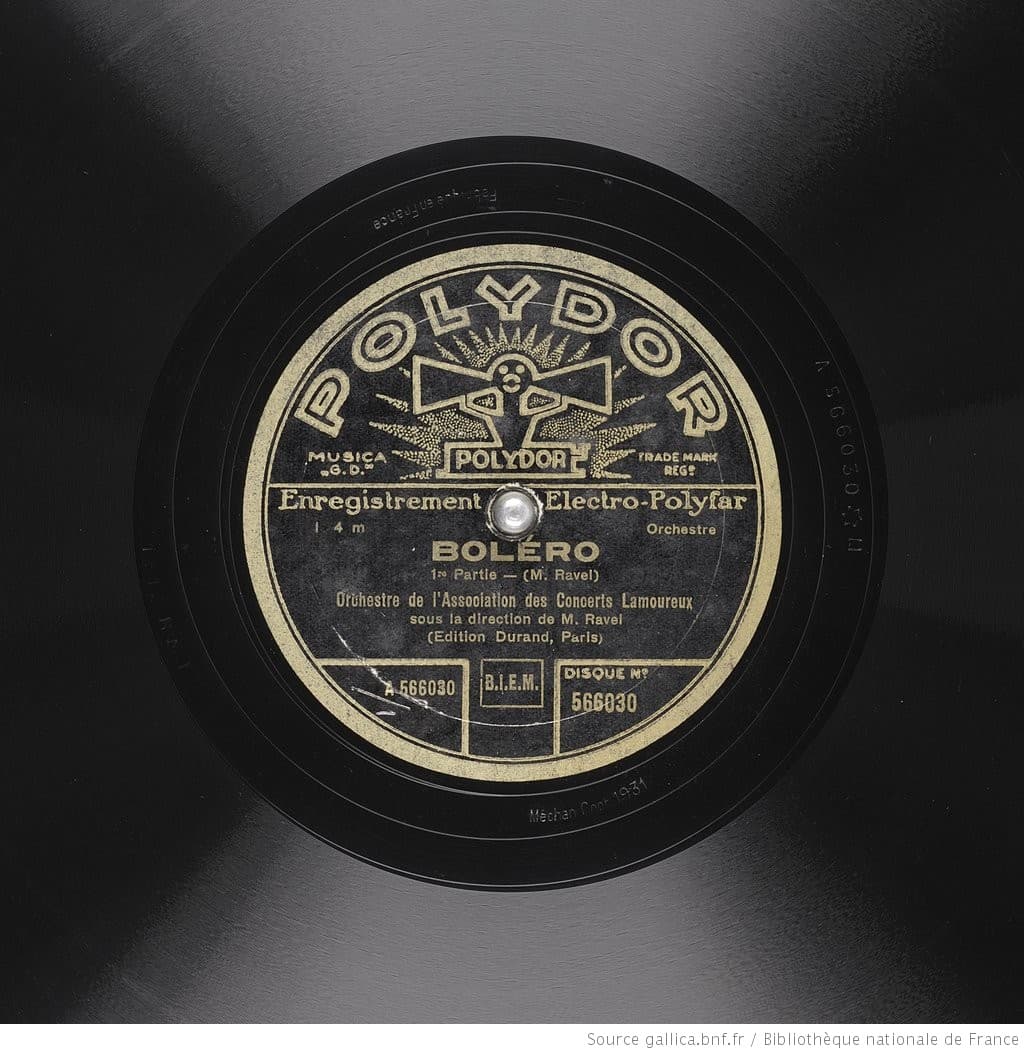
Maurice Ravel — This file comes from Gallica Digital Library and is available under the digital ID bpt6k1081526n · Public domain
Boléro began life as a commission for the dancer and patron Ida Rubinstein, who had asked Ravel to orchestrate pieces from Albéniz's Iberia; when copyright difficulties intervened, Ravel wrote an entirely new work built on the Spanish bolero rhythm instead. It reached the stage on 22 November 1928 at the Paris Opéra, choreographed by Bronislava Nijinska with designs and scenario by Alexandre Benois, conducted by Walther Straram, and starring Rubinstein herself. The article is emphatic that the music, not the ballet, is what made Boléro famous: Ravel called it a piece of "orchestral tissue without music" and predicted (wrongly) that orchestras would refuse to play it, and the piece is now, in the article's words, "usually played as a purely orchestral work, only rarely staged as a ballet."
What is danced
The only staged action the article describes is the printed programme scenario from the 1928 premiere: a Spanish tavern beneath a hanging brass lamp, a crowd dancing, and a woman who leaps onto a long table and dances with steps that grow more animated as the piece proceeds — a single sustained solo-against-crowd structure that mirrors the score's one long crescendo. The article gives no technical detail of Nijinska's actual vocabulary (no mention of pointe work, character shoes, port de bras, or partnering), so nothing further can be said about how the steps were built. It also records that Ravel himself disliked this scenario, preferring an abstract, mechanized setting — an open-air factory backdrop reflecting what he called the music's "mechanical nature" — which suggests the choreography and Ravel's own conception of the piece pulled in different directions from the start.
Context
The 1928 premiere sits inside the same Paris theatrical world that had recently absorbed the Ballets Russes and its wave of experimental one-act, single-idea ballets; the piece was made for Ida Rubinstein's own company, for which Nijinska was a house choreographer after her earlier work for Diaghilev. The article does not otherwise place the ballet within a broader dance-historical narrative, focusing instead on Boléro's afterlife as a concert and recording phenomenon (the Toscanini controversy, the flood of 1930s recordings, radio and film use) rather than on its stage life or influence on other choreographers.
Staging history
The article's staging information is limited to the 1928 premiere details already given (Nijinska's choreography, Benois's designs and scenario, Straram conducting, with Ansermet originally engaged but rejected by the orchestra's musicians). It explicitly states that later performance history has run almost entirely through the concert hall and recording studio rather than the theatre, and it names no subsequent choreographic productions, revivals, or companies that restaged the ballet after 1928.
How to watch it
Because the score is one unbroken 15-to-18-minute crescendo built on a fixed snare-drum ostinato and two alternating melodies passed between instruments, any staging is structurally locked to that arc: a single figure (in the 1928 version, a woman on a tabletop) whose movement must intensify in step with the orchestration rather than through narrative incident. Watch for how a choreographer handles the total absence of harmonic or formal contrast that Ravel himself flagged — the dance has to generate its own escalation since the music offers no sectional breaks to structure it against.
Credits
- composer: Maurice Ravel
On screen
- Bolero (1992)
- Lonlon
Related works
Other staged works in the register connected to this one by author or lineage.
 RenardBallet · 1922Nijinska · video
 Le baiser de la féeBallet · 1928Nijinska · video
 La valseBallet · 1920Music by Ravel · video
 L'éventail de JeanneBallet · 1929Music by Ravel
- La Fin du jourLa Fin du jourBalletMusic by Ravel
 In G MajorBallet · 1975Music by Ravel · video
 Le tombeau de CouperinBallet · 1975Music by Ravel · video
 La ValseBallet · 1951Music by Ravel · video