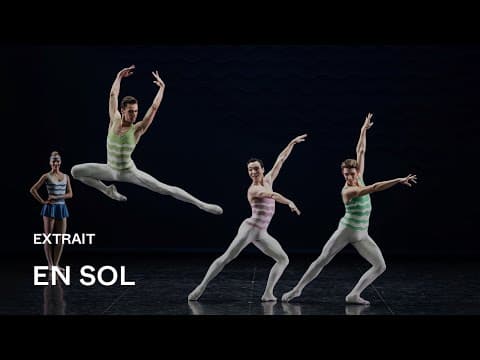
In G Major is a plotless, one-act ballet Jerome Robbins made for New York City Ballet's 1975 Ravel Festival, set to Ravel's Piano Concerto in G Major. It was danced by fourteen performers — two soloists and a twelve-strong corps (six men, six women) — with the central slow movement given over to a single pas de deux. It entered the repertory under the working title Concerto in G and was renamed by that autumn.
What it contains
- Broadway / Theatrical Jazz — Outer movements · The outer, faster first and third movements — Presentational, theatrical stepping drawn from Broadway vocabulary, deliberately echoing familiar showbiz idiom in keeping with the concerto's jazz-inflected orchestration. Source: "Performed by a cast of fourteen, the ballet featured Broadway-inspired choreography."
- Neoclassical Ballet — Central pas de deux (second movement) · The central pas de deux, second movement — Sustained, lyrical partnering built on approach-and-retreat and unfolding, with parallel holds and lifts characteristic of NYCB's plotless, music-driven concerto-ballet tradition of the period. Source: "their duet is full of parallel partnering alternating with beautiful exultant lifts."
What is danced
The ballet follows the three-movement shape of Ravel's concerto. The outer, faster movements are built from what the source calls 'extensive quotations of Broadway-style material' — a vein of theatrical, presentational, jazz-and-vaudeville-inflected stepping that critic Nancy Reynolds found deliberately familiar, even 'too-obvious,' in keeping with Ravel's own description of the concerto as light-hearted rather than profound. This Broadway vocabulary sits inside a corps-and-soloist structure that is otherwise classical in its architecture.
Context
The ballet was made for NYCB's 1975 Ravel Festival, a two-week celebration of Ravel's centenary modelled directly on the company's 1972 Stravinsky Festival and instigated by George Balanchine; Robbins contributed four works to it. It marked the return to NYCB of Suzanne Farrell after her years away following her 1969 rupture with Balanchine, and was, notably, only the second Robbins ballet she had ever danced (the first being a walk-on trumpet role in Fanfare) — a fact her biographers connect to her long association with Balanchine rather than Robbins.
Staging history
The ballet premiered with sets and costumes by Rouben Ter-Arutunian, then passed the same year to the Paris Opéra Ballet as En Sol, in new décor and costumes by Erté suggesting a French Riviera setting. New York City Ballet acquired the Erté designs in 1984 and has used them since, meaning the ballet's visual identity today is not the one it premiered in.
How to watch it
Watch for the contrast between the two outer movements, played for theatrical, Broadway-flavoured effect, and the slow second-movement duet, which is built on a push-pull of advance and retreat before opening into parallel partnering and sustained lifts. The piece is plotless — there is no story to track, only the relationship between Ravel's jazz-tinged orchestration and Robbins's choice of vocabulary for each movement.
Structure
- Outer movementsThe corps of six men and six women dance the faster first and third movements, built from Broadway-style quotations that both music and choreography deliberately echo familiar idioms.
- Central pas de deux (second movement)The two soloists dance a slow duet of approach and retreat, resolving into parallel partnering and sustained lifts.
Structure read from an encyclopaedia article, not from a libretto or score we hold. Confirm against a programme before treating the numbering as authoritative.
Credits
- composer: Maurice Ravel
More from Maurice Ravel
Other staged works in the register connected to this one by author or lineage.
 BoléroBallet · 1928Music by Ravel · video
 La valseBallet · 1920Music by Ravel · video
 L'éventail de JeanneBallet · 1929Music by Ravel
- La Fin du jourLa Fin du jourBalletMusic by Ravel
 La ValseBallet · 1951Music by Ravel · video
 Le tombeau de CouperinBallet · 1975Music by Ravel · video
 Symphony in Three MovementsBallet · 1972Same lineage · video
- Requiem CanticlesRequiem CanticlesBallet · 1968Same lineage