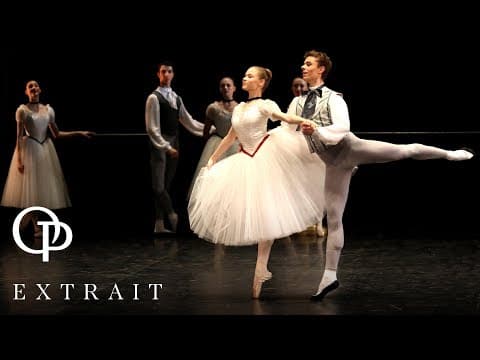
Le Conservatoire, or A Marriage by Advertisement is a two-act vaudeville ballet made by August Bournonville for the Royal Danish Ballet in 1849. It is built around a dance studio at the Paris Conservatoire, the school where Bournonville himself trained in the 1820s under Auguste Vestris, and it pairs a classroom divertissement with a light comic plot about a matrimonial advertisement gone wrong.
The ballet matters to the catalogue less for its farcical second act than for its first-act divertissement, 'The Dancing School' (Pas d'école), which the article credits with raising Bournonville's own classroom vocabulary 'to the level of enduring art.' It also launched the career of prima ballerina Juliette Price, tying it to a specific generation of Royal Danish Ballet dancers.
What it contains
- Bournonville Method — The Dancing School (Pas d'école) · Act I, the Pas d'école divertissement ('The Dancing School') — A staged recreation of a classical ballet class (in the Vestris/Paris Conservatoire tradition Bournonville trained in) built specifically to display 'the basics of his style' as concert-worthy dance rather than mere pedagogy. Source: "A divertissement within the larger work called "The Dancing School" (Pas d'école) permitted Bournonville to display the basics of his style and raise them to the level of enduring art."
What is danced
The first act stages a Vestris-style ballet class exactly as Bournonville would have attended one in Paris in the 1820s — the article calls it 'a recreation of a Vestris dance class.' Within that act sits the Pas d'école, a self-contained divertissement explicitly built to show 'the basics of his style' as a performance piece rather than a demonstration, making it the ballet's technical showpiece and the part of the work most often extracted and taught on its own. A named pas de trois within that divertissement is set almost entirely to Pierre Rode's Violin Concerto No.7 — a piece that was itself a conservatoire examination showpiece for young violinists in Bournonville's Paris years, which tells a dancer something about the pas de trois's intended virtuosity and formality.
The second act trades the classroom for comic mime: Monsieur Dufour's matrimonial misadventure and the pupils' prank of disguising themselves as attractive women to fool him. The article stresses that the vaudeville genre depended on 'well-known melodies... to facilitate the audience's understanding of the extensive mime,' which tells us the second act leans on legible pantomime and borrowed tunes for comic and narrative effect rather than on set academic dance numbers, but the article gives no specific step vocabulary for this section beyond that general genre convention.
Context
Bournonville made the ballet in 1849, drawing directly on his own Paris training under Auguste Vestris in the 1820s, and used the vaudeville-ballet convention of quoting recognisable melodies (Weber, Chopin, Paisiello) to anchor time and place for a Copenhagen audience unfamiliar with Paris. The work sits inside the wider project of Bournonville's Danish repertoire, which repeatedly folds virtuoso classroom technique into narrative and comic frames rather than presenting it as abstract display.
Staging history
The Royal Danish Ballet performed the complete two-act ballet continuously from 1849 until 1934, when it dropped from the repertoire, reportedly for seeming old-fashioned. In 1942 director Harald Lander pulled the Pas d'école divertissement out of the larger work and staged it as a standalone one-act piece, which is the form in which the ballet has most often survived and travelled since. The full two-act version was reconstructed and returned to the Royal Danish Ballet repertoire in 1995 by Kirsten Ralov, Niels Bjørn Larsen and Dinna Bjørn, working from personal memories of 1930s stagings, Bournonville's own notations, and Valborg Borchsenius's writings on Lander's 1930s production.
How to watch it
Watch the first act's Pas d'école for the clean, articulate classroom vocabulary Bournonville is known for, and note the pas de trois's unusually close dependence on a single violin concerto rather than a purpose-composed ballet score. In the second act, follow the mime rather than expecting extended formal dance: the comedy is carried by borrowed, audience-recognisable tunes cueing the pantomime, in line with the vaudeville-ballet convention the article describes.
Structure
- Act IA recreation of a Vestris-style ballet class of the type Bournonville attended in Paris in the 1820s.
- Act I · The Dancing School (Pas d'école)A divertissement within the class scene built to display and elevate the basics of Bournonville's own style.
- Act I · Pas de trois (within Pas d'école)A pas de trois set to nearly all of Pierre Rode's Violin Concerto No.7, a piece used as a conservatoire examination showpiece in Bournonville's Paris years.
- Act IIMonsieur Dufour, an inspecteur at the Conservatoire, places a matrimonial advertisement and ends up marrying his housekeeper, Mademoiselle Bonjour.
- Act IIThe Conservatoire's pupils disguise themselves as attractive women to make a fool of Monsieur Dufour.
Structure read from an encyclopaedia article, not from a libretto or score we hold. Confirm against a programme before treating the numbering as authoritative.
Credits
- composer: Holger Simon Paulli
More from August Bournonville
Other staged works in the register connected to this one by author or lineage.


