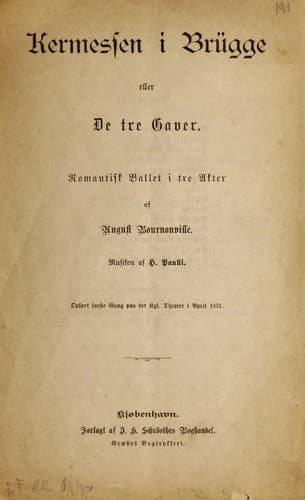
Unknown authorUnknown author — https://openlibrary.org/works/OL16909238W/Kermessen_i_Br%C3%BCgge_eller_De_tre_gaver?edition=ia%3Akermessenibrggee00bour · Public domain
The Kermesse in Bruges, or The Three Gifts is a three-act burlesque ballet made by August Bournonville for the Royal Danish Ballet, first given on 4 April 1851 with a score by Holger Simon Paulli. It follows three brothers who receive magic gifts (a sword, a ring, and a lute) from an alchemist at a Flemish church fair, and uses their contrasting fortunes to satirise the pursuit of power and love over simple good cheer.
What it contains
- Bournonville Method — Pas de deux (Carelis and Eleonore) · Act I, the pas de deux between Carelis and Eleonore — A romantic pas de deux built and later refined by Bournonville himself, described as one of his finest dance compositions expressing a declaration of love; this is the signature choreographic set piece of the ballet. Source: "one of Bournonville's most beautiful dance compositions, the pas de deux in Act I, Carelis' declaration of love to Eleonore"
- Galop — Final galop · The closing ensemble finale, after the condemned brothers are released — A fast communal ensemble galop closing the ballet, the standard joyful group finale form Paulli regularly wrote for Bournonville productions of this period. Source: "the obligatory final galop is a characteristic example of the dance music Paulli wrote for Bournonville"
What is danced
The article names only two set pieces with any specificity: a pas de deux for Carelis and Eleonore in Act I, described as Carelis' declaration of love and singled out as one of Bournonville's most beautiful dance compositions, and an 'obligatory final galop' closing the ballet in the vein of the ensemble finales Paulli regularly supplied for Bournonville. The Act I marketplace (kermesse) scene is danced to borrowed operatic and ballet music — passages from Rossini's Le Comte Ory and a round dance lifted from Paulli's score for Bournonville's The White Rose — indicating a crowd scene built from folk-inflected character dancing rather than academic display, but the source gives no step-level detail for it.
Context
The ballet dates from 1851, within Bournonville's long tenure shaping the Royal Danish Ballet's distinctive style, and the article frames it as a topical comment made two years after Denmark's 1849 constitution — a burlesque about a society learning to handle new freedoms, set safely at a distance in 17th-century Flanders. Paulli's score is a patchwork typical of the period's ballet-pantomime practice, mixing original numbers with borrowings from Rossini and Hérold, which the article treats as characteristic of how Bournonville-era house composers worked.
Staging history
The Act I pas de deux reached what the article calls its definitive form when Bournonville himself restaged the ballet in 1865. Later Danish revivals reworked the piece repeatedly: Harald Lander and Valborg Borchsenius trimmed scenes in 1943; Flemming Flindt and Hans Brenaa produced a new treatment in 1966 with bright period costume against a moodier, medieval lighting scheme; Brenaa made a faster, more cheerful version in 1979 that held the stage until 2000; and in 2000 Dinna Bjørn, Anne Marie Vessel Schlüter and Jan Maagaard added a more serious shade to that lightness. Also in 2000, Peter Schaufuss mounted a separate version for his own company, the Peter Schaufuss Ballet.
How to watch it
Watch the Act I pas de deux for the lyrical, unforced quality the source calls 'declaration of love' dancing — this is the number later generations kept intact even as surrounding scenes were cut. In the marketplace scenes, listen for borrowed opera tunes (Rossini, Hérold) doing double duty as dance music, a Bournonville-era convention worth noting rather than a fault; the final galop is the expected communal release after the plot's mock trial-by-fire.
Structure
- Act IThe market-fair (kermesse) crowd scene in which the three brothers receive their magic gifts from the alchemist Mirewelt.
- Act I · Pas de deux (Carelis and Eleonore)Carelis declares his love to Eleonore, Mirewelt's daughter, in a pas de deux singled out as one of Bournonville's finest dance compositions.
- Final galopThe condemned brothers are freed and reunited with their sweethearts as Carelis' lute sets everyone dancing joyfully, closing in an ensemble galop.
Structure read from an encyclopaedia article, not from a libretto or score we hold. Confirm against a programme before treating the numbering as authoritative.
Credits
- composer: Holger Simon Paulli
More from August Bournonville
Other staged works in the register connected to this one by author or lineage.
 NapoliBallet · 1842Bournonville · video
 Flower Festival in GenzanoBallet · 1858Bournonville · video
 A Folk TaleBallet · 1854Bournonville · video
 Le ConservatoireBallet · 1849Bournonville · video
 The Golden AgeBallet · 1930Same lineage · video
 Les Millions d'ArlequinBallet · 1900Same lineage · video
- Le Petit Elfe Ferme-l'œilLe Petit Elfe Ferme-l'œilBallet · 1924Same lineage
 L'Île EnchantéeBallet · 1864Same lineage