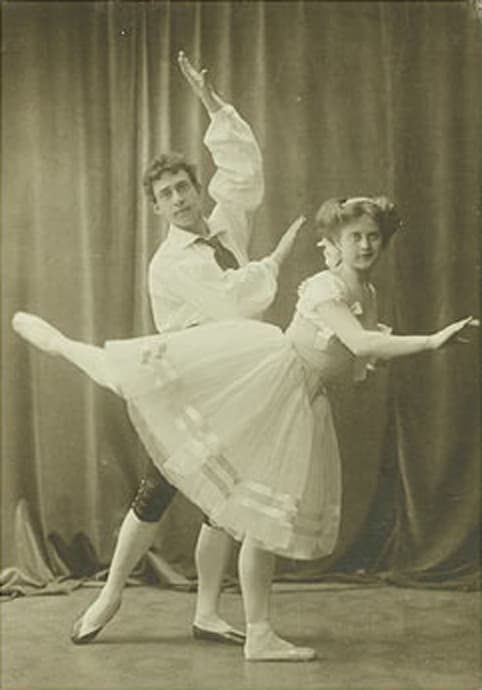
Peter Elfelt — Датский Балет Журнал · Public domain
Napoli, or The Fisherman and His Bride is a three-act ballet made in 1842 by August Bournonville for the Royal Danish Ballet, telling the story of the Neapolitan fisherman Gennaro and his bride Teresina, who is abducted by the sea demon Golfo and transformed into a naiad before being restored to human form and marriage. It grew directly out of Bournonville's own travels to Naples and his attempt to capture that city's street life and energy on stage.
What it contains
- Bournonville Method — The Wedding · Whole ballet, most concentrated in the Act III wedding solos — Choreographed by Bournonville himself, and the article credits the piece's male solo work in particular as exceptional - the technical hallmark of the school that bears his name. Source: "the exceptional male solos"
- Galop — The Wedding · Act III, the closing number after the tarantella — A social-dance galop composed by Lumbye to close the wedding act, following on immediately from the tarantella as the ballet's final dance number. Source: "provide the music for the concluding galop that follows Paulli's tarantella"
What is danced
The article is explicit that the ballet is unevenly weighted between mime and dance: the first two acts carry heavy pantomime (Teresina's courtship, the storm, the search for her in the Blue Grotto), and it is only in Act III, the wedding, that dancing dominates. That final act is built around a tarantella that Bournonville says he composed in his head, humming it during a carriage journey, before the rest of the ballet existed around it - the tarantella is described as the seed of the whole work. The act ends with a galop, commissioned separately from Hans Christian Lumbye, that follows directly on from Paulli's tarantella as the ballet's closing dance number.
Context
The ballet dates from the height of the Romantic era in ballet and was created by Bournonville, the dominant figure of the Danish school and the source of the technique that still bears his name. The article frames its genesis as a direct response to a real journey - Bournonville trying to translate the 'local colour' and 'vibrancy of a city in constant movement' he witnessed in Naples into stage movement, rather than working from a literary or classical-mythological source as many Romantic ballets did.
How to watch it
Expect the first two acts to move slowly through mime and stage effects (the storm, the transformation in the grotto) before the dancing proper arrives in Act III; the article itself flags this pacing as a point of critical debate. Watch the wedding act for the tarantella-into-galop sequence, and for the male solo work the article singles out as exceptional - the Bournonville style favours quick, precise footwork and light, unforced elevation over overt display.
Structure
- Act I · The MarketTeresina refuses two wealthy suitors and reunites with Gennaro; a storm strikes during a street entertainers' show and Teresina disappears, presumed drowned.
- Act II · The Blue GrottoGennaro finds Teresina transformed into a naiad by the sea demon Golfo; faith restores her humanity and memory, and the two escape the grotto.
- Act III · The WeddingThe townsfolk's suspicion of the returned couple is overcome and the ballet closes with a wedding celebration built around a tarantella and a concluding galop.
Structure read from an encyclopaedia article, not from a libretto or score we hold. Confirm against a programme before treating the numbering as authoritative.
Credits
- composer: Edvard Helsted
- composer: Hans Christian Lumbye
- composer: Holger Simon Paulli
- composer: Niels Gade
More from August Bournonville
Other staged works in the register connected to this one by author or lineage.
 Flower Festival in GenzanoBallet · 1858Bournonville · video
 A Folk TaleBallet · 1854Bournonville · video
 Le ConservatoireBallet · 1849Bournonville · video
 The Kermesse in BrugesBallet · 1851Bournonville · video
 The Golden AgeBallet · 1930Same lineage · video
 Les Millions d'ArlequinBallet · 1900Same lineage · video
 L'Île EnchantéeBallet · 1864Same lineage
- Le Petit Elfe Ferme-l'œilLe Petit Elfe Ferme-l'œilBallet · 1924Same lineage