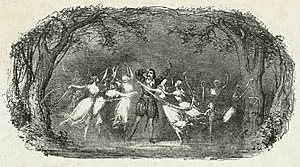
Unknown authorUnknown author — http://wayback-01.kb.dk/wayback/20101108104943/http://www2.kb.dk/kb/dept/nbo/ma/nyhbre/jun05.htm · Public domain
A Folk Tale (Et Folkesagn) is a three-act ballet made by August Bournonville for the Royal Danish Ballet, first given on 20 March 1854, with music divided between J.P.E. Hartmann (the troll scenes) and Niels W. Gade (the beech-forest scenes). Bournonville drew on Danish folk-ballad tradition — Elveskud and Elvehøj — and on published folklore collections rather than crediting the contemporary folklorist Svend Grundtvig, building a changeling story in which a human girl raised among trolls, Hilda, is restored to her true place while the troll-born Birthe is married off for gold.
What it contains
- Bournonville Method · whole work — Choreographed by Bournonville for the Royal Danish Ballet in his own idiom, later transmitted generation to generation by named Bournonville stagers as core repertory technique. Source: "the Danish ballet master and choreographer August Bournonville"
- Romantic Ballet · whole work — The work is built on Romantic-era national folklore themes and is explicitly compared by the article to Bournonville's Taglioni-lineage Romantic ballet La Sylphide. Source: "Bournonville's Taglioni-inspired ballet from 1836"
- Galop · Act II, troll wedding feast — A festive galop performed by the drunken troll ensemble at Hilda and Diderik's wedding feast. Source: "festive galop for the drunken trolls"
- Minuet · Act I, forest outing scene — A formal minuet danced by the noble characters, described as musically 'dignified', within the mixed suite of Act I dances. Source: "the nobles' dignified minuet"
What is danced
The article describes the ballet's musical numbers closely enough to identify set dances within each act. Act I is built around a hunting scene, folksong-derived melodies, a formal minuet for the nobility, a reel for the peasants, and a set-piece dance for the elf-maidens who lure Junker Ove into a trance — a sequence explicitly contrasted by the source with the darker enchantment of La Sylphide. Act II, scored by Hartmann in an 'Old Norse' idiom, gives Hilda a solo built as a bolero and stages a drunken troll celebration around a galop; the article calls out 'rhythmic tension and dark resonance' as the character quality of this act's dancing, implying grotesque, weighted troll-dance contrasted with Hilda's more lyrical solo. Act III returns to Gade's forest music and closes with a gypsy polonaise followed by the Bridal Waltz, still danced at Danish weddings according to the article, as the culminating wedding dance for Hilda and Ove.
Context
The ballet belongs to Danish Romanticism's turn toward national folklore as source material, made in the same decade Grundtvig was systematically collecting Danish folk tales; Bournonville positioned his own retelling of the Elveskud/Elvehøj material against J.L. Heiberg's rival stage version of Elvehøj. Bournonville himself framed the work as a deliberate answer to what he saw as an unpoetic, materialistic present — art's duty to restore 'the spiritual, the poetry' — and he rated it above all his other ballets.
Staging history
After Bournonville's death the ballet passed through a chain of named stagers at the Royal Danish Ballet: Hans Beck (1894), Gustav Uhlendorff (1922), Kaj Smith (1931), Harald Lander and Valborg Borchsenius (1941), Niels-Bjørn Larsen and Gerda Karstens (1952), Hans Brenaa and Kirsten Ralov (1969, with Ralov again in 1977 and 1979), and Frank Andersen and Anne Marie Vessel Schlüter in 1991, the last with designs by Queen Margrethe II.
How to watch it
Watch for the contrast the article draws between Gade's Mendelssohn-inflected forest music (hunt, folksong, minuet, reel, elf dance) and Hartmann's harsher troll-hill idiom in Act II — the two composers were deliberately assigned to different worlds within the same ballet. Pay attention to how the elf and troll episodes stage enchantment as reversible and comic rather than fatal, in contrast to Bournonville's own La Sylphide, and to the Bridal Waltz finale, which the source notes survives independently as a real Danish wedding piece.
Structure
- Act IBirthe flirts with Sir Mogens in front of her fiancé Ove; left alone, Ove refuses Hilda's magic drink, and elf-girls conjured by Muri dance him into derangement.
- Act IIIn the elf-hill, troll brothers Diderik and Viderik vie for Hilda; her wedding to Diderik is celebrated with a drunken feast before she flees.
- Act III · Scene 1Hilda leads the elf-struck Ove to a healing spring to restore his senses; harvesters overpower him and Hilda flees.
- Act III · Scene 2Birthe bullies her servants and it is revealed she is the true troll child, Hilda the rightful heir.
- Act III · Scene final · Bridal WaltzMogens marries Birthe for gold while Hilda is united with Ove, and the couple celebrate their wedding with a waltz.
Structure read from an encyclopaedia article, not from a libretto or score we hold. Confirm against a programme before treating the numbering as authoritative.
Credits
- composer: Johan Peter Emilius Hartmann
- composer: Niels Gade
More from August Bournonville
Other staged works in the register connected to this one by author or lineage.
 NapoliBallet · 1842Bournonville · video
 Flower Festival in GenzanoBallet · 1858Bournonville · video
 Le ConservatoireBallet · 1849Bournonville · video
 The Kermesse in BrugesBallet · 1851Bournonville · video
 GiselleBallet · 1841Same lineage · video
 La SylphideBallet · 1832Same lineage · video
 L'Île EnchantéeBallet · 1864Same lineage
 La sonnambulaBallet · 1946Same lineage · video