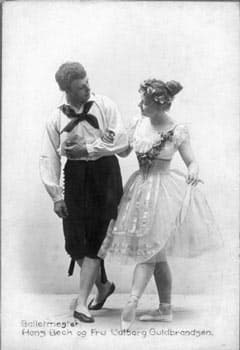
The Flower Festival in Genzano is a one-act ballet made by August Bournonville for the Royal Danish Ballet, first given at the Royal Danish Theatre on 19 December 1858. It grew out of Danish fascination with Italy and adapts an episode from Alexandre Dumas's travel writing into a love story between Rosa and Paolo, set against the real flower festival still held each June in Genzano. The full ballet is lost; what survives, and what almost every modern audience means when they refer to the title, is a single pas de deux that has become one of the most widely taught and competed showpieces of the Bournonville repertoire.
What it contains
- Bournonville Method — Flower Festival in Genzano pas de deux · The surviving pas de deux (originally made for Napoli, later grafted onto this ballet) — Small gargouillade, petit manège with four grand jetés into first arabesque, fast repeated relevés on pointe in the second solo, brilliant small batterie in the man's second solo, and a low inclined partnering hold repeated four times with fast ronds de jambe — the article calls this passage a clear example of the Danish style. Source: "the dancer performs a small gargouillade and her round of petit manège, with four grand jetés in the first arabesque at the end of the solo"
- Classical Ballet — Flower Festival in Genzano pas de deux · The surviving pas de deux — Follows the standard classical pas de deux architecture: entrée for solo violin, adagio, separate male and female variations, and a closing coda, the conventional four-part structure of nineteenth-century classical pas de deux repertoire. Source: "The entrée of the pas de deux opens with an episode for solo violin, followed by a polka-like section. After the adage follows the male variation"
What is danced
The article's detailed movement description concerns the surviving pas de deux, not the lost full-length ballet, and a reader should treat the two as separate objects. The woman's solo is built on a small gargouillade, a petit manège (a travelling circular run of turns/jumps), and four grand jetés into first arabesque at the close; her second solo is characterized by a repeated series of fast relevés on pointe. The pas de deux structure follows the classical pattern of entrée, adagio, male variation, and coda: it opens with a solo-violin episode, moves into a polka-like passage, and the male variation is set to a waltz lifted from Adolphe Adam's score for Le Diable à quatre.
The partnering includes a repeated low, inclined hold in which the man supports the woman while she executes fast ronds de jambe, performed four times as a small circle; a flirtatious exchange between the two dancers at the start of the coda, which the article flags as unusual for Bournonville; and a sequence in which the woman, held by her partner, arrives in first arabesque, rotates into an avant arabesque, and turns again back to first arabesque — again described as atypical of his other choreography. The man's two solos exploit the strong rhythms of the score; the first keeps to simple, direct floor patterns (a diagonal, then parallel travel), while the second is described as the passage most representative of Bournonville's characteristic style — brilliant small batterie, quick, soft footwork, and lively jumps.
Context
Bournonville, trained under his father Antoine (a Noverre disciple) and later under Vestris in Paris, spent decades building the Royal Danish Ballet's distinct national style out of Romantic ballet's vocabulary, favouring naturalistic characterisation and virtuosic but unforced footwork over exaggerated display. The article places this ballet as a marker of his move toward naturalism within that development, and calls it one of his most perfectly achieved works. Its pas de deux, however, did not originate here: it was created in 1842 by the dancer Lorenzo Vienna for a Vienna staging of Bournonville's Napoli, to music by the Austrian composer Matthias Strebinger, and was only later grafted onto Genzano, with Holger Simon Paulli reorchestrating Strebinger's material.
Staging history
The full ballet was danced in its entirety by the Royal Danish Ballet from the 1858 premiere until it was dropped from the repertoire in 1929. Bournonville had already made a divertissement version in 1875 that preserved the pas de deux he had used for the Vienna Flower Festival staging, and it was this fragment that endured after the complete work was lost. Harald Lander, then director of the Royal Ballet, brought the surviving material back to the stage in 1949; the pas de deux subsequently entered international repertoire and the ballet competition circuit, often performed with the music misattributed solely to Paulli and/or Helsted rather than credited to its true composer, Strebinger.
How to watch it
Watch the woman's petit manège and closing grand jetés into arabesque, and the contrast between the man's plain, direct first solo and his more characteristically Bournonville-brilliant second solo with its rapid batterie. Note the low, inclined partnering hold repeated four times and the arabesque-turn sequence for the woman, both singled out as departures from Bournonville's usual vocabulary, and the flirtatious byplay opening the coda, equally unusual for him. The piece is customarily danced in Bournonville-school finery specifically to showcase the method, separate from any narrative context.
Structure
- Flower Festival in Genzano pas de deuxThe surviving fragment of the ballet: an entrée for solo violin, a polka-like passage, an adage, two contrasting solos for the man and two for the woman, and a coda that opens with a flirtatious exchange between the couple.
Structure read from an encyclopaedia article, not from a libretto or score we hold. Confirm against a programme before treating the numbering as authoritative.
Credits
- composer: Edvard Helsted
- composer: Holger Simon Paulli
More from August Bournonville
Other staged works in the register connected to this one by author or lineage.
 NapoliBallet · 1842Bournonville · video
 A Folk TaleBallet · 1854Bournonville · video
 Le ConservatoireBallet · 1849Bournonville · video
 The Kermesse in BrugesBallet · 1851Bournonville · video
 Swan LakeBallet · 1877Same lineage · video
 The NutcrackerBallet · 1892Same lineage · video
 MovesBallet · 1959Same lineage · video
 The Green TableBallet · 1932Same lineage · video