The Dream (1964)
The Dream is Frederick Ashton's one-act condensation of A Midsummer Night's Dream, made for the Royal Ballet and set to Mendelssohn's overture and incidental music for the play, arranged by John Lanchbery. The article records its premiere on 2 April 1964 at Covent Garden, on a triple bill marking Shakespeare's 400th anniversary alongside new Shakespeare-themed works by Kenneth MacMillan and Robert Helpmann.
What it contains
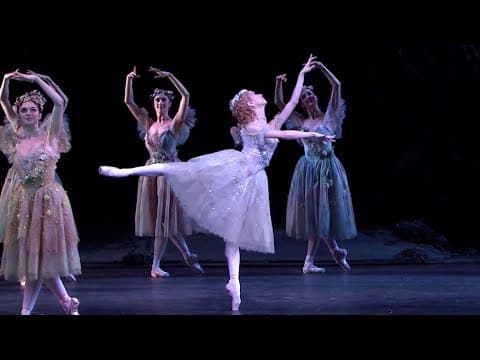
- Romantic Ballet · The corps passages for Titania's four fairy attendants (Peaseblossom, Cobweb, Moth, Mustardseed) — Quick, silvery footwork and a soft, flowing upper body for the fairy corps, including a staged quotation of the four-woman grouping and pose from the Romantic-era Pas de Quatre lithographs. Source: "Ashton's choreography for the corps is an elegant and witty commentary on the period, with quick and silvery movements, and a soft, flowing upper body, with delicate echoes of the Romantic style (at one point Titania's four attendants strike the famous pose from the Pas de Quatre of the old lithogra"
What is danced
Ashton stripped the play to its fairy and lover plots, cutting Theseus, Hippolyta and the Pyramus-and-Thisbe play-within-a-play, so the danced action centres on Oberon and Titania's quarrel and reconciliation, the four Athenian lovers' tangled pursuits, and Bottom's transformation and courtship of Titania. The critical-reception material quoted in the article singles out the corps writing for Titania's four fairy attendants (Peaseblossom, Cobweb, Moth, Mustardseed) as 'quick and silvery' with a 'soft, flowing upper body' and 'delicate echoes of the Romantic style', including a moment where the four attendants strike the pose from the lithographs of the Romantic-era Pas de Quatre — a deliberate historical quotation for audiences who 'know their ballet history'.
The article also flags that the piece was, in Alexander Bland's words, 'the first Ashton ballet to be slanted heavily in favour of the men', pointing to substantial dancing for Oberon, Puck, the four lovers and Bottom rather than a ballerina-centred structure. The work is staged in a single unified set, with the dancing integrated so continuously into the storytelling that, per Mary Cargill's review, 'the dramatic skill involved is hidden' — a structural point relevant to anyone staging or rehearsing the piece, since the choreography is built to read as narrative rather than as a sequence of set numbers.
Context
The ballet was made for a specific occasion — the Royal Ballet's 1964 tribute to Shakespeare's quatercentenary — and sat on an opening bill with two other new Shakespeare-derived works, showing three different choreographic approaches to the same source material in one evening. Within Ashton's own output the piece is noted, per the article's quoted criticism, for shifting weight onto the male roles rather than centring a ballerina, a departure the critics of the day registered as unusual for him.
Staging history
The Royal Ballet's touring company carried the work through the 1960s and 70s in designs by Peter Farmer, and a new Covent Garden production reproducing Ashton's choreography was mounted under Anthony Dowell's direction in June 1986. It entered other companies' repertories from the late 1960s onward — the Australian Ballet (1969), the Joffrey Ballet (1973, set by John Hart and Faith Worth), the Royal Swedish Ballet (1975), Dutch National Ballet (1977) and the National Ballet of Canada (1977), the last three staged from Faith Worth's Benesh notation score — and reached American Ballet Theatre in 2002, with a 2003 ABT performance (Ethan Stiefel, Alessandra Ferri, Herman Cornejo) issued on Kultur DVD.
How to watch it
Watch the corps passages for Titania's fairy attendants for the deliberate quotation of the Romantic-era Pas de Quatre pose — a piece of ballet-historical in-joke built into the choreography. Note how much dancing is given to Oberon, Puck, Bottom and the four lovers rather than reserved for Titania, and watch for how smoothly the mime and dancing are fused within the single unified set so that the narrative seems to unfold without visible choreographic seams.
Credits
- composer: Felix Mendelssohn
More from Felix Mendelssohn
Other staged works in the register connected to this one by author or lineage.
 A Midsummer Night's DreamBallet · 1962Music by Mendelssohn · video
 Scotch SymphonyBallet · 1952Music by Mendelssohn · video
 GiselleBallet · 1841Same lineage · video
 La SylphideBallet · 1832Same lineage · video
 Les SylphidesBallet · 1908Same lineage · video
 La fille mal gardéeBallet · 1789Same lineage · video
 L'Île EnchantéeBallet · 1864Same lineage
 La sonnambulaBallet · 1946Same lineage · video