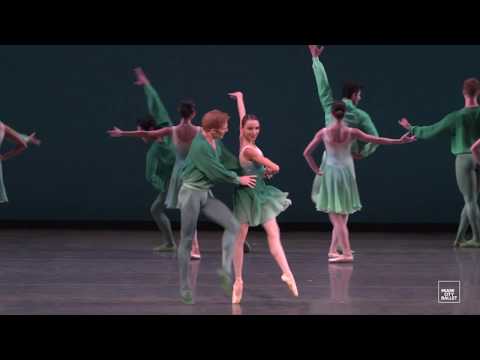
Brahms/Handel is a 1984 ballet made jointly by Jerome Robbins and Twyla Tharp for New York City Ballet, set to Brahms' Variations and Fugue on a Theme by Handel, Op. 24, in an orchestration by Edmund Rubbra. It is notable chiefly as a formal collaboration between two choreographers of very different working methods and backgrounds — Robbins the long-serving NYCB ballet master rooted in the company's classical repertory, Tharp the choreographer who had built her reputation crossing ballet with vernacular and modern dance idioms.
The pairing itself is the reason the work sits in the catalogue: joint-authorship ballets between choreographers of this stature are rare, and the piece is generally discussed as a case study in how two distinct sensibilities were reconciled (or left visibly juxtaposed) within a single score. The premiere took place at the New York State Theater, Lincoln Center, with designs by Oscar de la Renta and lighting by Jennifer Tipton.
What is danced
The source article gives no synopsis, cast breakdown detail, or description of steps, structure, or vocabulary — it records only the creative credits, music, premiere date and venue, and design credits. It does not state how the choreography was divided between Robbins and Tharp, whether sections were danced by separate casts or blended, or what technical demands (pointe work, partnering, ensemble patterning) the piece makes. Nothing here can be verified from the text about specific movement content, so no claims about vocabulary are made.
Context
The article situates the work only by date and company: 1984, New York City Ballet, Lincoln Center. It gives no further context about the choreographic climate, Robbins' or Tharp's other activity that season, or how the work was received relative to their separate output — those connections would need to be drawn from outside sources, not this article.
Staging history
The article's section headings indicate an original 1984 cast and at least one NYCB revival, listed under "2008 Spring — Jerome Robbins celebration," implying the ballet was brought back as part of a company retrospective devoted to Robbins. No cast names, changes to the choreography, or reception details for that revival are given in the text supplied.
How to watch it
Because the piece is a joint work, audiences and dancers typically watch for where Robbins' and Tharp's contributions can be told apart within the same Brahms/Handel variations — the article does not specify how the sections are divided, so this is a matter for the choreographic record or a program note rather than something this source confirms. Attend to the costume and lighting design credited to Oscar de la Renta and Jennifer Tipton, which the article flags as notable enough to record by name.
Credits
- composer: Johannes Brahms
Related works
Other staged works in the register connected to this one by author or lineage.
 West Side StoryMusical theatre · 1957Robbins · video
 Fancy FreeBallet · 1944Robbins · video
- DybbukDybbukBallet · 1974Robbins
 The ConcertBallet · 1956Robbins · video
 Antique EpigraphsBallet · 1984Robbins · video
 A Suite of DancesBallet · 1994Robbins · video
- In Memory Of ...In Memory Of ...Ballet · 1985Robbins
 Brahms–Schoenberg QuartetBallet · 1966Music by Brahms · video