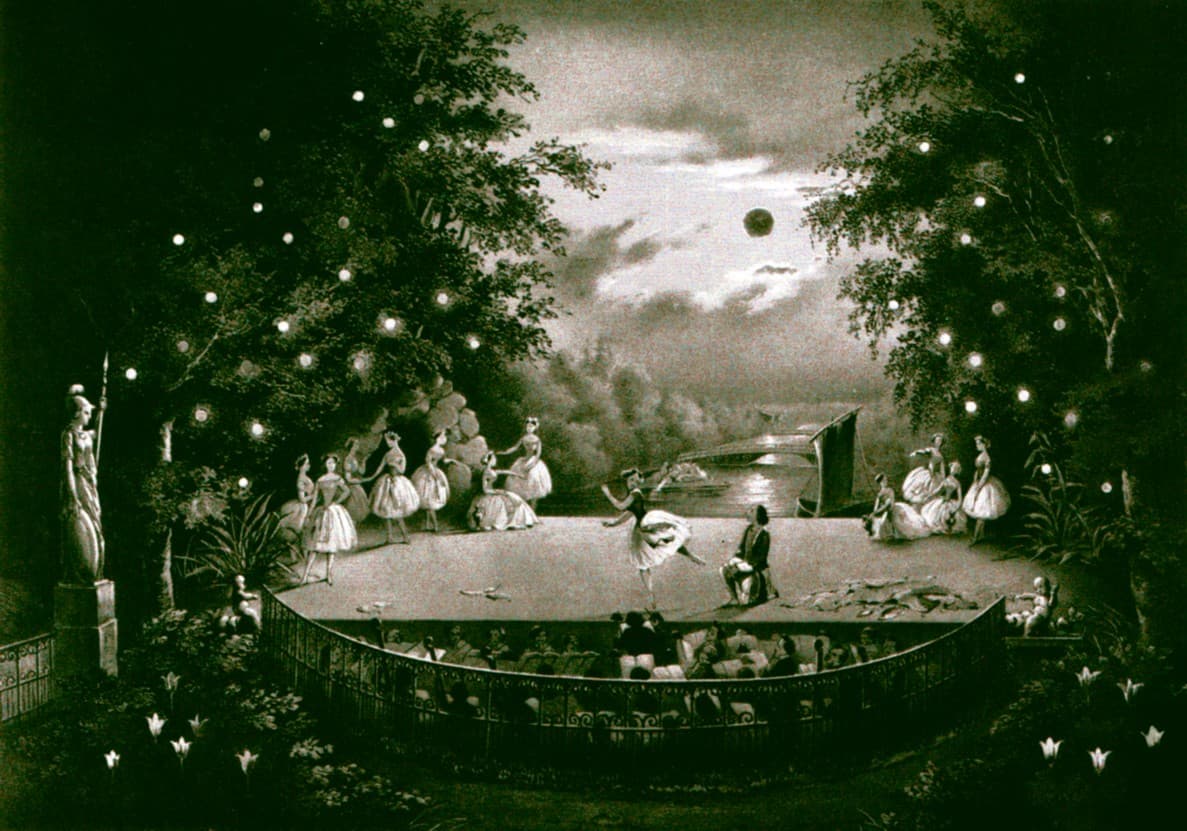
Adolf Charlamagne (1826-1901) — Scanned from the book "Ballet Art: From the Renaissance to the Present" by Mary Clark and Clement Crisp. Published by Clarkson N. Potter, Inc. 1978. · Public domain
Ondine, ou La naïade (1843)
Ondine, ou La naïade is a Romantic-era ballet made for Her Majesty's Theatre, London, in 1843, with choreography by Jules Perrot and a score by Cesare Pugni, loosely built on Fouqué's Undine by way of intervening French stage adaptations. Fanny Cerrito created the title role of the water-nymph Ondine opposite Perrot himself as the fisherman Mattéo, and the piece was praised at the time both for its stage picture and for Pugni's illustrative, wave-mimicking score.
What it contains
- Romantic Ballet · The underwater scene where Mattéo is drawn into the depths, surrounded by the corps of naiads; and the title role as danced by Cerrito throughout — A massed corps of supernatural female water-spirits dances en masse around a solitary mortal male to programmatic wave-imitating music, the classic Romantic ballet-blanc device; the ballerina in the title role was singled out for pointe-based, 'step-revealing' virtuosity typical of Romantic-era nymph and sylph parts. Source: "the naiads dance their many fascinations around him"
What is danced
The article does not give a scene-by-scene choreographic breakdown, but it is explicit about one set piece: an underwater sequence in which the fisherman Mattéo is 'conveyed into the depths of the sea' and surrounded by a corps of naiads performing 'their many fascinations around him' while Pugni's music imitates the rise and fall of waves. This is the ballet-blanc convention of Romantic ballet applied to a marine rather than a woodland or graveyard setting — a massed corps of supernatural female dancers moving around a solitary mortal male, choreographed to programmatic, water-mimicking orchestration rather than abstract melody. Cerrito herself was singled out in period criticism as a 'step-revealing goddess,' language that points to virtuosic, pointe-based footwork of the kind Romantic ballerinas used to mark the otherworldliness of nymph and sylph roles.
The article also notes, in passing, that when Frederick Ashton made his own, unrelated Ondine to Henze's music over a century later, he built into its first act 'his own version of the Shadow Dance' as a deliberate tribute to Perrot — implying that a Shadow Dance was a recognisable, prized element of Perrot's original choreography, though the source gives no further detail on where it fell in the six scenes or what it consisted of. Beyond these two points, the surviving record is thin on step vocabulary, holds, or technical demands, and a dancer wanting reconstruction detail would need to go past this article to Lacotte's 2006 staging notes or period répétiteur material.
Context
The 1843 premiere sits at the height of London's Romantic ballet fashion, the same climate that produced Giselle (Perrot's own contribution to that ballet is well known) and the vogue for ethereal, supernatural heroines danced en pointe by touring virtuosas like Cerrito. Pugni's dedication to Augusta, Duchess of Cambridge situates the work within the London balletomane patronage culture of the period. Its migration to St Petersburg in 1851, where Perrot was Premier Maître de Ballet, exemplifies the era's routine transplantation of Western European Romantic ballets into the Imperial Russian repertory, where Pugni's score was itself revised to suit the larger Imperial stage and company.
Staging history
Perrot's own expanded revival, retitled La Naïade et le pêcheur, opened at the Imperial Bolshoi Kamenny Theatre in St Petersburg in 1851 with an extensively reworked Pugni score, and later that year was given outdoors on a stage built over the lake at the Ozerky Pavilion for Grand Duchess Olga Nikolaevna's name-day. Marius Petipa kept the work in the Imperial repertory for decades, revising Perrot's choreography for Ekaterina Vazem in 1867 (with two new Pugni variations written for her), then mounting full revivals in 1874 (music revised by Ludwig Minkus, for Eugenia Sokolova) and 1892 (revised by Riccardo Drigo, for Anna Johansson). Pugni's grandson Alexander Shiryaev staged a final Imperial-era revival for Anna Pavlova in 1903, after which the ballet persisted in the Leningrad repertory only until 1931; Pierre Lacotte reconstructed the work as Ondine for the Mariinsky in 2006 using a score assembled from Pugni's 1843 and 1851 versions. Ashton's separate, unrelated Ondine (to Henze) later folded in a tribute Shadow Dance referencing Perrot's original.
How to watch it
Watch for the contrast Perrot builds between the earthbound, characterful mime of Mattéo the fisherman and the massed, ethereal patterning of the naiad corps around him in the underwater scene — the same supernatural-corps convention that defines the Wilis in Giselle. Listen for Pugni's wave-imitating orchestration, praised by The Times for its 'ripple' and 'rushing' effects timed to the corps's movement. Be aware that almost every revival after 1843 was staged and re-scored by other hands (Petipa, Minkus, Drigo, Lacotte), so 'the ballet' as usually seen is several layers removed from Perrot's original text.
Credits
- composer: Cesare Pugni
More from Cesare Pugni
Other staged works in the register connected to this one by author or lineage.
 Pas de QuatreBallet · 1845Music by Pugni · video
 La Vivandière or MarkitenkaBallet · 1844Music by Pugni · video
 The Little Humpbacked HorseBalletMusic by Pugni · video
 The Pharaoh's DaughterBallet · 1862Music by Pugni · video
- Catarina or La Fille du BanditBallet · 1846Music by Pugni
 The Blue DahliaBallet · 1860Music by Pugni
 The DreamBallet · 1964Same lineage · video
 La sonnambulaBallet · 1946Same lineage · video
