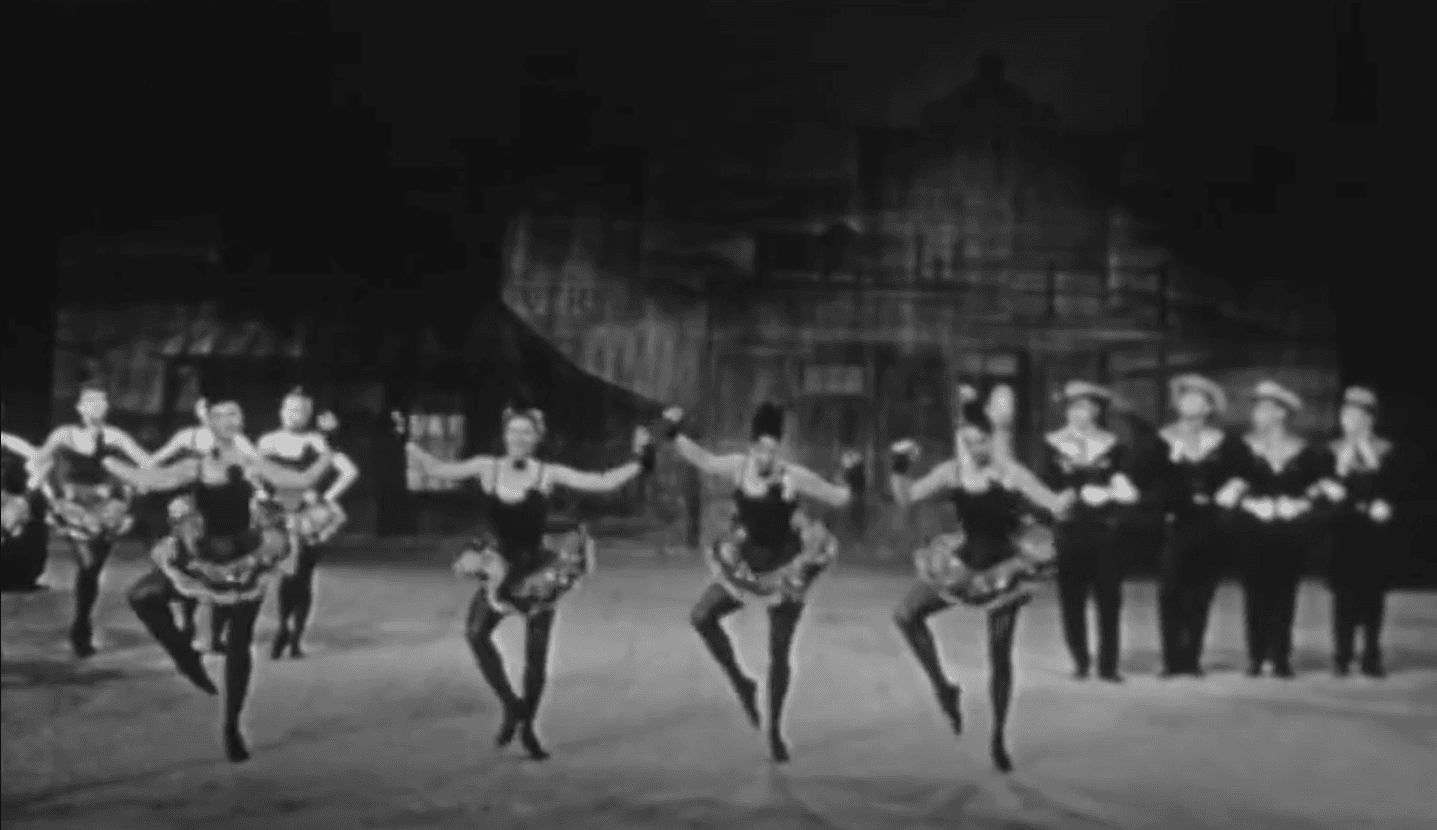
United States Information Service — https://www.ina.fr/ina-eclaire-actu/video/vdd11021500/western-symphony · Public domain
Western Symphony is a plotless, four-movement ballet George Balanchine made for New York City Ballet in 1954, set to American folk tunes arranged and orchestrated by Hershy Kay. It transposes the vocabulary and structure of the nineteenth-century classical ballet onto an imagined Western saloon setting, with cowboys and dance-hall girls standing in for the princes and swans of the Romantic repertoire. It premiered in practice clothes with no scenery, the designs (John Boyt sets, Karinska costumes) following a year later.
What it contains
- Classical Ballet — Adagio (Waltz) · Adagio (Waltz), the second movement — A duet built around pointe-based partnering that directly quotes Romantic-era ballet vocabulary, staged as parody rather than tragedy, with a corps standing in for a classical ensemble. Source: "It is almost a satire on classical ballet with imitations of Giselle and Swan Lake (second movement)."
- Neoclassical Ballet · The whole ballet — A plotless, episodic structure of successive dance statements rather than mimed narrative, explicitly compared by the article to Serenade, Balanchine's own foundational plotless ballet. Source: "The ballet follows no plot but presents several short stories throughout the ballet (similar to Serenade) outside a saloon."
- Classical Ballet — Scherzo · Scherzo (third movement, later removed) — High-difficulty female pointe bravura, technically demanding enough that the movement was dropped from performance rather than simplified. Source: "The Scherzo was removed ca. 1960 due to the complex nature of the female bravura dancing required."
- Classical Ballet — Allegro · Allegro, nested pas de deux — A full classical adagio pas de deux for the lead couple embedded inside the faster ensemble movement, requiring sustained pointe balances and partnering distinct from the surrounding allegro footwork. Source: "There is an extended Adagio pas de deux section in the Allegro"
What is danced
The article frames the ballet as episodic rather than narrative: 'The ballet follows no plot but presents several short stories throughout the ballet (similar to Serenade) outside a saloon,' with the choreography built as a sequence of ensemble and pas de deux statements rather than a story told through mime. Balanchine treats the four movements as classical-ballet forms in disguise: the Allegro is a long (roughly ten-minute) ensemble for four men, two groups of four women, and a lead couple, and contains within it 'an extended Adagio pas de deux section' — a full classical pas de deux nested inside a fast movement. The second movement, the Adagio (Waltz), is a night-set duet for the lead couple with four women dancing the role of horses, structured as a chase-and-elude flirtation, and the article notes it is here that the choreography most directly quotes Romantic-era ballet, since the piece is 'almost a satire on classical ballet with imitations of Giselle and Swan Lake (second movement).'
The removed Scherzo demanded, in the article's words, 'the complex nature of the female bravura dancing required' — pointing to a solo or small-ensemble passage built on high-difficulty pointe bravura, technically severe enough that it dropped out of the standard staging by around 1960. The closing Rondo returns the full cast to the stage behind the lead couple, functioning as the finale. Overall the piece asks for the same classical technique (pointe work, sustained adagio partnering, allegro ensemble precision) that underlies Romantic and Petipa-style ballet, but stripped of mime and narrative and pushed toward speed, wit and structural parody rather than storytelling.
Context
The work belongs to the first decade of New York City Ballet, the company Balanchine co-founded, and to his ongoing project of building a plotless, structurally driven American ballet repertory — the same impulse behind Serenade, to which the article explicitly compares it. Premiering the piece in practice clothes without scenery, only adding designs the following year, reflects the company's characteristic mid-1950s presentation style, where the dancing itself, not decor, carried the work. Its use of American vernacular material (Western folk tunes reorchestrated symphonically) alongside quotations of Giselle and Swan Lake positioned it as a deliberately American answer to European Romantic and Imperial ballet convention.
Staging history
Scenery by John Boyt and costumes by Karinska were added in 1955, a year after the unadorned 1954 premiere, with lighting originally by Jean Rosenthal and later by Mark Stanley. The ballet originally had four movements, but the Scherzo was dropped from the repertory around 1960 because of the extreme bravura demands it placed on the female dancers, leaving the three-movement version now normally performed. It has been broadcast repeatedly in excerpt form — Australian television (1958), French television (1977), and several PBS Dance in America programs (1984, 1990, 1993) and BBC 2 (1993) — almost always via the Rondo or Adagio movements, and was filmed in 1955 and issued on video by The Balanchine Library (1996) and Kultur (2004); a 1959 Kapp Records LP paired it with Stars and Stripes.
How to watch it
Watch the Adagio (Waltz) for its direct citation of Giselle and Swan Lake staged as flirtatious comedy rather than tragedy, and notice how the four women dancing 'horses' recast the corps-de-ballet convention. In the Allegro, watch for the shift from fast ensemble dancing into a full classical pas de deux and back — the movement titles (Allegro, Adagio, Rondo) are named after their music but the choreography frequently runs against that tempo. There is no story to follow; the piece is best read as a set of dance statements framed by a saloon setting.
Structure
- AllegroAn extended (about ten-minute) ensemble for four cowboys, two groups of four women, and a lead couple, containing a nested classical Adagio pas de deux.
- Adagio (Waltz)A night-set duet for the lead couple and four women representing horses; the cowboy pursues the lead woman, who flirts, eludes him, and leaves alone.
- ScherzoA bravura movement for the women, removed from the ballet around 1960 owing to its technical difficulty.
- RondoA finale for a lead couple and the full company.
Structure read from an encyclopaedia article, not from a libretto or score we hold. Confirm against a programme before treating the numbering as authoritative.
Credits
- composer: Hershy Kay
More from George Balanchine
Other staged works in the register connected to this one by author or lineage.
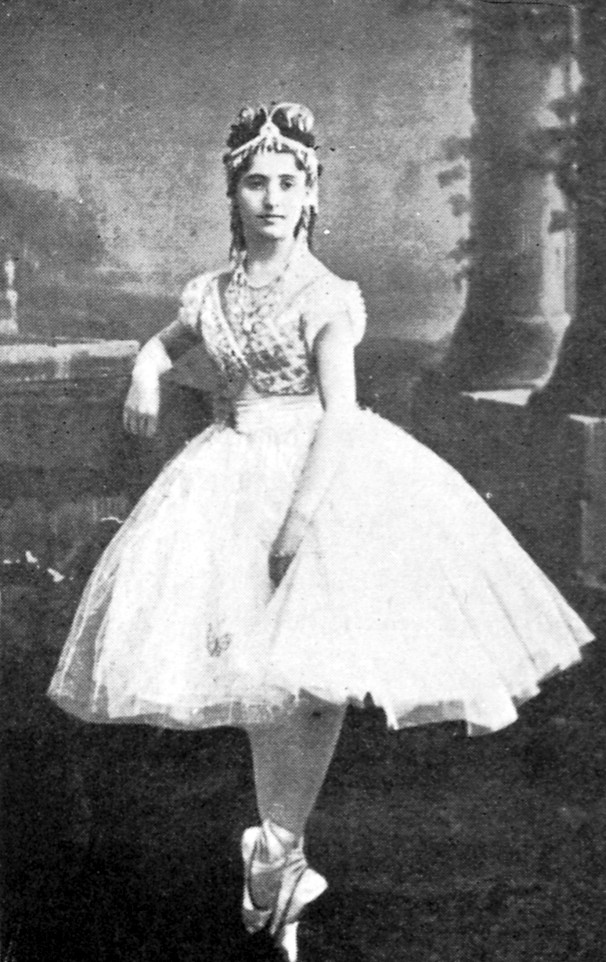 CoppéliaBallet · 1870Balanchine · video
 ApolloBallet · 1928Balanchine · video
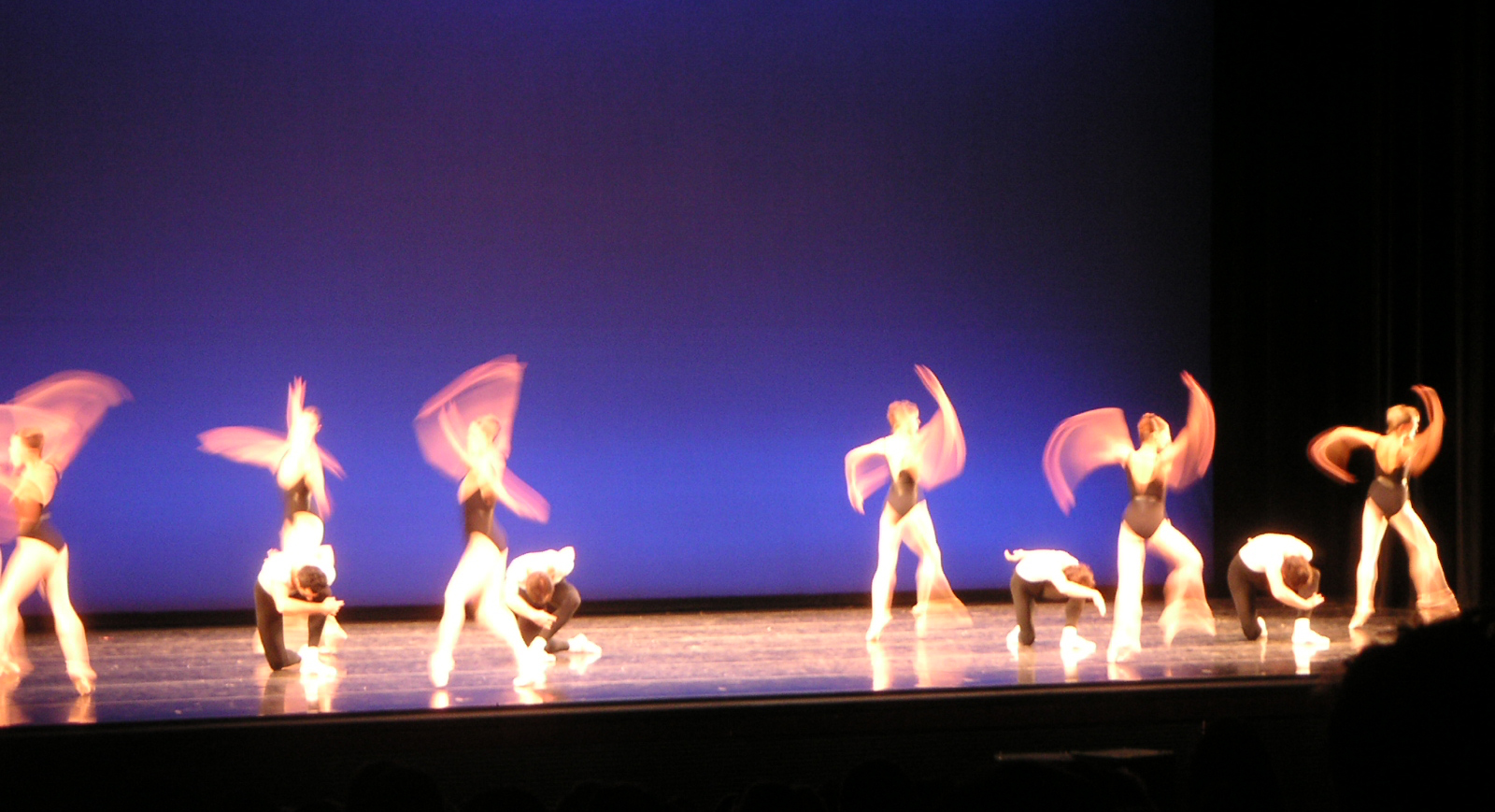 AgonBallet · 1957Balanchine · video
 Le chant du rossignolBallet · 1920Balanchine · video
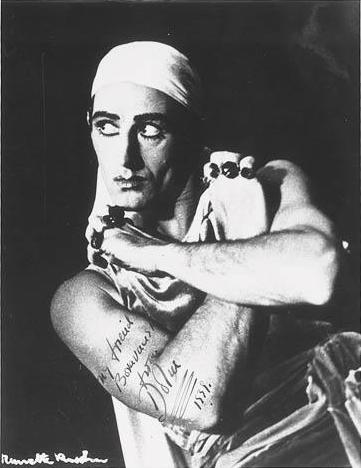 The Prodigal SonBallet · 1929Balanchine · video
 The Seven Deadly SinsBallet · 1933Balanchine · video
 FaçadeBallet · 1931Same lineage · video
 The FloodBallet · 1962Balanchine · video