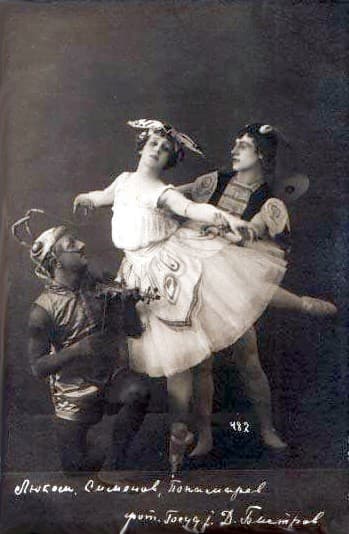
Дмитрий Иванович Быстров (1875-1927) — Photo comes from my collection and was scanned by me. Mrlopez2681. · Public domain
The Whims of the Butterfly is a one-act ballet made by Marius Petipa to music by Nikolai Krotkov, with a libretto Petipa drew from Yakov Polonsky's poem 'The Grasshopper Musician.' It was created as an occasional court piece, first given privately at Peterhof Palace in June 1889 to mark the wedding of Grand Duke Pavel Alexandrovich to Princess Alexandra of Greece, then given a public premiere at the Imperial Mariinsky Theatre that October with the same cast.
What it contains
- Classical Ballet · the whole one-act ballet — Made by Petipa for the Imperial Ballet in 1889, in the same institutional and stylistic context as his grand classical repertory, with a ballerina-led principal pairing (Butterfly/Phoenix Moth) typical of the Petipa era's pointe-based idiom Source: "with choreography by Marius Petipa, and music by Nikolai Krotkov"
What is danced
The article gives a cast list rather than a synopsis, so the actual steps danced are not described. What can be read from it is the shape of the piece: a small ensemble of insect and animal characters — Butterfly, Phoenix Moth, Grasshopper, Fly, Spider, Nightingale — built around a ballerina lead (Nikitina, later Roslavleva) opposite a principal danseur (Pavel Gerdt, later Nikolai Legat) as the Phoenix Moth, with the supporting insect roles taken by dancers associated with character and mime work.
Context
1889 falls in the middle of Petipa's long tenure as chief choreographer of the Imperial Ballet, the same years in which he was also building the grand multi-act repertory (Sleeping Beauty followed the next year). Short, occasional works like this one were part of the everyday output of the Imperial theatres for court and dynastic events, sitting alongside the full-evening ballets rather than instead of them.
Staging history
The ballet was created for the Imperial Ballet, premiered at the court theatre of Peterhof in June 1889, then transferred to the Mariinsky Theatre for the general public that autumn with the same principal cast. Petipa revived it himself in November 1895 at the Mariinsky with a substantially new cast, including Lyubov Roslavleva as the Butterfly and Enrico Cecchetti as the Grasshopper. Petipa's choreography was recorded by the Imperial Ballet's régisseur and notators in Stepanov notation and survives today in the Sergeyev Collection.
How to watch it
Because the article supplies no synopsis or number-by-number breakdown, there is nothing here to point a viewer toward specific steps; treat the surviving information as a documentary trace (cast, dates, notation source) rather than a performance guide. Anyone encountering a staging should watch for how the insect characters are differentiated by role type — predator, prey, musician, singer — since that contrast is built into the libretto's source poem even though the article does not describe the movement itself.
Credits
- composer: Nikolai Krotkov
More from Marius Petipa
Other staged works in the register connected to this one by author or lineage.
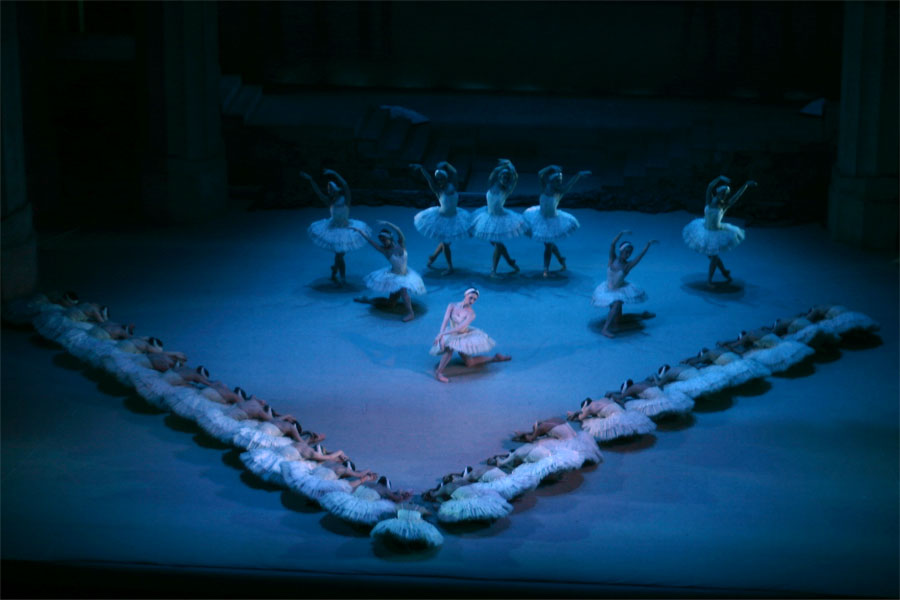 Swan LakeBallet · 1877Petipa · video
 The NutcrackerBallet · 1892Petipa · video
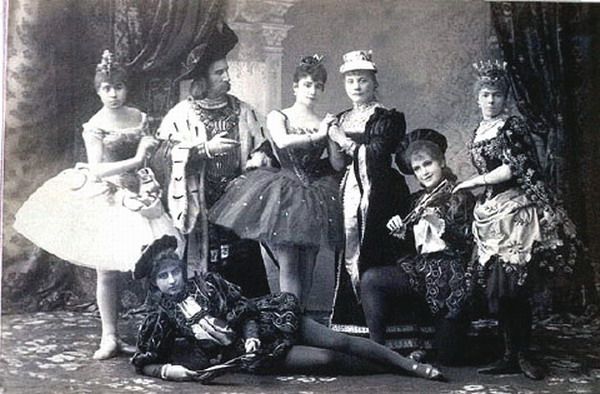 The Sleeping BeautyBallet · 1890Petipa · video
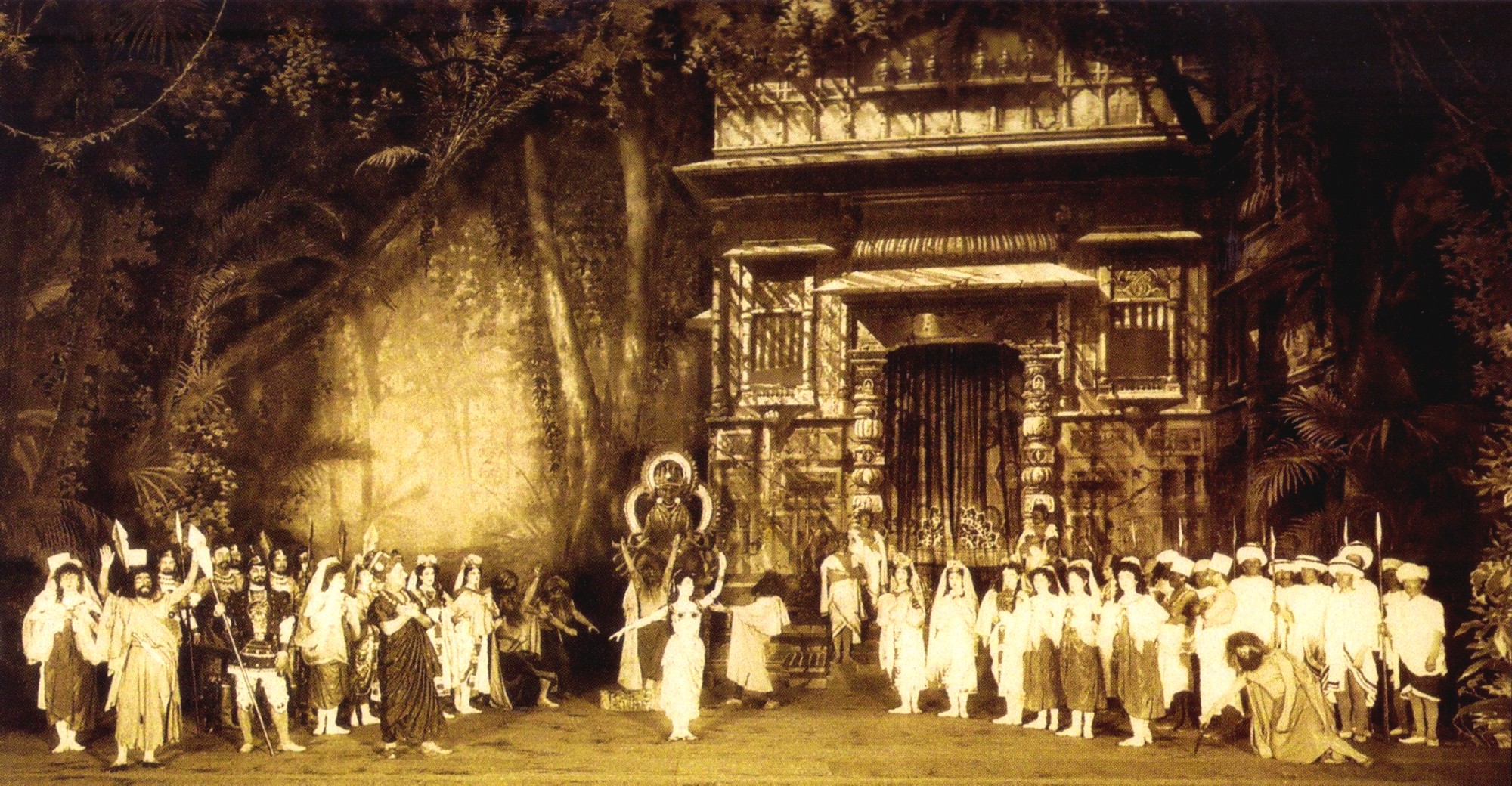 La BayadèreBallet · 1877Petipa · video
 Don QuixoteBallet · 1869Petipa · video
 RaymondaBallet · 1898Petipa · video
 FaçadeBallet · 1931Same lineage · video
 Western SymphonyBallet · 1954Same lineage · video