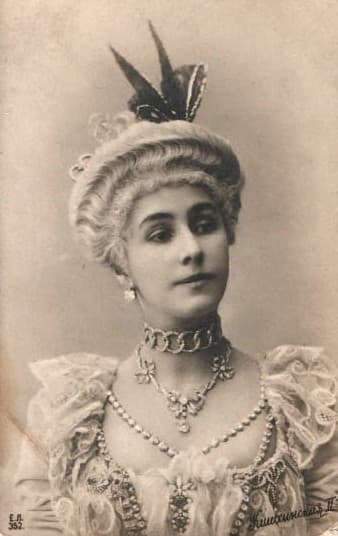
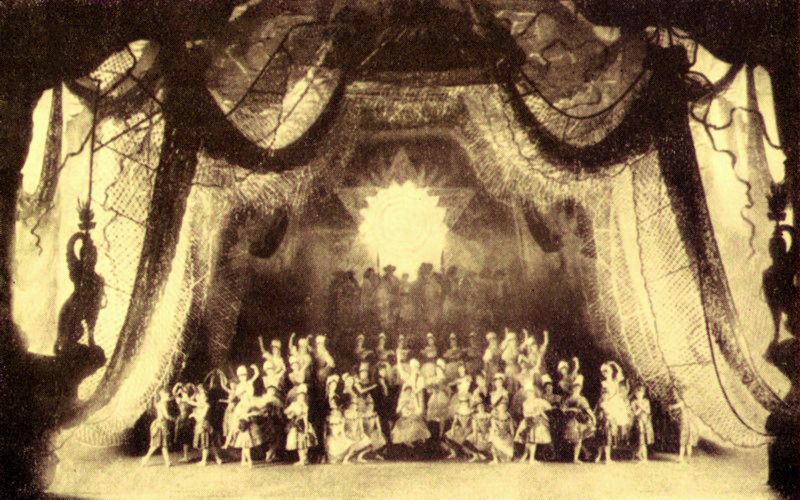
Unknown, Imperial Mariinsky Theatre · Public domain
Camargo is a grand ballet in three acts and nine scenes, choreographed by Marius Petipa to a score by Ludwig Minkus, with a libretto by Jules-Henri Vernoy de Saint-Georges and Petipa himself. It dramatizes a real incident from the life of the 18th-century dancer Marie Camargo: her abduction, together with her sister Madeleine, by the Comte de Melun in May 1728. It premiered with the Imperial Ballet on 7/19 December 1872 at the Imperial Bolshoi Kamenny Theatre in St. Petersburg.
What is danced
The source article does not describe the choreography, the vocabulary danced, or any scene-by-scene breakdown of dances. It names the principal roles at both the 1872 premiere and the 1901 revival — Marie Camargo, her sister Madeleine, 'Vestris, the Maître de Ballet' (a character representing the real-life ballet master Gaëtan Vestris), and the Comte de Melun — but gives no indication of what steps, holds, or technical demands these roles carried on stage. Without a synopsis, programme, or scholarly account of the choreography, nothing about pas, mime, or set pieces can be responsibly claimed here.
Context
The article situates the ballet only through its date, venue and creators, without commentary on its place in the broader development of Imperial Ballet repertoire.
Staging history
The premiere cast was led by Adèle Grantzow as Marie Camargo, with Alexandra Virginia as Madeleine, Lev Ivanov as Vestris, and Timofei Stukolkin as the Comte de Melun. The ballet was revived by Lev Ivanov, Petipa's second ballet master, for the Imperial Mariinsky Theatre on 17–30 January 1901, staged specifically as the farewell benefit performance for prima ballerina assoluta Pierina Legnani before her departure for Italy; that cast starred Legnani as Marie Camargo, Olga Preobrajenskaya as Madeleine, Pavel Gerdt as Vestris, and Georgii Kiaksht as the Comte de Melun.
How to watch it
Approach this as a biographical narrative ballet rather than a plotless showcase: the drama turns on an abduction plot involving named historical figures (Camargo, her sister, the Comte de Melun, and the ballet master Vestris), so character and mime relationships likely carry as much weight as any set dances. The article gives no further guide to specific numbers or technical highlights, so a viewer should treat any claims about its choreographic content with caution absent a fuller staging record or score analysis.
Credits
- composer: Ludwig Minkus
Related works
Other staged works in the register connected to this one by author or lineage.
 Swan LakeBallet · 1877Petipa · video
 The NutcrackerBallet · 1892Petipa · video
 The Sleeping BeautyBallet · 1890Petipa · video
 La BayadèreBallet · 1877Petipa · video
 Don QuixoteBallet · 1869Petipa · video
 RaymondaBallet · 1898Petipa · video
 The Whims of the ButterflyBallet · 1889Petipa
 The Magic PillsBallet · 1886Music by Minkus