25 works in this view — arrow keys or swipe to move between them.
Dance in Art
Dancing Couple
Jan Steen
- Medium:
- oil on canvas
- Era:
- Pre-1700 (Renaissance/Baroque)
- Source:
- Wikimedia Commons
- Rights:
- Public domain — free to use, share and adapt.
- Recorded as:
- public_domain
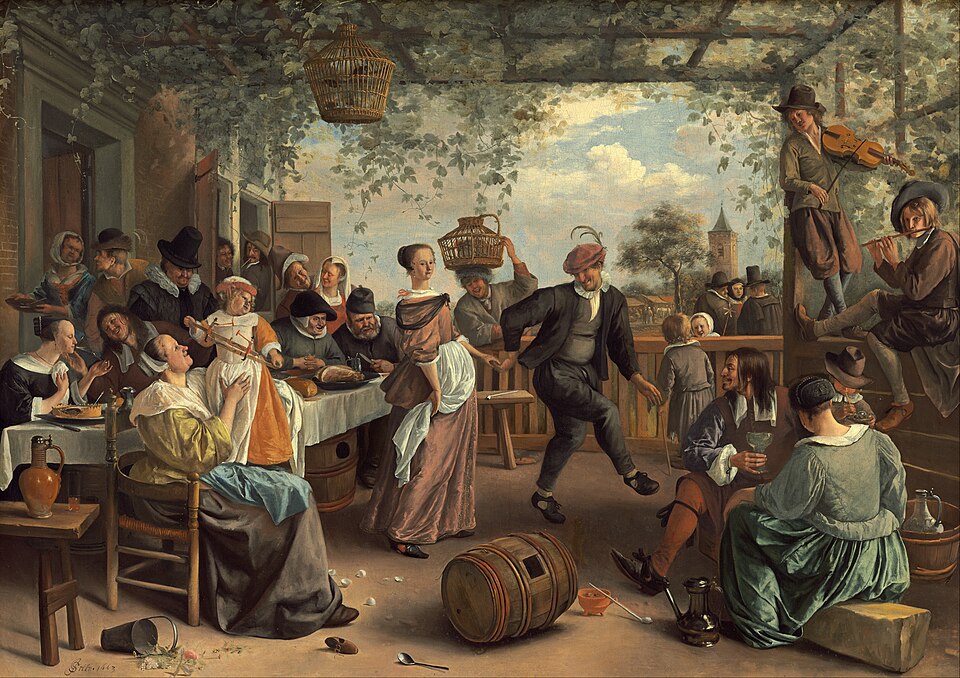
This is one of the most specific visual records of 17th-century folk dance practice: the costumes, the hold, the spatial relationship between partners, and the social context are all legible and consistent with what we know from dance manuals and surviving traditions. It shows dance not as an elite accomplishment but as an essential social technology—a way for people to assert joy, attract attention, and belong to a community. The painting's status as a serious artwork, signed by a major painter and preserved as a major work, testifies to the cultural importance of this moment, even if the moment itself is small and local.
What you are looking at
A village celebration unfolds under a vine-draped pergola, with a couple dancing at the center of a densely packed gathering of rural people. The man wears dark breeches and a tan doublet; the woman a brown skirt with a white apron and linen headcloth. They occupy the open floor of what appears to be a farmyard or cottage courtyard. Around them, figures sit at tables laden with food and drink—pitchers, glasses, and baskets of provisions visible—while others stand, gesture, and watch. The composition radiates outward from the dancers: musicians play (a violinist stands to the right), children scatter at ground level, and the architecture frames the scene—a cottage wall and shuttered window on the left, a distant landscape with a church tower visible through the pergola's opening. The light is warm and diffuse, suggesting late afternoon. The scene captures not a formal dance but a moment of spontaneous celebration, with the couple's energetic movement the focal point amid general merrymaking.
The dancing
The couple dances in a loose, upright position without a closed ballroom hold. The man's posture is relaxed and animated, his legs in motion; the woman's body turns toward him, her skirts flared by the movement. Their positioning suggests a country dance where partners move together but with space between them—characteristic of folk dances where contact is minimal and movement is driven by the legs and torso. The woman's weighted stance and the man's forward momentum suggest a step-and-turn pattern rather than a fixed frame. Other figures gesture with raised arms, point, and lean forward to watch, their attitudes mimicking or encouraging the dancers.
The dance depicted
This depicts a Dutch village dance of the mid-17th century, most likely a country or folk celebration rather than a learned courtly form. The costumes, setting, and the informal raised-heel movement visible in the man's posture all point to a vernacular couple-dance of the type common in northern Europe at harvest or festival time. The presence of a violin and the outdoor setting are typical of folk celebration contexts. The painting captures the social function of dance—as entertainment, courtship display, and community gathering—rather than technical virtuosity. The dance itself appears to be a simple turning and stepping pattern, executed with joy rather than formality.
How it was made
Oil on canvas, as recorded. Steen's technique here is one of densely interlocked figures and warm, amber-toned light that unifies the composition despite its crowded surface. The medium allowed Steen to render the textures of cloth, the play of light on skin and fabric, and the spatial recession from foreground figures to the distant landscape. The painting's scale and finish suggest it was made for a wealthy patron's domestic collection, not for public display, which shapes its intimate, observational tone. The technique reveals careful compositional control beneath the apparent disorder—every figure and object plays a role in drawing the eye toward the dancing couple.
About this work
Jan Steen's *Dancing Couple* is a document of vernacular social dance in the Dutch Golden Age, painted around 1663. It captures not a theatrical or court performance but the ordinary, joyful eruption of dance at a rural gathering—a moment when music, food, drink, and movement combined in communal celebration. The work belongs to a small body of Dutch genre paintings that treat dance as a subject worthy of serious artistic attention, worthy of the same oil-on-canvas medium and compositional sophistication as history or portraiture. For a gallery of dance in art, it answers a crucial question: what did ordinary people's dance look like when no one was teaching it, and how did artists of the period understand and value it?
How to look at it
Look first at the freeze-frame quality of the image: Steen has caught the dance mid-movement, with the couple's bodies in asymmetrical, dynamic positions and the surrounding figures in attitudes of attention and response. This creates a sense of a moment interrupted, as if the viewer has just stepped into the celebration. Notice next how the light guides your eye: the warm glow picks out the dancing couple's faces and limbs against the darker ground and architecture, making them the inevitable focal point even though they are surrounded. Finally, observe the costumes and their precision: the woman's linen headcloth, the man's doublet, the aprons and caps of the onlookers are all rendered with specificity that suggests Steen was recording authentic dress, not inventing it. This visual specificity is your guide to what 17th-century folk dance actually looked like.
The artist
Jan Steen (1626–1679) was a prolific Dutch Golden Age painter known for genre scenes of everyday life, taverns, households, and village celebrations. He worked primarily in Leiden and The Hague and developed a distinctive style combining narrative incident, moral wit, and precise observation of costume and behavior. Many of his works depict revelry, intoxication, and dancing, often with a moralizing undertone—yet his technical skill and compositional sophistication ensure these scenes are never merely cautionary. Steen's interest in dance scenes places him in a tradition that includes Pieter Bruegel the Elder; he was one of the few major painters to treat vernacular dance as a serious subject. His paintings were sought after by wealthy collectors in his own time.
The period
In the 1660s, dance in Europe existed in two nearly separate worlds. The nobility and educated elite practiced formalized, rule-based dances codified in printed manuals—the pavane, galliard, courante, and other Renaissance and early Baroque forms. Meanwhile, common people danced to the music of whatever instruments were at hand, following local tradition and improvisation. Dutch Golden Age painting had developed a taste for depicting both courtly and common life, and artists like Steen treated rural and urban entertainments with the same compositional care as history paintings. The village dance was also becoming a subject of cultural anxiety: moralists and religious authorities condemned dance as potentially lascivious or demonic, which may explain why artists like Steen felt compelled to document it closely and paint it with sympathy.
Where it lives
The catalogue record indicates the work is oil on canvas, dated 1663, but provides no current holding institution or accession number. The image source is Wikimedia Commons.
Dance in this work
Questions about this work
How do we know what dance this is?
We cannot name it with certainty—17th-century folk dances were learned by imitation and varied by region. But the hold (loose and upright), the footwork visible in the figures' postures (stepping and turning rather than gliding), the instruments (a fiddle), and the setting (an outdoor celebration) all point to the kind of country or village dance common across northern Europe. The painting is valuable precisely because it shows us the physical reality of such a dance when written sources are silent.
Was this a real party or a moral lesson?
Probably both. Steen painted many celebration scenes, and art historians debate whether he intended moral criticism of drunkenness and revelry or whether he was simply documenting the life he saw. The painting's energy and compositional care suggest genuine affection for the subject rather than mere moralizing—but the tension between celebration and potential excess was real in 17th-century culture. What matters for dance history is that Steen took the scene seriously enough to render it with precision.
What can we learn from the clothing?
The costumes tell us that folk dancers wore their everyday garments, not special dress—the doublets, skirts, aprons, and headcloths are rural working clothes of the period. This contrasts sharply with the elaborate costumes required for courtly dances and confirms that folk dance was an extension of daily life rather than a separate, formal activity. The specificity of Steen's rendering allows costume historians and dance scholars to reconstruct authentic 17th-century village dress.
Who would have seen this painting?
Oil paintings of this scale and quality were made for wealthy collectors—merchants, minor nobility, urban patricians with enough disposable income to commission or purchase art. Steen's paintings were highly valued in his own time. So while the *subject* of the painting is a village celebration, the *audience* was educated, urban, and likely positioned socially above the people being depicted—a gap that makes the painting's respectful, detailed treatment of folk life even more significant.
More dance artwork