49 works in this view — arrow keys or swipe to move between them.
Dance in Art
Black Crook waltzes
Unknown artist
- Medium:
- Lithograph
- Dance:
- Waltz
- Era:
- Early 1800s (Waltz Revolution)
- Source:
- New York Public Library
- Rights:
- Public domain — free to use, share and adapt.
- Recorded as:
- public_domain
The Black Crook was the most commercially successful theatrical production of its time in America, running for over a year and spawning multiple touring versions. This lithograph is direct evidence of how a major popular entertainment staged the waltz and ballet for mass consumption—not as social dances but as spectacular, otherworldly performance. For anyone studying the waltz in America, or theatrical spectacle in the 1860s, this image is primary source material.
What you are looking at
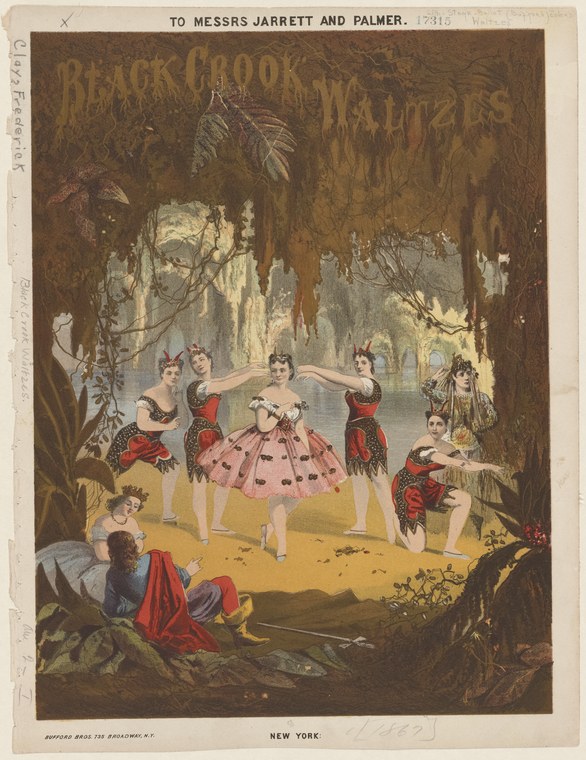
A theatrical scene set in a forest glade, with hanging willow branches framing a luminous clearing where supernatural creatures and dancers perform. In the foreground at left, a recumbent figure in red drapery watches the action. Center stage, a corps of six female dancers in elaborate costumes—some wearing pink or red tutus with insect-like or fairy wings, others in red and black—perform together in the dappled light. The setting appears magical and nocturnal, with dark foliage above and pale ground below suggesting moonlit clearings. The figures wear stage makeup and elaborate headdresses; the composition is steeply raked, emphasizing theatrical depth.
The dancing
The dancers stand upright in a loose formation across the stage floor, their bodies oriented toward the viewer in a relatively frontal tableau. Several have raised arms and extended limbs suggesting buoyant or weightless movement. The figures wear the full tutus and heeled shoes of mid-19th-century theatrical dance, and their poses suggest sustained, elegant positions rather than rapid footwork. The recumbent male figure at left appears to be an audience surrogate, positioned to draw our gaze toward the performers.
The dance depicted
This is a scene from *The Black Crook*, the 1866 New York musical extravaganza that became one of the most popular theatrical productions of its era. The lithograph depicts the supernatural dance sequences that were central to the show's appeal—ethereal, otherworldly performances by the corps de ballet in elaborate fantastical costumes. The work represents the theatrical waltz as a staged spectacle rather than a social ballroom dance, embedded in narrative fantasy and performed for an audience. The emphasis on corps work, uniform costuming, and scenic design places this squarely in the theatrical ballet tradition of the mid-Victorian stage.
How it was made
This is a hand-colored lithograph, a mass-production technique ideal for theatrical promotion and souvenirs in the 1860s. The title and publication credit (Strobridge Bros. N.Y., New York) are printed at top and bottom. Lithography allowed soft tonal effects—the atmospheric rendering of light in the forest, the subtle shading of fabric and flesh—while maintaining the bold outlines and bright colors essential to theatrical advertisement. The technique placed this image within the commercial entertainment industry, likely sold as a souvenir at the theater or through music publishers.
About this work
This lithograph documents a performance moment from *The Black Crook*, the sensation of the 1866 American theatrical season. The work captures the spectacular ballet sequences that defined the show: a supernatural corps de ballet in elaborate costume, positioned in a magical landscape, performing the kind of ethereal movement that characterized mid-Victorian theatrical dance. It is a record of a specific production rather than a study of dance technique, yet it testifies to how thoroughly the waltz and balletic spectacle had penetrated American popular entertainment by the Civil War era. The image belongs in a dance history because it shows us what audiences paid to see, and what the American stage understood dance to be.
How to look at it
Notice how the lithographer positioned the dancers in a loose group formation rather than in the tight lines or couples that characterize ballroom waltz instruction. The moment frozen is one of elegant floating rather than turning or stepping—the bodies are poised and lifted, not engaged in the pivoting motion of actual waltzing. This is spectacle waltz, where the dance is visual decor and narrative element rather than an exercise in social technique. The supernatural setting—the dark foliage, the magical glade—signals to the viewer that this is not real social dance, but theatrical transformation. The figure reclining in the foreground invites us to join him in beholding this spectacle.
The artist
The work is credited to Strobridge Bros., a major theatrical lithography house active in New York in the 1860s–1880s. Strobridge produced thousands of theatrical posters, playbills, and souvenir prints; the firm was known for bright color work and dynamic composition. This print represents their standard commercial output—high-quality but designed for rapid production and mass sale rather than artistic distinction.
The period
The Black Crook premiered at Niblo's Garden in New York in September 1866, just after the Civil War, and ran for 474 performances—an extraordinary run for the era. The production was a hybrid spectacle: a melodramatic plot about a sorcerer's curse, combined with elaborate ballet numbers, acrobatic feats, and scenic machinery. It arrived in America at the moment when Romantic ballet was declining in Europe but spectacular theatrical dance was booming in America. The work appeared just as American theater was beginning to develop its own distinctive forms rather than importing European models wholesale. Waltzes and waltz-like dances had become standard theatrical fare by mid-century, though still performed by actresses and dancers in elaborate costumes rather than as the ballroom social practice.
Where it lives
This lithograph is held in the New York Public Library collection, catalogued as a theatrical souvenir and promotional print from the 1866 production of The Black Crook. Such prints were sold at the theater, in music shops, and through the postal service, making them accessible to a broad public audience.
Dance in this work
Questions about this work
What is The Black Crook?
The Black Crook was an American theatrical spectacle that premiered in New York in 1866, combining melodrama with elaborate ballet, acrobatics, and scenic effects. It became the longest-running theatrical production in America up to that time and established a template for theatrical dance spectacle that influenced American entertainment for decades. The production was famous for its supernatural scenes and elaborate costumes.
Is this an actual waltz being danced?
Not in the ballroom sense. This is theatrical waltz—a staged dance performance using the name and some elements of waltz choreography, but designed as spectacle and narrative rather than as social dance instruction. The dancers are in character as supernatural beings, and the movement is carefully posed for visual effect rather than as an exercise in ballroom technique.
Who made this print and why?
This is a commercial lithograph produced by Strobridge Bros., a major New York theatrical print house. Such prints were sold as souvenirs to audience members and in music shops, allowing people who had not seen the show to own an image of it, and serving as promotion for the production and touring companies.
Why is there someone lying down in the foreground?
That figure is likely part of the theatrical narrative—possibly a bewitched character—but it also functions compositionally to draw the viewer's eye toward the corps of dancers and to position us as observers of a magical scene. This was a common device in theatrical lithographs of the era.
More Waltz artwork