49 works in this view — arrow keys or swipe to move between them.
Dance in Art · 2019
Ancient dancing
Unknown artist
- Medium:
- Source:
- New York Public Library
- Rights:
- Public domain — free to use, share and adapt.
- Recorded as:
- public_domain
This work documents the profound influence of classical antiquity on European dance aesthetics in the period when modern ballet was forming. For historians and dancers, it shows how the ideal of the antique body—posed, rational, and harmonious—shaped what professionals believed dance should look like and express. The technical virtuosity of the engraving also demonstrates how seriously prints were deployed to circulate and legitimize dance as an art form.
What you are looking at
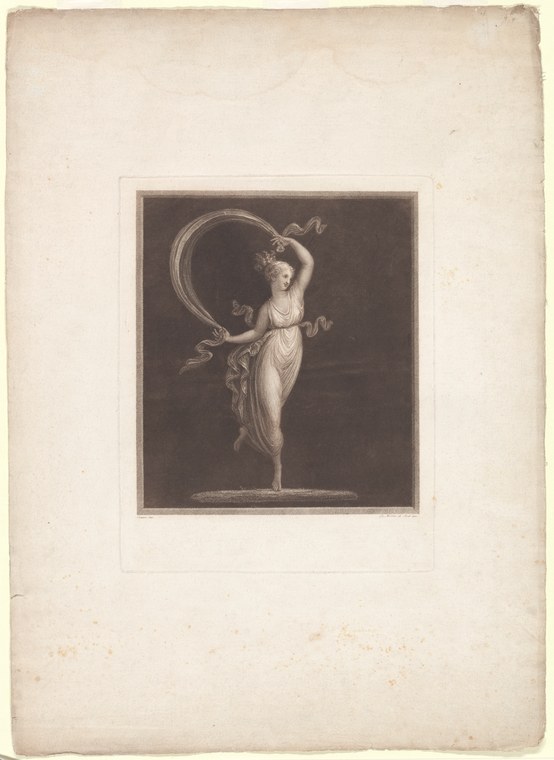
A single female figure stands in contrapposto against a dark background, her body arched gracefully in a pose of classical elegance. She wears a diaphanous Greco-Roman drapery that falls from one shoulder, leaving the torso partially exposed in the manner of ancient sculpture. Her left arm is raised above her head in a curved gesture; her right arm is extended outward. Her weight rests on one leg while the other bends, creating an S-curve through the body. She stands alone on a small ground line, her figure illuminated against the dark ground, rendered in fine tonal gradation that suggests the technique of engraving or stipple printing. The composition is austere and focused entirely on the single dancer and the expressiveness of her pose.
The dancing
The dancer's body demonstrates the classical contrapposto stance: weight shifted onto one supporting leg while the other relaxes, creating a natural curve through hips and spine. The raised arm curves gracefully overhead in a gesture suggestive of both repose and dynamism. The extended opposite arm balances the composition. The drapery clings and flows, revealing the underlying musculature and the line of the body. The pose suggests a moment of suspended motion rather than active stepping or turning—a held attitude of classical poise.
The dance depicted
This work depicts idealized classical dance in the neoclassical taste of the late 18th or early 19th century. The subject appears to be interpretive or theatrical movement modeled on Greek and Roman precedent, rather than a specific contemporary dance form. The single figure and the emphasis on sculptural pose align with pantomimic or ballet d'action conventions of the Romantic era, where solo female dancers performed mythological or classical subjects in attitudes of emotional and physical grace. The lack of a partner, the theatrical isolation, and the classical allusion suggest this may represent a famous solo or a generic 'ancient dancer'—a figure of aesthetic aspiration rather than documented social practice.
How it was made
This is a fine engraving or stipple engraving, evident from the delicate tonal modeling built from tiny dots and lines rather than continuous marks. The technique allows extraordinary subtlety in rendering the play of light on drapery and flesh, and was favored for reproductive prints and high-quality illustration in the late 18th and early 19th centuries. The print has been carefully pulled and the plate cut to size; the work is mounted on larger cream paper as was standard practice for fine prints. The medium suggests a work of some prestige, intended for an educated audience with means to purchase original or early impressions.
About this work
This engraving presents a solitary female dancer in classical dress, captured in an attitude of grace and repose. The work exemplifies the neoclassical revival in European art and dance, a period when artists and performers turned to Greco-Roman antiquity for aesthetic models. The isolated figure, the emphasis on sculptural pose over narrative action, and the refined technique all mark this as a work of high art rather than popular entertainment—a print made for collectors and students of dance and the classical ideal.
The work sits within a tradition of representing dance as an expression of beauty and virtue through the body's geometry and line. It belongs to the era when ballet was establishing itself as the preeminent form of theatrical dance, and when the female body in motion was increasingly treated as a subject worthy of serious artistic attention. The print circulated ideas about grace, proportion, and the aesthetics of movement to a wider audience than the theater alone could reach.
How to look at it
Attend to the pose itself: the artist has chosen a moment of stillness and balance rather than of vigorous movement, emphasizing the line and proportion of the body over the energy of action. Notice how the drapery both reveals and eloquates the form beneath it—a key principle of neoclassical aesthetics, which valued the body's geometry. The raised arm and extended limbs create a pattern of curves that the eye can follow; this compositional grace was considered essential to beauty in both sculpture and dance. The dark ground isolates the figure entirely, making her form the sole focus and giving her the status of a classical sculpture come to life.
The period
The late 18th and early 19th centuries saw a Europe-wide embrace of neoclassicism as a reaction against Rococo excess. In dance, this meant a turn toward greater simplicity, nobility, and formal restraint—ideals embodied in the work of choreographers like Jean-Georges Noverre and realized by dancers such as Marie Taglioni. The ballet d'action, which sought to tell stories through dance without words, looked to classical myth and classical art for both subject matter and the vocabulary of gesture. Engravings and lithographs of dancers became a major form of art production and consumption, allowing the image of the ideal dancer to circulate far beyond those who could attend performances. This print reflects a moment when the dancer's body was being consciously aligned with the standards of high art and academic beauty.
Where it lives
The work is held in the New York Public Library collection and was digitized as part of their broader effort to make historical prints accessible. It is catalogued simply as a print of unknown artist and date, suggesting it entered the collection as part of a larger accession or acquisition of historical dance imagery.
Dance in this work
Questions about this work
Is this a real dancer or an imagined figure?
It is almost certainly imagined—an idealized representation of how an educated artist of the neoclassical period believed an 'ancient dancer' should look and move. The pose is too perfectly balanced and too explicitly sculptural to be drawn from life or performance. It represents an aesthetic ideal rather than documentation of what anyone actually danced.
What dance style is this?
No single style. The image draws on classical dance vocabulary—the contrapposto, the lifted carriage, the expressive arm—but applies it to a figure dressed in Greco-Roman costume and posed as if she were a living sculpture. It belongs to the world of neoclassical ballet and pantomimic dance of the Romantic era, but does not depict a specific named dance or form.
Why is she alone?
The isolation focuses attention entirely on the beauty and expressiveness of the individual body. This was a key feature of the Romantic ballet ideal: the soloist, usually a woman, as the embodiment of grace and virtue. Solo performances of classical or mythological subjects were popular in this period.
More dance artwork