35 works in this view — arrow keys or swipe to move between them.
Dance in Art
Ballroom scenes
Unknown artist
- Medium:
- Dance:
- Ballroom
- Source:
- New York Public Library
- Rights:
- Public domain — free to use, share and adapt.
- Recorded as:
- public_domain
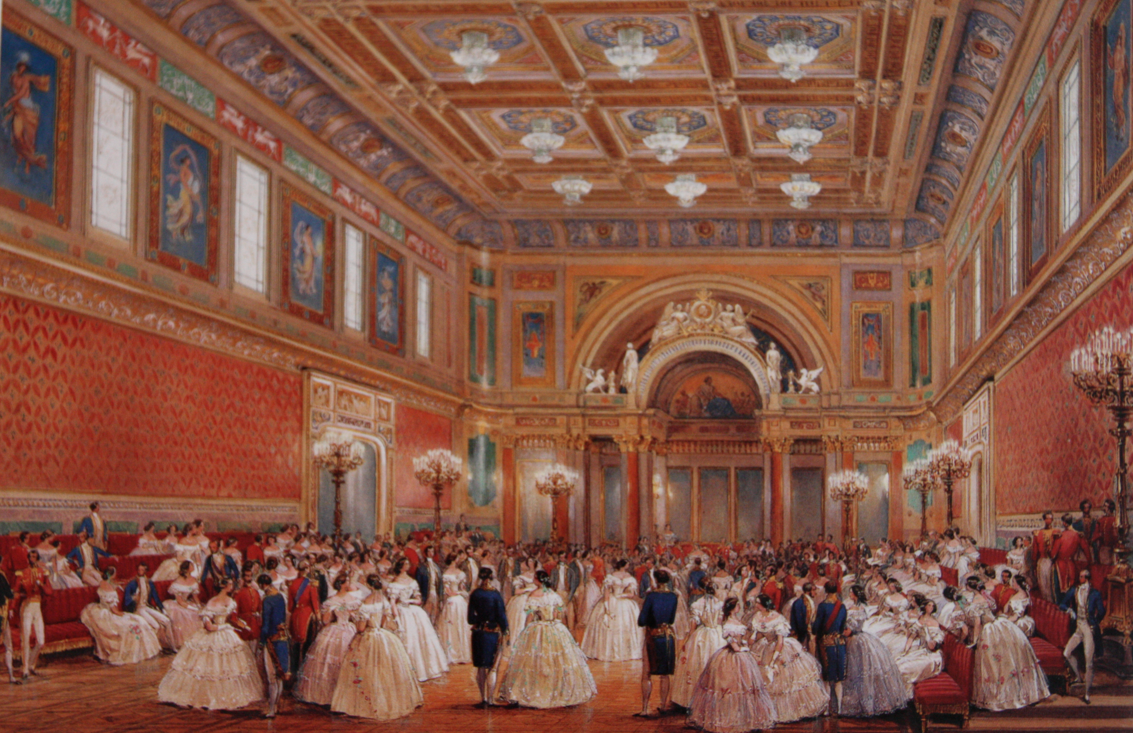
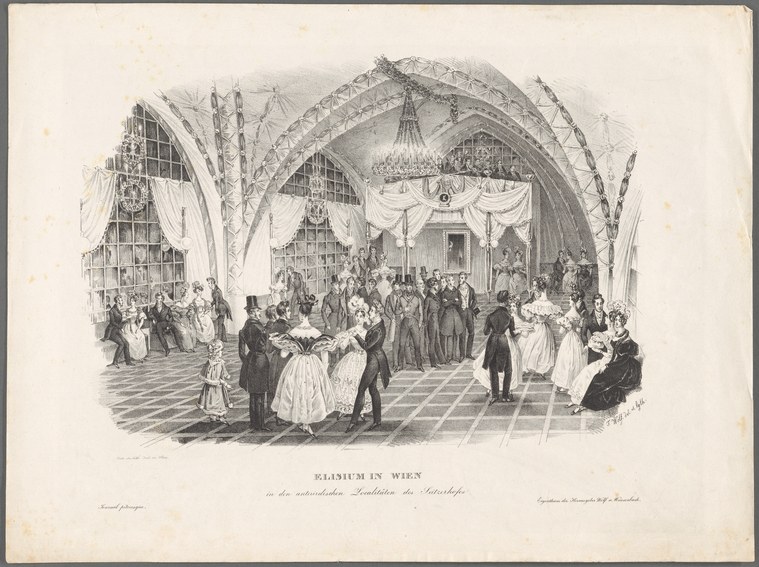
This is a primary visual source for understanding how the waltz was performed, held, and framed in the 19th-century ballroom—not an idealized or theatrical rendering, but a documentary image from a periodical or book intended to record contemporary practice. It preserves the architectural and social context in which the dance was danced, showing the scale, decoration, and crowding of a formal ball.
What you are looking at
A grand ballroom filled with formally dressed dancers and observers. The space is defined by soaring Gothic Revival architecture—pointed arches spring from slender columns, and the ceiling is coffered with a deep vault. Elaborate drapery swags from the upper reaches, and a chandelier hangs at the apex. The floor is a geometric checkerboard pattern. In the immediate foreground, a couple executes a turn: the woman in a voluminous white gown with full skirt caught mid-rotation, the man in dark evening wear supporting her. Around them, a crowd of figures in black tailcoats and white gowns move through various partnered figures, while observers line the edges and stand in clusters. The lighting is even and classical, rendered through fine engraving line-work that gives equal attention to architecture and human figures. The scene captures a moment of social ritual—dance as formal performance within a carefully staged and decorated interior.
The dancing
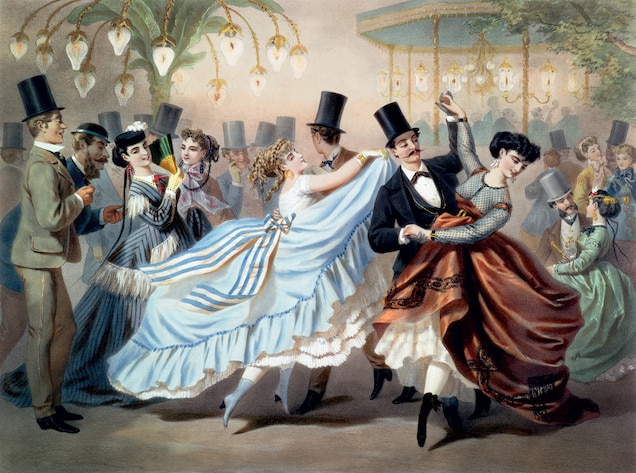
The primary couple in the foreground demonstrates a closed ballroom hold with the man's right hand supporting the woman's waist and their opposite hands joined; the woman's skirt is billowing from centrifugal motion, suggesting a waltz turn captured mid-movement. Her posture is upright and her weight appears to be rising through the turn. Around them, other couples maintain similar closed positions, moving through the space in parallel lines and circles characteristic of ballroom formation. The overall frame is vertical and formal—no dramatic extension, but a controlled partnership where the man leads and the woman follows through smooth, rotating movement.
The dance depicted
This depicts a formal ballroom waltz, most likely from the mid-to-late 19th century based on the architectural style and dress. The Viennese waltz was the dominant partner dance of the Gilded Age ballroom, performed at court, society balls, and grand public venues like the one shown here. The image records the turn as the fundamental unit of the waltz—a three-count rotation of the couple around a central axis, executed in triple meter with characteristic rise-and-fall action. The presence of multiple couples moving simultaneously in the same space and direction suggests a formal ballroom setting where dancers moved in lanes or squares, distinguishing this from the tighter, more intimate modern closed-position waltz.
How it was made
This is a steel engraving, a technique that allowed fine detail and deep blacks through closely spaced parallel lines (hatching and cross-hatching). Steel-engraved plates could be printed in large quantities without loss of clarity, making this an economical medium for mass-market illustrated books, periodicals, and standalone prints distributed across Europe and America in the 19th century. The signature and date appear to be engraved into the plate. The even, meticulous line-work and the capacity to render architectural space in convincing perspective are hallmarks of the steel-engraving process at its height. This was a popular medium for documenting social customs and fashionable life.
About this work
A formal ballroom waltz in a palatial Gothic Revival interior, rendered as a steel engraving. The image records both the architecture of public dance spaces and the physical vocabulary of the waltz as a closed-position partner dance, capturing the moment of the turn—the signature figure of the form. The work belongs to the 19th-century tradition of ballroom genre prints that documented social life and fashionable customs for a broad educated public.
The image is evidence of the waltz's dominance in elite European and American ballroom culture, and of the venues—grand ballrooms decorated in neoclassical and Gothic styles—that housed it. The careful depiction of multiple couples, all in formal dress and executing parallel figures, underscores the waltz's role as a structured social ritual rather than an improvisational or intimate encounter.
How to look at it
Attend to the moment of the turn: the woman's skirt, lifted and spread by the centrifugal force of the rotation, is the artist's chief evidence of motion. Notice how all the couples are arranged in parallel, their movements synchronized—this is not improvisation but formal procedure. Look at the hold: the closed embrace is the essential innovation of the waltz, and it is preserved across every couple in the room. The architectural frame is as important as the figures; the scale and decoration of the space itself convey the social importance of ballroom dancing.
The artist
Not recorded in the catalogue. The signature and notation on the plate are not legible from the image. Steel engravings of this type were produced by commercial engraving firms and individual specialists throughout the 19th century, many unsigned or credited only to the publisher. The quality of the engraving—the precision of the architecture and the naturalism of the figures—suggests a practitioner of skill and experience working within an established tradition of ballroom genre imagery.
The period
The waltz emerged in Vienna in the late 18th century as a revolutionary dance—the first European couple dance in a closed position, with partners in continuous contact. By the early 19th century, it had become the dominant form of elite ballroom dancing across Europe and America, despite initial moral opposition. The architectural style depicted here—the Gothic Revival interior with vaulted ceilings—places the work in the mid-to-late 19th century, when such ballrooms were built or renovated across Europe as symbols of civic grandeur and social refinement. This was also the period of the greatest proliferation of ballroom genre imagery in prints, books, and periodicals, as ballroom culture itself became a subject of fascination and documentation.
Where it lives
From the New York Public Library collection. The work is catalogued as a print, likely from a 19th-century illustrated book or periodical. Steel engravings of this type were widely distributed and collected, and are now held in public and private collections across Europe and America.
Dance in this work
Questions about this work
Is this a real ballroom or an imagined scene?
Most likely a real ballroom, or at least a composited image based on actual ballrooms of the period. Steel-engraved genre prints were intended as documentary records of contemporary life and fashion. The architectural details and the crowd are rendered with specificity, though the exact venue is not identified in the catalogue.
How do I know this is a waltz and not another dance?
The closed-position hold, the moment of the turn, and the rising posture are the defining features of the waltz. Other 19th-century ballroom dances (quadrille, polka, mazurka) either used open positions, different holds, or different formations. The synchronized rotation of multiple couples is characteristic of waltz ballroom practice.
What is the purpose of all the people standing around?
In formal 19th-century ballrooms, spectators and non-dancing guests stood at the edges of the floor, observing the dancers. Ballroom attendance was as much a social event as a dancing event. The seated and standing figures enlarge the sense of an occasion of public importance.
When was the waltz banned or controversial?
In the late 18th and early 19th centuries, the waltz's closed position was considered scandalous by some conservative critics, who objected to the bodily contact and the speed of movement. By the time this print was made (mid-19th century), the waltz was fully established and respectable, especially in ballroom contexts.
More Ballroom artwork