28 works in this view — arrow keys or swipe to move between them.
Dance in Art · 2019
Peasant dance
Unknown artist
- Medium:
- Dance:
- Folk/Country
- Source:
- New York Public Library
- Rights:
- Public domain — free to use, share and adapt.
- Recorded as:
- public_domain
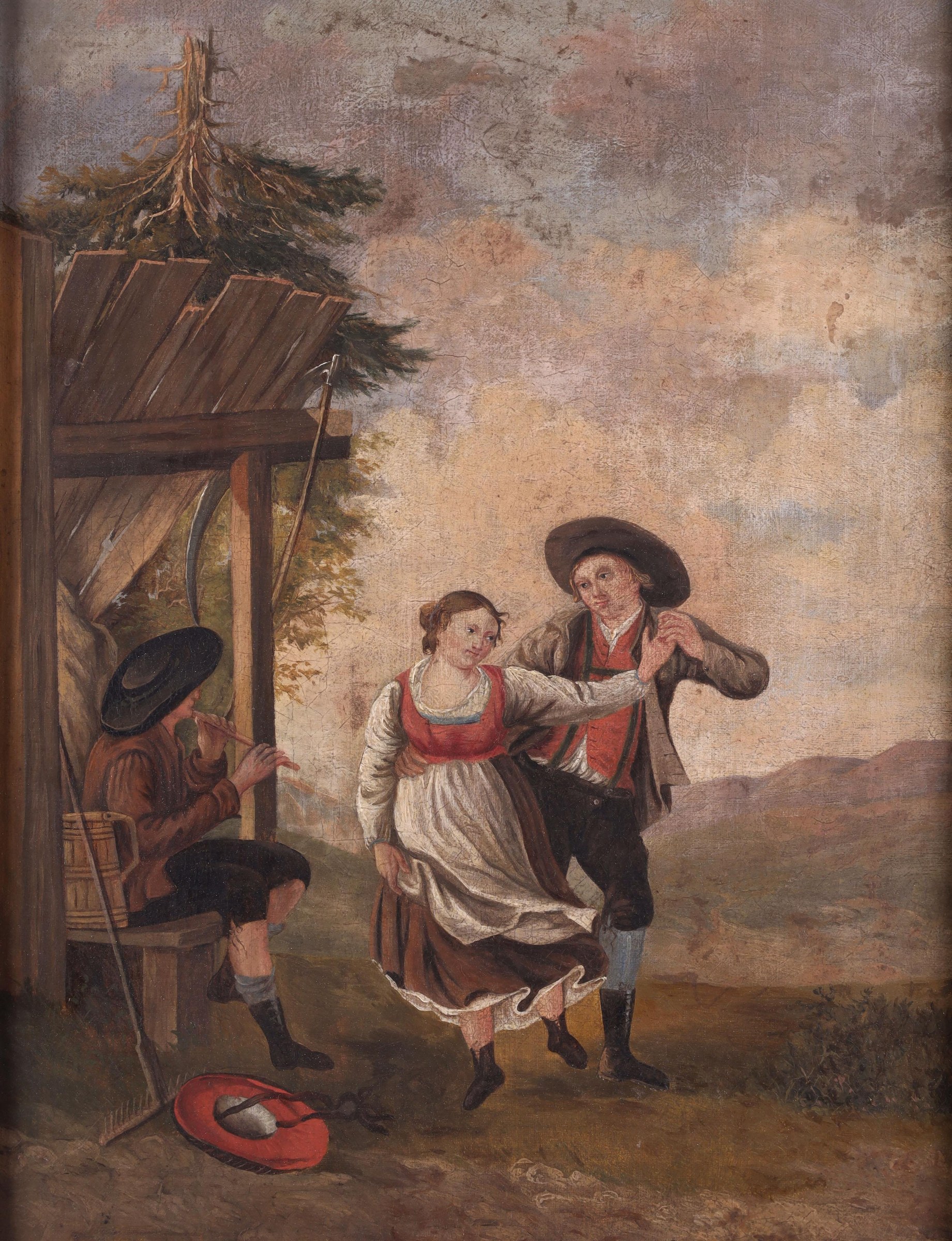
This engraving is rare evidence of how peasant people actually moved and danced together, observed and recorded by an artist working in a tradition that documented social customs. It shows the open, gestural quality of folk dance as distinct from the codified, contained movement of aristocratic forms—a distinction crucial to understanding the range of dance in the period.
What you are looking at
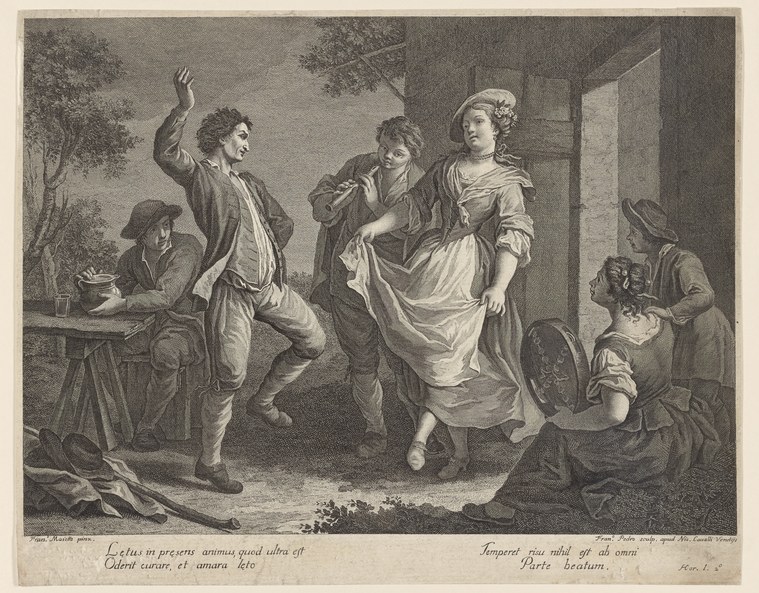
This engraving depicts a lively peasant dance scene set in a rural setting with classical architecture—a column and building visible at right. A woman in a white chemise and cap dances center-stage with raised arms in a sprightly pose, her body in three-quarter view and skirt animated as if mid-movement. To her left, a young man in breeches and coat gestures expansively with one arm raised; to her right, another figure in dark clothing observes or participates. At left, a seated man at a small table appears to be the musician or organizer. Two children or younger figures sit at the right margin, watching the proceedings. The composition is arranged in shallow depth with figures distributed across the foreground, lit evenly in the manner of 18th-century printmaking.
The dancing
The central female dancer stands with weight on one leg, arms raised in an open, exuberant frame—a posture that suggests folk dance rather than the contained frame of court dance. The man beside her adopts an animated, asymmetrical stance with one arm extended, suggesting call-and-response or turn-taking in the dance. The seated figure at left and the watching children frame the action as a social event witnessed by a community rather than a performance for spectators. No formal ballroom hold is present; the figures move in a looser, more spontaneous arrangement.
The dance depicted
This appears to be a depiction of a peasant or country dance from the 18th century, likely a branle, cotillion, or similar social folk form danced by rural people. The open arms, animated torso, and raised energy of the central figure suggest a sprightly, social dance of the kind documented in European village life across this period. The setting among common people, the informal grouping, and the presence of children mark this as a community celebration rather than a courtly or theatrical performance. The image provides evidence of how such dances were danced—with emphasis on arm and upper-body movement, celebratory gesture, and social participation rather than technical footwork.
How it was made
This is an engraving, identifiable by its fine parallel line-work (hatching and cross-hatching) to create tone and shadow, and its even, crisp black line on white paper. The medium allowed for wide circulation and reproduction, making such scenes accessible to urban audiences interested in rural life and customs. The style and technique suggest an 18th-century origin, likely Continental European. Engravings of this kind were often produced as part of series documenting daily life, costume, and social customs.
About this work
This engraving preserves a moment of peasant social dancing, capturing both the posture and energy of folk performance in the 18th century. The image is not a formal documentation of technique but a lively genre scene—the kind that appealed to urban viewers as a window onto rural life. It belongs in a dance gallery because it shows how ordinary people danced together in celebration, what their bodies did, and how such moments were valued and circulated in print. The work reminds us that dance history is not only about courts and stages but about the everyday movement vocabularies of entire communities.
How to look at it
Note the moment the artist chose: not a geometric or formally arranged group, but a snapshot of animation and spontaneity. The raised arms of the central dancer and the expansive gesture of the man beside her convey movement and celebration in a way that the contained frames of courtly dance do not. The presence of the musician at left and the watching children grounds this in lived community practice rather than theatrical performance. Pay attention to how the artist uses the open composition to suggest freedom of movement—the figures are not arranged in a line or closed group but scattered and responsive to one another.
The period
In the 18th century, peasant and folk dance became a subject of interest to urban, educated audiences, both as a picturesque window onto 'natural' or 'authentic' movement and as a marker of social class and region. Engravings and prints documenting rural customs proliferated, reflecting Enlightenment curiosity about the lives of common people. Simultaneously, folk dance forms were being incorporated into courtly entertainment and theatrical dance—a process visible in the development of the cotillion and quadrille. This image sits at that intersection: a celebration of peasant life as observed and aestheticized by an urban printmaking tradition.
Where it lives
The work is held in the New York Public Library collection. It is catalogued simply as a print but is not further identified by accession number or provenance details in the record consulted.
Dance in this work
Questions about this work
How do I know this is peasant dance and not courtly dance?
The setting—rural, with common people and children—and the dress—simple chemise and breeches rather than elaborate court costume—mark this as peasant life. More importantly, the gesture is open and exuberant rather than contained and formal. The open arms and animated torso of the central figure belong to a vocabulary of folk celebration quite different from the restrained frame of court dances like the minuet.
What dance is this?
The image does not give enough detail to identify a specific form with certainty. The grouping and energy suggest a branle, cotillion, or similar social dance of the 18th century, but the artist was more interested in capturing the liveliness and social context of the moment than in documenting precise steps or form.
Why was a peasant dance worth engraving and printing?
In the 18th century, rural and peasant life became a fashionable subject for educated urban audiences, who were curious about the customs and dress of common people. Such engravings offered a glimpse into a world that most print-buyers would never directly experience, and they also satisfied a growing interest in documenting the authentic or 'natural' movements of people untrained in courtly dance.
More Folk/Country artwork