42 works in this view — arrow keys or swipe to move between them.
Dance in Art
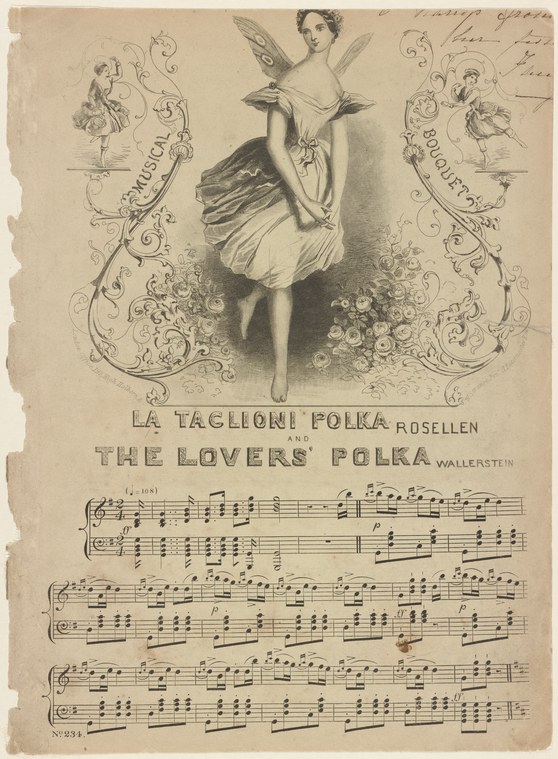
Musical bouquet. La Taglioni polka... The lovers' polka
Unknown artist
- Medium:
- Lithograph
- Dance:
- Polka
- Era:
- Late 1800s (Victorian Ballroom)
- Source:
- New York Public Library
- Rights:
- Public domain — free to use, share and adapt.
- Recorded as:
- public_domain
It demonstrates how Romantic ballet imagery was appropriated to market and legitimize popular social dances to middle-class audiences. It preserves evidence of the crossover between theatrical dance and ballroom practice in the nineteenth century, showing how a "lowborn" couple dance was dressed up in the language of classical ballet to appeal to aspirations for cultural sophistication.
What you are looking at
A lithographed musical score occupies the lower two-thirds of the sheet, while the upper portion is devoted to an ornate decorative composition. A single female dancer dominates the center, posed en attitude derrière with her weight lifted and her body in a graceful extension. She wears a romantic-era tutu—a layered, bell-shaped skirt of gauzy white material—and her upper body is bare or clad only in a fitted bodice. Her dark hair is crowned with a wreath or floral ornament. The dancer's pose is classical and idealized, with her back arched and her arms positioned in classical port de bras. She is surrounded by elaborate rococo scrollwork and floral garlands rendered in fine linear detail. Smaller cherub or putto figures flutter among the ornamental flourishes on either side. The entire composition has the flavor of mid-nineteenth-century theatrical promotion: the dancer is presented as the star attraction, the music below as her accompaniment, and the decorative apparatus as a frame elevating her to the status of a muse or allegorical figure.
The dancing
The single dancer is shown in a lifted, ethereal pose characteristic of Romantic ballet: weight on one supporting leg (the left), the right leg extended behind in a high, turned-out attitude, the torso in a slight forward tilt that creates an impression of weightlessness. Her arms are in a soft, rounded position typical of classical ballet carriage. The pose suggests mid-turn or mid-suspension, a moment of arrested motion. The absence of a male partner, the centrality of the female form, and the emphasis on line and verticality are all hallmarks of the Romantic ballet aesthetic.
The dance depicted
This is a polka—explicitly stated in the title—but rendered here in a highly stylized and theatrical manner. The polka was a popular social dance of the mid-nineteenth century, typically danced by couples in closed or semi-closed hold with a distinctive hop and turning action. However, this image presents the dance through the lens of Romantic ballet: a single soloist, pointe work implied (though not explicitly shown in the footwork), and an idealized, transcendent treatment of the female body. The title invokes "La Taglioni," referring almost certainly to the famous Romantic ballerina Marie Taglioni (1804–1884), suggesting that this score may have been inspired by her performances or marketed using her name to capitalize on her celebrity. The polka was sometimes incorporated into ballet divertissements of this period, and the composer Émile Waldteufel (suggested by the name "Wallerstein" on the score) was known for such salon and theatrical dances.
How it was made
This is a lithograph, a process well suited to the rapid, economical reproduction of popular music and theatrical imagery in the mid-nineteenth century. The upper illustration has been carefully composed and drawn on stone, allowing multiple prints to be pulled and distributed widely to sheet-music retailers, dance halls, and drawing rooms. The combination of figural illustration with musical notation below is typical of published sheet music of this era, which functioned both as a commercial commodity and as domestic entertainment. The fine detail of the rococo ornamentation and the delicate rendering of the dancer's form showcase lithography's capacity for nuanced tonal gradation and intricate linework.
About this work
This is a lithographed cover for a published polka in two languages—Italian and English—dating from the mid-to-late nineteenth century. It exemplifies the intersection of ballroom dance, Romantic ballet aesthetics, and commercial popular music in the Victorian era. The image presents a stylized, theatrical vision of the polka, elevating a common social dance through the vocabulary and iconography of high art. The invocation of Taglioni's name and the painting of the dancer in a classical ballet pose suggest that this score was marketed to an educated, affluent audience with aspirations to gentility. The work survives as a document of how dance was consumed, commodified, and imagined in the nineteenth-century drawing room and concert hall.
How to look at it
Observe the pose: this is not a natural, spontaneous moment but a carefully composed idealization of the female dancer's body. The attitude derrière—a classical ballet position—is a code understood by the educated viewer of the period as a marker of gentility, training, and aesthetic refinement. Notice too how the dancer is isolated and elevated, framed by ornament rather than embedded in a narrative or a social scene. The absence of a male partner, the absence of a crowd, the absence of a ballroom setting all tell us that this is a vision of the polka as high art, not as a common social practice. The musical score below anchors the image in the material world of sheet music and domestic performance—this was meant to hang on a piano or rest on a music stand.
The artist
The artist's name is not recorded in the catalogue. The lithographer would have been a skilled artisan in a commercial print shop, working from a design brief that likely came from the music publisher or composer. Such sheet-music illustrations were typically unsigned or attributed only to the printing house. The style—the rococo ornamentation, the Romantic-era ballet aesthetic, the delicate stippling and line work—is consistent with mid-nineteenth-century salon music publishing, a field dominated by Parisian and London firms catering to amateur musicians and dancers.
The period
The mid-nineteenth century saw an explosive growth in ballroom and salon dance, driven by the rise of a leisure class and the expansion of dance instruction and published music to a broader market. At the same time, Romantic ballet—with its emphasis on the female form, ethereal weightlessness, and the supernatural—was at its height, with dancers like Marie Taglioni achieving international stardom. The polka itself was a newcomer to European dance floors, having arrived from Bohemia in the 1840s and spreading rapidly through fashionable society. Publishers and composers capitalized on this enthusiasm by producing vast quantities of polkas, mazurkas, and other dances in every conceivable arrangement. The association of this polka with Taglioni's name suggests an attempt to bridge the worlds of concert ballet and ballroom dance, lending prestige to a relatively humble social dance.
Where it lives
The work is held in the New York Public Library's collection. It appears as a published sheet-music cover, likely from a print run of hundreds or thousands, and is catalogued without a named artist or precise date. The catalogue number (N°334, visible in the lower left) suggests it is part of a larger thematic collection, possibly of dance-related imagery or nineteenth-century sheet music.
Dance in this work
Questions about this work
What is a polka, and why is it represented as ballet here?
The polka is a lively couple dance in 2/4 time that originated in Bohemia in the 1840s and spread rapidly through European ballrooms. It typically involves a hop-step action and a turning motion. This lithograph presents it through a Romantic ballet lens—a single, ethereal female soloist in a classical pose—to market it to an educated audience and lend it artistic legitimacy. By the mid-nineteenth century, polkas were sometimes incorporated into ballet divertissements and theater programs, blurring the boundaries between ballroom and stage dance.
Who was La Taglioni, and what does her name do here?
Marie Taglioni (1804–1884) was a Swedish-Italian ballerina and the most celebrated dancer of the Romantic era. She created and danced the role of the sylph in La Sylphide (1832), which defined Romantic ballet for generations. Her name on this score is almost certainly a marketing strategy: by invoking her fame and the Romantic ballet aesthetic she embodied, the publisher sought to elevate the polka and appeal to buyers who admired her artistry. Whether she actually performed this polka or danced in a version of it remains unclear.
What does lithography tell us about how this dance was consumed?
Lithography was fast, cheap, and capable of fine detail, making it the ideal medium for mass-producing sheet-music covers. This work was likely printed in the hundreds or thousands and distributed to music shops, drawing rooms, and dance halls across Europe and North America. It represents dance as a commodity, a product to be bought and consumed in the home. The quality of the illustration suggests that even cheap, popular dances were marketed with artistic imagery and aspirational aesthetics.
Why is the dancer posed alone, without a partner?
The polka is fundamentally a couple dance, yet this image shows a solitary female figure. This is a convention of Romantic ballet representation and sheet-music illustration: the prima ballerina is elevated as a star and muse, often portrayed alone or in an idealized, allegorical frame. The absence of a partner emphasizes her virtuosity and her embodiment of an abstract ideal (grace, beauty, refined femininity) rather than a social or narrative context. This is how the polka is being sold to a genteel audience—not as a democratic, participatory ballroom practice, but as an art form centered on a celebrated female performer.
More Polka artwork