35 works in this view — arrow keys or swipe to move between them.
Dance in Art
Images of ballroom dancing
Unknown artist
- Medium:
- Dance:
- Ballroom
- Source:
- New York Public Library
- Rights:
- Public domain — free to use, share and adapt.
- Recorded as:
- public_domain
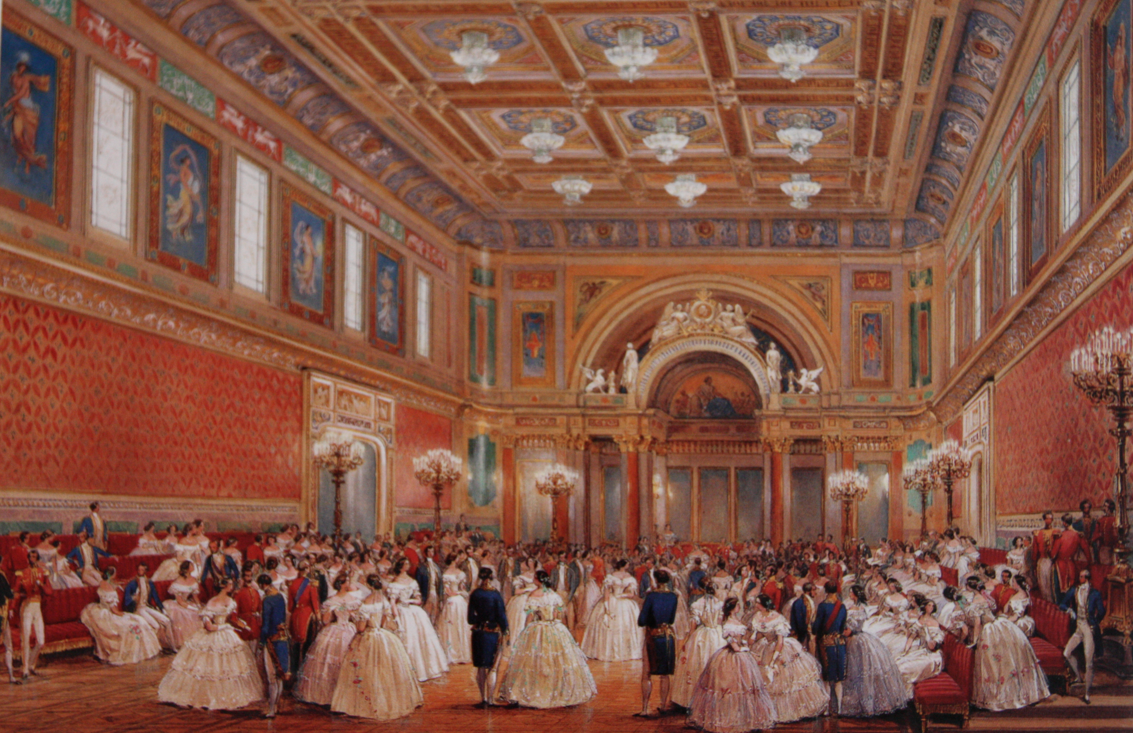
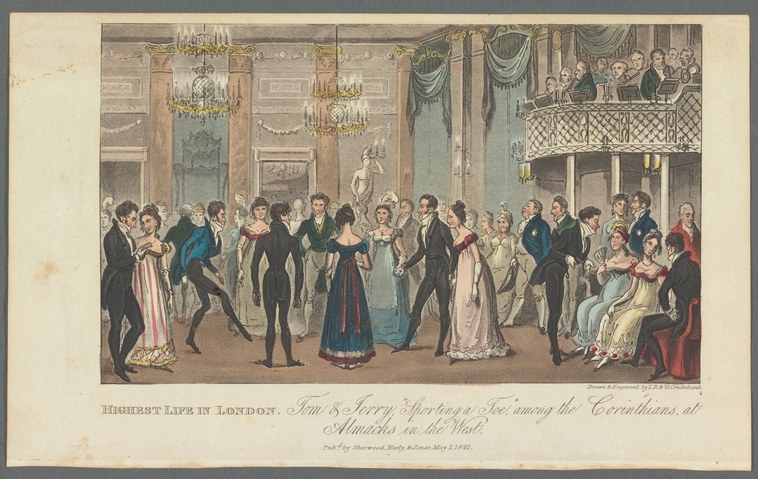
This work shows ballroom dancing as a living social practice, not as an isolated technical skill. It demonstrates that early-19th-century English dancing was embedded in conversation, observation, and the careful choreography of public status—women and men moved through the room, took partners, danced, and withdrew in patterns that reinforced social hierarchy and courtship possibility. No written description of a quadrille or cotillion conveys what dancers actually looked like in motion or how they shared space.
What you are looking at
A grand ballroom scene rendered in colored engraving, showing a formal evening assembly in what appears to be an aristocratic London townhouse. The room is richly appointed with tall columns, elaborate gilt chandeliers, heavy drapery, and a musicians' gallery above where an orchestra performs. The floor is crowded with fashionably dressed figures in Regency-era clothing: the women in high-waisted white or pastel gowns with long sleeves, the men in dark tailcoats and breeches. In the foreground, couples stand in conversation or prepare to dance; in the middle ground, several pairs are actively dancing in closed positions; in the background, spectators line the walls and crowd the gallery above. The composition captures a moment of animated social interaction—some figures are mid-turn or mid-step, others gesture in conversation, creating a sense of liveliness and orchestrated movement across the crowded floor.
The dancing
The dancers occupy closed positions typical of early-19th-century ballroom dance: partners face each other with the man's right hand at the woman's waist and their outer hands joined. The couples are distributed across the floor at varying depths, with some pairs mid-pivot suggesting rotational movement, and others standing at ease. The women's high-waisted Empire silhouettes and long skirts move freely; the men stand upright in formal posture. The overall frame is open and social rather than locked—this is not a performance piece but a participatory evening where dancing shares space equally with conversation and observation.
The dance depicted
This depicts a Regency-era ballroom assembly, most likely in London given the architectural styling and the inscription's reference to Almack's (a fashionable subscription rooms). The dances shown are consistent with quadrilles, cotillions, or country dances—the standard repertoire of English ballrooms c. 1815–1825. The closed couples, the scale of the gathering, and the presence of an orchestra all point to formal social dancing of the period. The inscription's mention of 'Cornellians' (members of a social set) anchors this as a specific event rather than a generic ballroom scene, suggesting the work documents an actual or well-known gathering.
How it was made
This is a hand-colored engraving, identifiable by the fine parallel line-work of the printed outlines and the careful watercolor wash applied afterward to define fabrics, skin tones, and architectural elements. The engraving technique allowed for sharp detail and wide circulation as a print, making this affordable documentation of fashionable life for a middle-class audience. The coloring was likely applied in a print workshop, with standardized palette choices—flesh tones, blue and pink silks, gold leaf accents—that were typical of high-quality commercial prints of the 1820s. The impressionistic handling of the crowd and the precise detail of foreground figures are characteristic of theatrical or social documentation engravings of the period.
About this work
This is a hand-colored engraving documenting a Regency-era ballroom assembly, likely at Almack's Assembly Rooms in London or a similar fashionable venue. It captures the formal social dancing, dress codes, and spatial choreography of English aristocratic life in the early 19th century. The work sits at the intersection of dance documentation, social history, and commercial print culture—it was made not to preserve a moment but to sell a representation of fashionable life to people who aspired to participate in it or to observe it. For historians of ballroom dance, it is invaluable evidence of how closed-position couple dances were actually performed, how they coexisted with standing and conversation, and how they were framed as leisure and sociability rather than spectacle. The print circulated widely and was reproduced in various editions, making it one of the most accessible images of Regency dancing.
How to look at it
Attend first to the architecture and the orchestra—they frame the dancing and show that this is a formal, governed space. Then trace the couples: watch how they occupy closed positions and rotate in place, and how their movement is interrupted by conversation and standing. The foreground figures are most detailed; the background crowd becomes more impressionistic, suggesting depth and scale. Notice the women's skirts: in mid-pivot, they would follow the body, not swing dramatically—the fabric is high-waisted and relatively narrow by later standards. The artist has chosen a moment of equilibrium, with some couples dancing and others at rest, which is more informative than any frozen pose would be.
The artist
The artist is not recorded. The style and execution are consistent with London print workshops of the 1820s, which produced thousands of hand-colored engravings documenting fashionable life, theater, sport, and social events. These workshops typically employed a master engraver, colorists, and distribution networks that sold prints to London galleries and private subscribers. The inscription and the specific subject (an identifiable social gathering) suggest the print was commissioned or licensed by someone with access to the event or a close account of it.
The period
This was made during the height of Regency social culture (c. 1811–1820, though Regency aesthetics persisted into the 1830s), when London's ballrooms were sites of intense social competition and marriage negotiation. The dances shown—quadrilles, cotillions, country dances—had recently been refined and standardized in French and English dancing manuals. The closed-position waltz was beginning to appear in fashionable circles by the 1820s but had not yet displaced the cotillion and quadrille as the dominant forms. In art, this period saw a boom in satirical and documentary engravings capturing contemporary manners; Rowlandson, Cruikshank, and their contemporaries established the form as a vehicle for social commentary and observation. This print sits squarely in that tradition: it is both celebration and gentle documentation of a specific social world.
Where it lives
This print is held by the New York Public Library, which does not record an accession number or acquisition history in the available catalogue. It is the type of popular commercial engraving that would have been sold in London print shops and distributed through subscription or retail channels in the 1820s.
Dance in this work
Questions about this work
What dances are being performed here?
The print shows quadrilles, cotillions, and country dances—the standard ballroom repertoire of Regency England. These were couple dances or set dances performed in closed or semi-closed positions, accompanied by a live orchestra. The specific steps are not visible, but the overall frame and floor pattern are consistent with the quadrille and cotillion as documented in contemporary dancing manuals.
Is this a specific event or a generic ballroom scene?
The inscription identifies this as an assembly at Almack's, a real and extremely exclusive subscription rooms in King Street, St. James's, London. The mention of 'Cornellians' suggests a specific social gathering, though it may also refer to a regular assembly. Either way, this is documentary rather than invented—it was made to record or to capitalize on a well-known social occasion.
Why are so many people standing and talking?
In Regency ballrooms, dancing and socializing were equally important. A gentleman would ask a woman to dance, they would dance one or two dances, and then they would stand aside for others. Much of the evening was spent in conversation, observation, and courtship negotiation. The print captures this realistic mix of activity and rest.
What can we learn about clothing and fashion from this print?
Women wore high-waisted Empire silhouettes with long sleeves, often in white or pale colors; men wore dark tailcoats with breeches and stockings. Both genders wore shoes (typically slippers for women, pumps for men). The precision of the engraving allows us to see embroidery, jewelry, and fabric detail, making this a valuable resource for costume historians.
More Ballroom artwork