49 works in this view — arrow keys or swipe to move between them.
Dance in Art · 2023
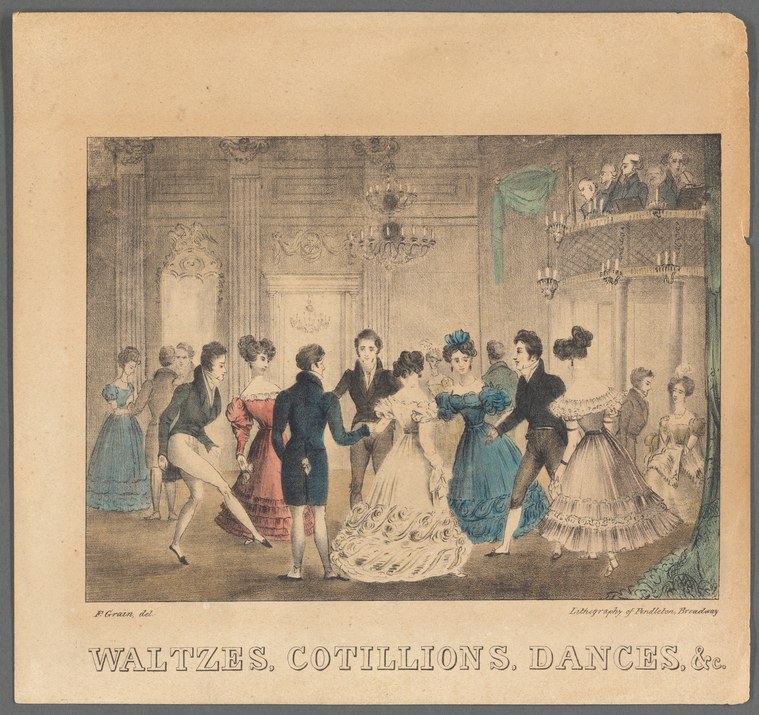
Waltzes, cotillions, dances, &c.
Unknown artist
- Medium:
- Lithograph
- Dance:
- Waltz
- Era:
- Late 1800s (Victorian Ballroom)
- Source:
- New York Public Library
- Rights:
- Public domain — free to use, share and adapt.
- Recorded as:
- public_domain
For historians of social dance and gender, this image is invaluable: it shows the actual ballroom context in which waltzes and cotillions were learned and performed, the formal training evident in posture and frame, and the integration of dance with courtship ritual and social hierarchy. For dancers and choreographers today, it demonstrates how a historical form of movement was embodied and valued, and provides raw material for informed reconstruction of period technique.
What you are looking at
A crowded ballroom scene in full evening dress, depicted in muted tones of sepia and green. The room is tall and formally appointed, with fluted columns, an ornate cornice, and multiple crystal chandeliers casting light from above. Observers sit in a box or gallery at the upper right. On the main floor, approximately fifteen figures in formal attire—men in dark coats with white shirts, women in full-skirted gowns with off-shoulder necklines and elaborate hairstyles—are arranged in a social dance configuration. The figures are distributed across the floor rather than in a single line or formation; some stand close together in conversation or preparation, while others appear to be in motion. One woman in the foreground wears a striking white gown with an exceptionally long, elaborately gathered train that extends dramatically across the floor, drawing the eye and suggesting a moment of particular prominence or display. The lighting is even and cool, typical of gaslit interiors of the period.
The dancing
The dancers show the closed and semi-closed holds characteristic of 19th-century ballroom dancing, with upright torsos, arms positioned at shoulder height or below, and a stiffness of frame that denotes formal training. Several couples appear to be in conversation rather than active movement, suggesting the social nature of the event as much as the danced portions. The woman in white with the train dominates the composition; her posture is upright and composed, and the handling of her voluminous skirt suggests either a moment of pause or a gliding action rather than rapid movement. Most figures are shown in profile or three-quarter view, a choice that displays the silhouettes of both partners and the formal line of the period.
The dance depicted
The title and composition identify this as a scene of mid-to-late 19th-century ballroom dancing, most likely depicting waltzes and cotillions as the primary forms. Cotillions were elaborate group dances with set figures, often conducted by a leader, while waltzes involved couples in continuous rotation. The mixed arrangement of figures—some dancing, some standing, some at the periphery—captures the reality of a ballroom evening, where social interaction and formal dance were intertwined. The formal dress, architectural setting, and overall decorum point to an elite social context, likely middle to upper-class urban Europe or America. The lithograph's title explicitly confirms the inclusion of both waltzes and cotillions, suggesting the artist aimed to document the actual practice of these dances as they occurred in social settings.
How it was made
This is a hand-colored lithograph, a reproductive process that allowed for relatively inexpensive mass production while retaining fine detail. The technique involved drawing on stone with a greasy crayon, which would accept oil-based ink while the blank areas rejected it. This particular print shows evidence of careful hand-coloring in green and flesh tones over a monochrome lithographic base, suggesting it was aimed at a middle-class audience who could afford modest prints but not original paintings. Lithography's capacity to show fine detail in dress and architectural setting made it ideal for documenting contemporary fashion and social practice, and the relatively quick turnaround from drawing to print meant such images could be topical and commercially responsive.
About this work
This is a documentary lithograph of ballroom dancing in the Victorian era, presenting an accurate if idealized view of formal social dancing as it was practiced in elite households and public balls of the mid-to-late 1800s. The print captures not a single choreographed moment but the texture of an entire evening—the mixture of dancing and socializing, the prominence of costume and setting, and the formality of the dance frame itself. It serves as a historical record of how waltzes and cotillions were performed and experienced, and of the gender presentation and social ritual that surrounded them. The work belongs in a dance archive because it documents a specific historical practice with remarkable precision, showing contemporary dress, spatial arrangement, and the bodies themselves as they were trained to move.
How to look at it
Notice the hand positions and the distance maintained between partners—the precision of the frame tells you this was taught, not improvised. Observe how the artist has frozen not a single movement but a social moment: some couples are clearly dancing (their bodies aligned, their direction clear), while others stand at the perimeter or in conversation, and the dominant figure in white is presented as a still point around which the action circulates. The architectural grandeur is as much the subject as the dancers: this is elite space, and the dance is as much about being seen in the right place as it is about movement. The hand-coloring adds a painterly quality that suggests this was a valued commemorative object, not a cheap news print.
The period
The waltz and cotillion were the dominant social dances of the 19th century, having displaced earlier courtly forms. The waltz, with its continuous three-beat rotation of a couple in closed embrace, was still regarded as daring by some in the early 1800s for its closeness and speed; by the Victorian era it was fully respectable and the centerpiece of formal balls. Cotillions were more elaborate, typically involving groups of four or eight couples executing a series of preset figures led by a master of ceremonies; they allowed for greater variety and gave dancers moments of public display. The period saw a rapid expansion of commercial dance instruction and the professionalization of dance masters, and lithographs such as this one served both as records of current fashion and as aspirational images for those learning to dance.
Where it lives
The print is held by the New York Public Library and is catalogued as part of their visual collections. It is a commercial lithograph, likely sold as a single sheet or as part of a series documenting contemporary social life and fashion.
Dance in this work
Questions about this work
What is the difference between a waltz and a cotillion?
A waltz is a couple dance in closed position, rotating continuously to a three-beat measure. A cotillion is a group dance (typically four to eight couples) that follows a sequence of set figures, often led by a master of ceremonies. Both are visible in this scene: the cotillion elements appear in the mixed arrangement and the presence of a potential leader, while the paired positioning of couples suggests waltzing was the primary continuous activity.
Why are the dresses so large?
The full skirts shown here, likely supported by crinolines or bustles, were the height of Victorian fashion for formal occasions. For dancing, the voluminous skirt was actually a technical challenge that dancers had to master—it required specific arm and hip positioning to manage the fabric and avoid tripping or tangling.
Was this a real event or an imagined scene?
The level of architectural detail and the specificity of the dress suggest this may be based on an actual ball, but the composition is clearly idealized and arranged for visual effect. The artist has combined observed details to create a type scene—a representative image of how such events looked and felt—rather than a documentary record of a particular occasion.
Who would have owned this print?
Middle-class families with ballroom aspirations, dance pupils, and dance masters. It served both as a window into the world of formal balls (which many could not attend) and as a visual reference for learning positions and comportment.
More Waltz artwork