40 works in this view — arrow keys or swipe to move between them.
Dance in Art
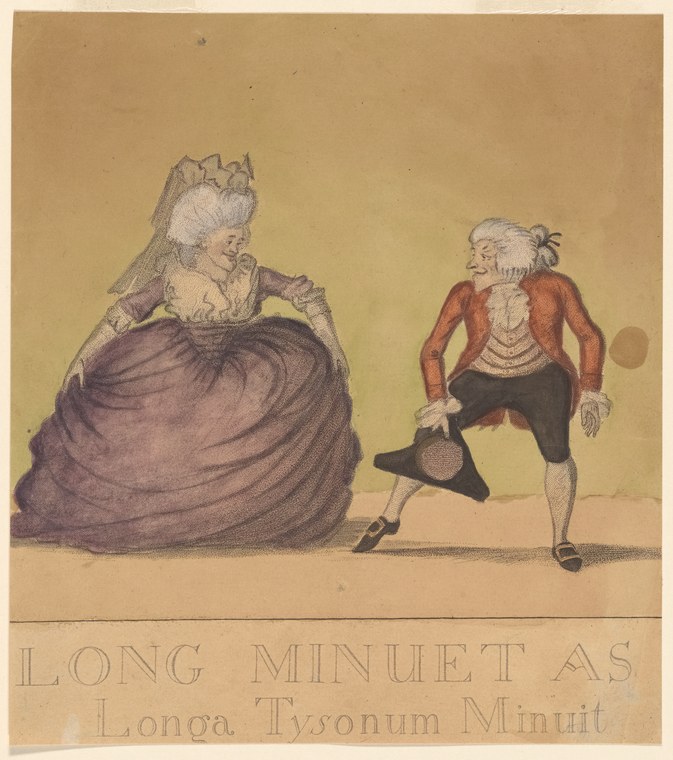
A long minuet as [danced at Bath], Longa Tysonum Minuit
Unknown artist
- Medium:
- Engraving
- Dance:
- Minuet
- Era:
- 1700s (Enlightenment/Minuet Era)
- Source:
- New York Public Library
- Rights:
- Public domain — free to use, share and adapt.
- Recorded as:
- public_domain
This is one of the few visual records of how the minuet was actually danced in England's most fashionable assembly rooms, rendered with enough anatomical and sartorial precision to show both the costume and the body's alignment in mid-movement. For historians of dance, fashion, and social practice, it documents the exact moment when the minuet reached its height of elaboration and formalization in English social life.
What you are looking at
A man and woman are shown in the moment of a minuet, positioned on a stage-like ground plane against a warm, pale background. The woman on the left wears an elaborate purple skirt of enormous volume, gathered and swept dramatically to one side, with a fitted bodice and white powdered hair styled high with ornamental detail. The man on the right, in profile facing her, wears a red coat with gold trim, knee breeches, and white stockings; he holds his hat in one hand in a gesture of courtly deference or salutation, his body bent slightly forward in an attitude of engagement. Their spatial relationship—separated but connected by the formality of the dance—and their opposed orientations suggest a moment of approach or acknowledgment within the dance's structure. The engraving's warm tone and the delicate, precise line work emphasize the artificiality and ceremony of the occasion.
The dancing
The woman stands upright with her weight settled, her posture composed and her gaze directed toward her partner. The man leans slightly forward from the waist, a deferential gesture characteristic of courtly address, his free arm curved and positioned with mannered elegance. His hat-holding gesture indicates a moment of salutation or reverence rather than active footwork. The disparity in their body language—her stillness against his lean—captures an asymmetry typical of minuet structure, where the gentleman often initiates approach while the lady receives and responds. The distance between them and their formal alignment suggest the opening or turning moment of a figure.
The dance depicted
This is identified by the inscription as a long minuet as danced at Bath, a fashionable English spa town of the 18th century. The minuet was the dominant social dance of the European aristocracy and gentry from the early 18th century through the 1780s, performed in courts, assemblies, and private houses. The Bath minuet would have been a version performed at the Assembly Rooms, which hosted some of the most formally choreographed social dancing in England. The inscription 'Longa Tysonum Minuit' suggests a variant or a specific choreographic sequence, though its precise meaning is unclear. This image captures the essential character of the minuet: a slow, stately dance in 3/4 time, built on elegant geometric figures, with emphasis on deportment, alignment of the body, and controlled gestural eloquence rather than vigorous footwork.
How it was made
This is an engraving, a technique that allowed for fine linear detail and wide circulation through printing. Engravings of dance scenes were common in the 18th century, used both for instruction and for satirical or celebratory documentation of fashionable practice. The delicate line work and careful modeling of the figures suggest a skilled hand; the warm tone and soft background are typical of hand-colored engravings of the period. The technique allowed the artist to freeze a specific moment of choreography with precision, making it a reliable document of both costume and movement convention at a particular time and place.
About this work
This engraving documents a minuet performed at Bath, one of England's most prestigious social venues, likely in the mid-to-late 18th century. It captures two dancers in a moment of formal courtship dance, their bodies arranged according to the strict conventions of minuet practice: the man in a posture of respectful address, the woman composed and receiving. The work is both a record of fashion—the woman's dramatically full skirt and the man's tailored coat are precisely rendered—and a manual of deportment, showing the upright carriage, measured spacing, and gestural restraint that defined minuet dancing. Engravings of this kind circulated among the dancing-master's clients and the socially ambitious, serving as both inspiration and instruction in the performance of social status through dance.
How to look at it
Observe the precise alignment of the two figures: the man's forward lean and the angle of his salute, the woman's vertical composure, and the exact distance maintained between them. This spacing and the man's deferential gesture capture a specific moment in the minuet's opening sequence. Notice also the extreme fashionability and volume of the woman's dress, which the engraver has rendered with fine parallel lines to convey the weight and movement of silk; the size of her skirt meant that the minuet's stepping had to be small and precise, confined to the space directly around her. The artist chose to show a moment of address and acknowledgment rather than active stepping, emphasizing the social and courtship dimensions of the dance over pure motion.
The period
The minuet was at the height of its prestige in the 1760s–1780s, the period suggested by the costume and style. Bath was a leading center of polite society and dancing-master practice under the direction of figures like Thomas Badger and other prominent dance instructors. Engravings of named dances and fashionable dancers proliferated in this period, both as didactic tools for those learning to dance and as mementos of social aspiration. The long minuet or 'minuet de la cour' was the most formal and technically demanding version, usually executed in couples within a larger assembly, and it required not only musical training but also training in the vocabulary of courtly gesture and alignment.
Where it lives
This engraving is held in the New York Public Library collection. It is catalogued as a single-sheet engraving, likely produced for circulation among Bath's dancing-master clients and fashionable patrons, and may have been bound or framed as part of a larger series of dance instruction or social documentation.
Dance in this work
Questions about this work
What is a long minuet?
A long minuet or minuet de la cour is the most formal version of the minuet, performed by a couple moving through a series of prescribed geometric figures—Z-shaped paths across the floor, turns, and courtly gestures of salutation. It differs from shorter or simpler minuets in the elaboration and length of the choreographic sequence. Bath assemblies featured these formal versions as a test of social knowledge and physical accomplishment.
Why is the woman's skirt so large?
The enormous gathered skirts shown here were fashionable in the 1760s–1780s, but they also had a choreographic function: they limited the dancer's footwork to small, precise steps and made the management of the skirt itself part of the dance's visual effect. The minuet's slow tempo and restrained movement meant the fabric could be displayed and controlled with maximum elegance.
What does the man's gesture with his hat mean?
The hat-holding gesture is a moment of courtly salutation or deference, one of the formal bows or acknowledgments that punctuated minuet choreography. It demonstrates respect for the lady and marks a structural moment in the dance, likely the opening approach or an exchange of positions.
How do we know this is from Bath?
The inscription explicitly states 'as danced at Bath,' referring to Bath's Assembly Rooms, which were England's most prestigious venue for fashionable social dancing in the 18th century. Bath was a center of minuet culture and the site of intensive dancing-master instruction.
More Minuet artwork