49 works in this view — arrow keys or swipe to move between them.
Dance in Art · 2019
Bon dance
Unknown artist
- Medium:
- Source:
- New York Public Library
- Rights:
- Public domain — free to use, share and adapt.
- Recorded as:
- public_domain
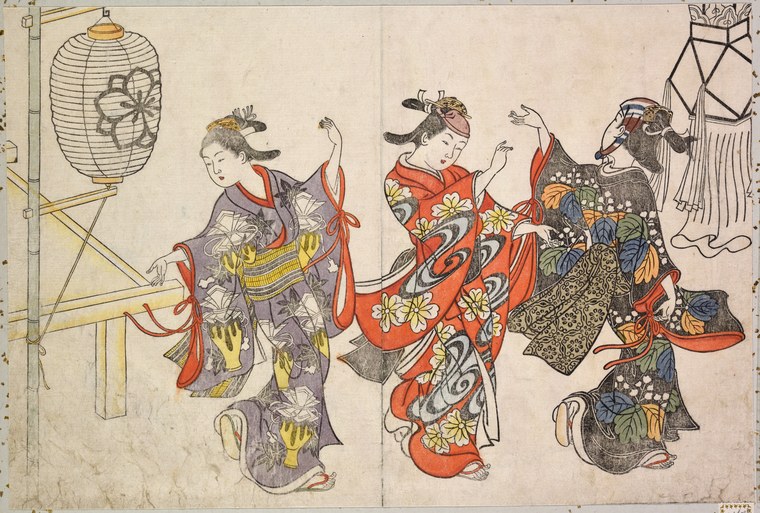
Bon odori is one of the few Japanese folk dances to survive and flourish from the pre-modern period into the present day. This print documents the dance as it was performed and understood in the urban centers of Japan, and provides rare visual evidence of the costume, grouping, and movement quality of the tradition before modern standardisation. For dancers and historians, it shows how a sacred ritual practice—honouring the dead—became a joyful, public, and inclusive celebration.
What you are looking at
A Japanese woodblock print depicting a lively bon odori (folk dance) celebration. Four figures in rich, colorful kimono dominate the composition—three women and one figure in masculine dress—arranged in an animated group. The dancers wear elaborate garments: the leftmost figure in a purple robe with gold-threaded patterns and red silk ribbons; a central woman in a striking red kimono decorated with white flowers and bold patterns; another in deep indigo with similar floral motifs; and a fourth figure in dark patterned cloth. Their long sleeves flow dramatically as their bodies curve and bend. A large paper lantern hangs above them to the left, suggesting a summer festival setting. To the right, a simple structural element—possibly a festival stand or shrine gateway—appears in lighter tones. The composition captures mid-movement, with heads tilted, arms extended, and bodies twisted in the characteristic fluid motion of bon dance. The color palette of reds, blues, purples, and golds against the pale paper ground creates visual rhythm that echoes the movement itself.
The dancing
The four dancers are positioned in close, informal grouping rather than the strict formations of court dance. Their bodies show the sideways sway and hip-centered weight characteristic of bon odori: curved spines, heads tilted back or to the side, long sleeves lifting away from the body as arms rise and extend. The leftmost dancer's arm reaches upward and back; the central figure's arms frame the face with palms outward. Weight appears to shift from one leg to another in the relaxed, circular stepping motion of folk celebration rather than the grounded stability of formal dance. The intimacy of their clustering and the lack of rigid hold or frame distinguish this from court or ballroom conventions.
The dance depicted
This is bon odori (Bon Odori), the traditional Japanese folk dance performed during the Bon festival (Obon), typically held in summer to honor deceased ancestors. Bon dance varies regionally but is characterised by simple, repetitive stepping patterns performed in circles or lines, often to the accompaniment of drums and folk songs. The dancers' posture—the gentle backward tilt of the torso, the loose arm movements, the informal grouping—are all consistent with bon odori as practised in early modern and modern Japan. The paper lantern visible in the composition is a standard element of Bon celebrations, used for both illumination and decoration. The print documents the dance as a popular, inclusive celebration rather than a specialised theatrical form.
How it was made
This is a woodblock print (likely ukiyo-e), identified by the characteristic bold outlines in black ink, flat planes of color applied from separate blocks, and the precise registration of overlapping hues. The technique allowed for mass production and wide circulation among urban audiences—these prints were affordable souvenirs and visual records of seasonal customs and entertainments. The use of rich pigments (likely Prussian blue, which arrived in Japan in the 1820s, and mineral reds) and the refined carving of fabric patterns indicate this was a commercial product of some quality, made for domestic sale. Woodblock printing was the dominant medium for documenting dance, fashion, and street life in Japan during the Edo and Meiji periods.
About this work
A Japanese woodblock print of bon odori, the traditional summer festival dance performed to honour ancestors during the Obon season. Four elegantly dressed dancers in flowing kimono are captured mid-movement in a moment of celebration—arms raised, bodies swaying, arranged in the loose, intimate grouping typical of folk celebration rather than formal court dance. The composition includes the characteristic paper lantern of the Bon festival, anchoring the work in a specific cultural and seasonal context.
Bon odori is one of Japan's most enduring and inclusive dance forms, performed by people of all ages and backgrounds at summer festivals across the country. This print preserves not a theatrical performance but a living folk tradition, documenting both the movement itself and the festive material culture—costume, lanterns, music—that surrounded it. The work is valuable evidence of how dance was visualised and circulated in Japanese popular culture, and of the persistent cultural importance of Bon observance.
How to look at it
The artist has chosen to freeze the dancers mid-sway, at a moment when all four figures are in motion—arms at varying heights, bodies curved, heads tilted. Notice the contrast between the ornate, static quality of the kimono patterns (which are rendered as flat, intricate designs) and the dynamic quality of the poses and gestures. The composition is crowded and informal, without the geometric precision of court dance: the dancers are close together, slightly overlapping, arranged in a moment rather than a formation. The large, simple lantern above them establishes the festive setting and creates a sense of looking up at the dancers from below, as if the viewer is part of the crowd at a festival ground.
The period
Bon odori has roots in 15th-century Buddhist practice but became widespread as a popular summer festival celebration during the Edo period (1603–1867). By the time this print was made, bon dancing was an established feature of urban summer life, organised by neighbourhoods, temples, and community groups. The late 18th and 19th centuries saw an explosion of woodblock prints documenting seasonal customs, entertainments, and street life—a visual record of urban culture that included actors, courtesans, festivals, and folk celebrations. This print sits within that tradition, capturing a moment of collective joy and cultural continuity.
Where it lives
This woodblock print is held in the New York Public Library collection, identified as a print from their holdings. The object type and provenance within NYPL's collection are not further specified in the available record.
Dance in this work
Questions about this work
Is this a theatrical performance or a folk celebration?
This is a folk celebration. Bon odori is not a theatrical form performed by professionals on stage, but a participatory dance performed by community members of all ages and skill levels during the Obon summer festival. The informal grouping, the simple repetitive movement, and the setting (indicated by the lantern) all confirm that this depicts a festival gathering rather than a performance.
What are the dancers wearing?
The dancers are wearing kimono—traditional Japanese robes—in rich fabrics with elaborate patterns. The garments shown here appear to be festival or best dress, with visible silk ribbons and fine woven or painted designs. The red and indigo robes with floral motifs are characteristic of summer festival attire. The long, flowing sleeves, called furisode, are typical of women's formal kimono and allow for the dramatic arm movements visible in the dance.
What is the lantern for?
Paper lanterns (chochin) are a central feature of Obon celebrations, used both for illumination and decoration. They are hung in festival grounds and homes during the Bon season and have strong cultural associations with the festival's purpose—honouring the spirits of ancestors. The lantern in this print anchors the scene firmly in the Bon context.
Is bon odori still danced today?
Yes. Bon odori is one of Japan's most persistent folk traditions, performed at summer festivals (Bon matsuri) throughout the country and wherever Japanese communities gather. Regional variations exist, but the basic stepping and arm movements have remained largely consistent from the early modern period to the present day. Many Japanese people learn bon odori as children and perform it throughout their lives.
More dance artwork