49 works in this view — arrow keys or swipe to move between them.
Dance in Art · 2015
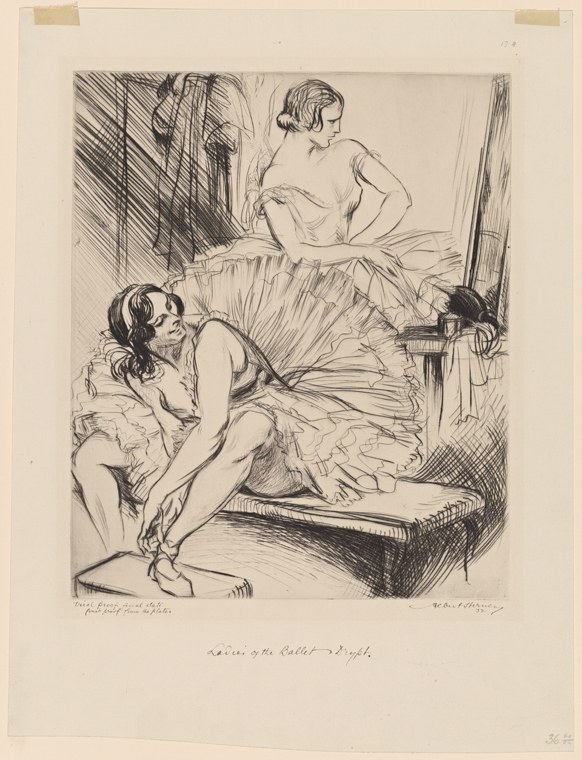
Ladies of the ballet
Unknown artist
- Medium:
- Dance:
- Ballet
- Source:
- New York Public Library
- Rights:
- Public domain — free to use, share and adapt.
- Recorded as:
- public_domain
For historians of ballet and theater, this image is valuable precisely because it refuses the idealized aesthetic of period ballet imagery, instead documenting the physical reality of a dancer's working life. For artists, it demonstrates how the etching technique can capture fleeting, intimate moments of human exhaustion with both empathy and formal precision.
What you are looking at
An intimate backstage scene rendered in pen and ink etching, showing two female ballet dancers in a dressing room or practice space. The figure in the foreground, crouching or bending forward on the floor in a posture of fatigue or repose, wears a light, draped costume; she has her hair pinned up in the period style. Behind her, a second dancer stands or reclines on what appears to be a chaise or bench, also partially undressed and equally languid. The setting is defined by bold cross-hatching suggesting walls or drapery; a window frame appears at the right, and scattered objects—possibly shoes, clothing, or personal effects—lie about the floor. The composition is asymmetrical and candid, capturing a moment of private exhaustion rather than performance.
The dancing
Both figures are off-duty and passive rather than in active dance positions. The foreground figure is bent forward at the waist with knees bent, weight forward and down—a posture of collapse or deep fatigue. The standing figure behind is twisted at the torso, one arm raised to her head in a gesture of weariness or undressing. Neither adopts the upright, controlled frame of formal ballet technique; the bodies are heavy, slack, almost sculptural in their weight. The positioning suggests two separate moments of rest rather than a partnered phrase.
The dance depicted
This is not a depiction of active ballet dancing but of ballet dancers at rest. The title 'Ladies of the ballet' and the partial costumes identify them as professional performers, likely from the late 19th or early 20th century. The work captures the physical toll and privacy of theatrical life—a counter-image to the ethereal, weightless ideal of romantic ballet as presented to audiences. The artist has chosen to show the body's exhaustion and materiality, not its art.
How it was made
This is a pen or etching needle line work, creating form through directional hatching and fine parallel lines rather than modeling in tone. The technique demands precision and cannot easily be revised; it creates a quality of immediacy and graphic clarity. The fineness of the line and the intimate domestic scale suggest this was made for circulation among collectors or in periodicals—a private or semi-private work rather than a public commission. The medium is well suited to the candid, observational subject matter.
About this work
This work belongs to a tradition of backstage and rehearsal imagery that emerged in the 19th century as artists became interested in the labor and private lives of performers. Unlike romantic ballet imagery, which emphasized weightlessness and grace, this etching foregrounds bodily fatigue, undress, and the gap between public spectacle and private reality. The print documents not how ballet dancers appear to audiences but how they experienced their own bodies in the moments between performance and rest. It is a work of social observation disguised as a genre scene.
How to look at it
Note the artist's choice to show the dancers at complete rest rather than in motion, and to position them asymmetrically across the composition. Observe how the etching technique uses line density to suggest both form and mood—the heavier cross-hatching in the background creates spatial depth and a sense of enclosure, while the more delicate lines on the bodies convey the softness of flesh and fabric. The work asks you to read exhaustion and intimacy in posture and line.
The period
The late 19th and early 20th centuries saw a significant shift in how artists depicted ballet. The romantic ballet tradition had emphasized otherworldly grace and the illusion of weightlessness; by contrast, realist and naturalist artists—influenced by developments in printmaking and by the theater criticism of the period—began documenting the labor, training, and backstage reality of professional dancers. This work aligns with that movement, contemporary with similar interests in rehearsal and off-stage imagery by artists across Europe.
Where it lives
The work is held in the New York Public Library collection. It is catalogued as a print, consistent with its execution as an etching or pen drawing for reproduction.
Dance in this work
Questions about this work
Are these dancers performing or resting?
They are at rest, in what appears to be a dressing room or practice space. The work is titled 'Ladies of the ballet' but depicts them off-duty, undressed, and exhausted—not dancing. This is a deliberate choice by the artist to show the private, unglamorous side of professional ballet.
What period is this from?
The catalogue date is uncertain, but the style and subject matter suggest the late 19th or early 20th century. The women's hairstyles and the treatment of costume are consistent with that era, as is the artist's interest in theatrical labor and realism.
Is this a finished work or a sketch?
The careful execution and deliberate composition suggest this is a finished work, likely an etching or pen drawing made for distribution or sale. The technique and subject matter were both fashionable in periodicals and among collectors interested in theatrical subjects.
More Ballet artwork