35 works in this view — arrow keys or swipe to move between them.
Dance in Art · 2019
Ballroom dancing
Unknown artist
- Medium:
- Dance:
- Ballroom
- Source:
- New York Public Library
- Rights:
- Public domain — free to use, share and adapt.
- Recorded as:
- public_domain
This print is evidence that early 19th-century dance instruction was primarily about social behavior and courtesy rather than steps or technique. For historians of ballroom dance, gender, and Regency society, it reveals what counted as 'correct' deportment and how the dance floor was a stage for performing social status and marital availability. The image also documents the moment when printed instruction and fashion imagery began to standardize ballroom practice across the English-speaking world.
What you are looking at
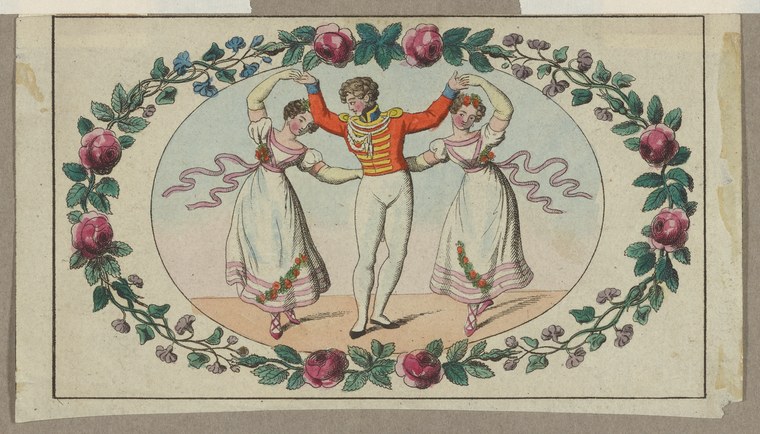
A hand-colored engraving shows three figures in a formal ballroom setting, arranged within an oval frame and bordered by an ornamental wreath of roses and flowering vines. The central figure is a young man in a bright red-orange coat with yellow trim, his arms raised and extended outward in an expansive, welcoming gesture. On either side stand two women in pale muslin gowns with high waists, puffed sleeves, and ankles visible above small slippers; both women hold their skirts slightly away from their bodies in a gesture of presentation or pirouette. The floor is rendered in pale ochre, and the composition radiates symmetry and formality. The decorative border—with its full-blown pink roses and delicate green foliage—signals this as a fashionable print intended for display in a drawing room or as part of a bound collection of dances.
The dancing
All three figures stand nearly upright with an elegant, elongated frame typical of early 19th-century fashion plates. The man's arms are raised to shoulder height or slightly higher, palms open, in a gesture of invitation or presentation. Both women hold their skirts with one hand, creating a slight lift and splay of fabric that suggests a moment of rotation or courtship salute rather than active footwork. The three are arranged equidistant and symmetrical, creating a tableau of formal social interaction rather than a moment of vigorous motion. The poses suggest controlled, measured movement within a highly codified social dance.
The dance depicted
This print most likely depicts a Regency-era cotillion or quadrille figure—specifically a moment of salutation or presentation that was central to ballroom protocol of the 1800s–1820s. The raised arms and frontal presentation of the man, combined with the women's gesture of skirt-lifting, align with documented etiquette for English country dances and the emerging quadrille, in which dancers acknowledged each other with formal bows and curtsies before executing figures. The symmetrical three-person arrangement may represent a specific figure or a composite ideal of ballroom deportment rather than an actual dance step sequence. The emphasis on gesture and hierarchy—the central man as focal point—reflects the social rather than athletic nature of this dance, in which courtesy and correct positioning mattered more than virtuosity.
How it was made
This is a hand-colored engraving or etching, rendered in the popular decorative style of early 19th-century fashion and dance prints. The outline is fine and precise, achieved through engraving; the color has been applied by hand in watercolor or gouache, which accounts for the soft, translucent appearance and the occasional unevenness of the tints. This technique was standard for mass-produced but still precious prints intended for the middle and upper classes—cheaper than a painting, but more refined and collectible than a plain etching. The ornamental border suggests this may have been part of a bound series on dance manners or a portfolio of fashionable recreations.
About this work
This is a Regency-era dance engraving depicting the formal gestures and social protocol of early 19th-century English ballroom dancing. The hand-colored print captures not a dynamic movement phrase but a moment of social ceremony—the salutation and presentation that opened dances and structured their figures. The symmetrical composition, elegant dress, and careful framing within a classical oval emphasize the ballroom dance as a ritual of courtship, hierarchy, and refined manners. Such prints served as both fashion documents and instructional guides, teaching the aspiring middle classes the correct posture, arm position, and social attitude required to participate in polite society. The work belongs in a dance gallery because it records not the technique of a dance but its social meaning and choreography—the unwritten but strictly observed rules of who stood where, who gestured to whom, and in what order.
How to look at it
Attend first to the raised arms and open palms of the central figure—this is not a dance step but a gesture of invitation and acknowledgment, freezing the moment of social greeting that preceded the dance itself. Notice the women's skirts and the slight lift of the fabric: this is not the full extension of a waltz or the rapid shuffling of a jig, but the controlled, measured lift associated with a curtsy or the opening salute of a figure dance. The oval frame and classical border signal that this is not a documentary image but an idealized type—a lesson in how ballroom dancers ought to look and behave. The frontality of all three figures, their parallel alignment, and their symmetry emphasize that ballroom dancing was a matter of form and formation, not individual virtuosity.
The period
This print dates to the early 19th century, an era of explosive growth in ballroom dancing as a defining feature of middle-class and aristocratic leisure. The cotillion and quadrille were replacing earlier country dances; they were more formally choreographed, required more instruction, and were more prestigious. Simultaneously, print culture was booming—fashion plates, dance manuals, and instructional imagery circulated widely to meet demand from provincial towns and the newly wealthy. The Regency period (1811–1820) in England saw an intensified idealization of refined femininity and masculine courtship, reflected in the pastel colors, high waists, and languid poses of fashion prints. This engraving sits at the intersection of three trends: the standardization of ballroom protocol, the rise of the middle-class ballroom, and the use of print to teach and police correct social behavior.
Where it lives
This work is held in the New York Public Library collection. It is catalogued as a print of unknown artist and date (though the style and dress indicate early 19th century). Such prints were typically bound into albums, framed as single sheets, or collected in series on dance, fashion, or manners.
Dance in this work
Questions about this work
Is this showing an actual dance step or just posing?
It is showing formal social gesture and positioning—the salutation that opened a ballroom dance rather than an active step sequence. Early 19th-century ballroom dancing was highly ritualized; the moment of acknowledgment between partners or in a group was itself part of the choreography. This print records that moment.
What dance is this? Waltz, cotillion, or quadrille?
It is most likely a cotillion or quadrille figure—specifically the moment of presentation or salutation that preceded the active steps. The symmetrical arrangement and formal salute gesture are consistent with the opening of English country dances and the emerging quadrille, both of which required dancers to stand and acknowledge each other before executing figures.
Why is the man in the center and the women on the sides?
The composition reflects both artistic convention (symmetry) and social hierarchy. In cotillions and quadrilles, a leading couple or a gentleman often initiated figures; the women's passive stance and the man's gesture of invitation mirror the social expectation that the man led and the woman followed. This was not unique to ballroom dance but was exaggerated in the formal, ritualized choreography of the Regency era.
How would someone learn to dance from this print?
Prints like this were often accompanied by written instructions describing the steps and figures. On its own, this print served as a reference for correct posture, arm position, and the formal manner expected of ballroom dancers—a visual standard of deportment to aspire to. Detailed step sequences would have come from a printed dance manual or a live dancing master.
More Ballroom artwork