35 works in this view — arrow keys or swipe to move between them.
Dance in Art · 2019
Ballroom dancing
Unknown artist
- Medium:
- Dance:
- Ballroom
- Source:
- New York Public Library
- Rights:
- Public domain — free to use, share and adapt.
- Recorded as:
- public_domain
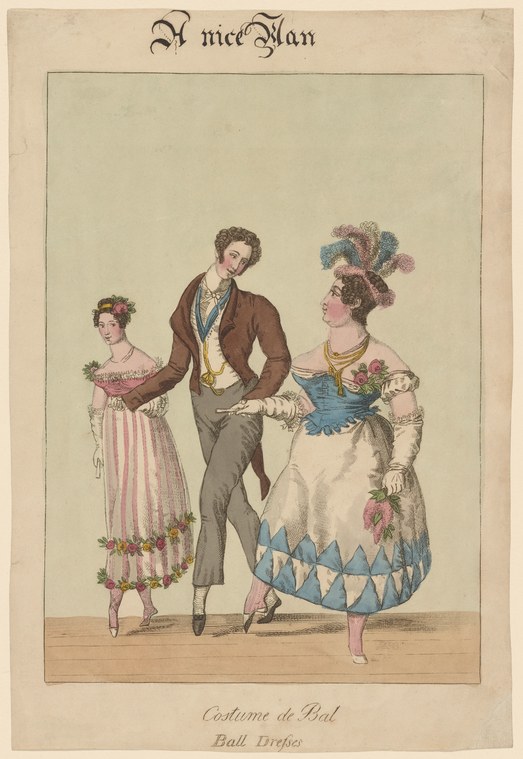
This print is essential visual evidence for the costume, posture, and social presentation of early 19th-century ballroom dancers—the silhouette, the headdress, the garlands, and the formal vertical carriage that distinguished fashionable dancing from earlier and later periods. For dance historians, it documents how ballroom dancers presented themselves socially, revealing that the spectacle of the ball extended far beyond the dance step itself into fashion, adornment, and bodily display.
What you are looking at
Three fashionably dressed figures occupy a pale stage against a neutral background in this colored print. A tall man in brown coat and pale breeches stands at center, flanked by two women in high-waisted muslin gowns. The woman on the left wears pink-striped fabric with a wreath of small flowers; the woman on the right, in white with blue trim and bold geometric patterning at the hem, wears an elaborate headdress crowned with ostrich plumes and ribbon. Both women hold garlands of flowers. The man gestures with his right arm extended, his posture upright and composed. The women's stances suggest forward motion, their bodies angled toward the viewer, their arms raised and graceful. The print's title and period inscription point to a formal ball setting, though no ballroom architecture is depicted—only the figures and their costumes command attention.
The dancing
The central male figure stands in a composed, almost presentational pose, his arm extended in a gesture of invitation or attention. The two women flank him asymmetrically; both are shown in profile or three-quarter view, their bodies angled forward in a promenade-like stance. Their arms are raised, held aloft with the garlands of flowers they carry. The women's feet are posed lightly, suggesting the upright posture and light carriage typical of early 19th-century ballroom dance, though no actual dance step is frozen in the image—the moment is closer to the social presentation of the dance than to its execution. The composition emphasizes vertical line and formal arrangement over dynamic movement.
The dance depicted
This is a ball-room dress print documenting the costume and social presentation of ballroom dancing around the 1820s, most likely depicting the Waltz or a Cotillion, the dominant partner dances of the Regency and early 19th-century ballroom. The figures are not mid-step but rather posed in the formal mode of social dance imagery—the moment of greeting, invitation, or promenade rather than the active embrace or turning of the waltz itself. The garlands of flowers and elaborate dress suggest this is courtship display as much as dance instruction; the print records how dancers dressed and presented themselves in this context, not how their bodies moved through space.
How it was made
This is a hand-colored engraving or aquatint, recognizable by the fine linear work, the even tone fields, and the period hand-coloring technique visible in the soft washes of pink, blue, and brown. The technique allowed for mass production and wide circulation among the middle and upper classes interested in fashion and ballroom culture. The delicate hand-coloring and the professional engraving suggest this was a commercial fashion print intended for display or binding in albums, part of the extensive visual literature on Regency-era dress and social dancing produced for the drawing room and print shop market.
About this work
This is a Regency-era ballroom dress plate from approximately 1820–1825, recording the fashionable costume and social presentation of a man and two women at a formal ball. It belongs to the large category of fashion and dance costume prints produced in Britain and France during this period—works intended not primarily as dance instruction but as records of how dancers dressed, carried themselves, and were displayed in polite society. The image is a social and sartorial document as much as a dance image: it shows us the flowers, the high waistlines, the elaborate headdresses, and the formal poses that signaled participation in the fashionable ballroom. Such prints circulated widely and have become invaluable sources for understanding both the material culture and the social choreography of Regency dancing.
How to look at it
Attend to the costume first: the cut of the gown, the placement of the waistline, the headdress, the flowers. These are not incidental details but the primary subject of the print. Notice the posture of all three figures—the upright spine, the lifted carriage, the formal arms. The artist has chosen not to show a dance step or turn but rather the moment of social presentation, the formal greeting or promenade. This was a deliberate choice, reflecting the function of such prints as guides to dress and deportment rather than as movement notation. The flowers in the women's hands are not mere decoration; they signal the aesthetic and social context of the ball—a space of courtship, display, and refined pleasure.
The period
This print dates to the Regency period (approximately 1811–1820) or the years immediately after, when the Waltz was becoming fashionable in Britain following its popularity in Vienna and the Congress of Vienna (1814–1815). The Waltz provoked controversy for its close partnering and embrace, yet it became the dominant dance of the aristocratic ballroom. Dance prints and fashion prints were produced in tandem during this period; images of dancers in their ball dress were commercial products sold to the aspiring middle classes and the fashionable elite. The florid presentation and the prominent display of flowers and elaborate headdresses reflect the neoclassical and Romantic aesthetics of the period, when women's fashion emphasized high waistlines, diaphanous muslin, and ornamental accessories. Such prints offered models of correct dress and deportment for the ballroom.
Where it lives
This print is held in the New York Public Library collections and is part of the extensive holdings of ballroom and fashion prints from the late 18th and 19th centuries. Such works were produced as commercial prints in Britain and France and were widely disseminated, making them now common in institutional collections.
Dance in this work
Questions about this work
What dance is this showing?
The print documents the costume and social presentation of ballroom dancing circa 1820s, most likely the Waltz or Cotillion, the dominant dances of the Regency ballroom. However, the image does not freeze a specific dance step; instead it shows the formal pose and dress of dancers at a ball. The garlands and elaborate costume are as much the subject as the dancing itself.
Why do the dancers look so formal and static?
This is a fashion and costume print, not a movement study. The artist's purpose was to record how dancers dressed and presented themselves in polite society—the headdress, the flowers, the posture, the silhouette. The formal, posed quality is intentional and reflects the conventions of Regency ballroom imagery, where social presentation and courtship display were as important as the dance itself.
Who is the artist?
The artist of this print is not recorded in the catalogue. It was produced as a commercial fashion plate and circulated widely; individual authorship was often unrecorded for such works. The print's style and subject matter are consistent with the output of London and Paris print publishers of the 1820s.
More Ballroom artwork