35 works in this view — arrow keys or swipe to move between them.
Dance in Art · 2019
Ballroom dancing
Unknown artist
- Medium:
- Dance:
- Ballroom
- Source:
- New York Public Library
- Rights:
- Public domain — free to use, share and adapt.
- Recorded as:
- public_domain
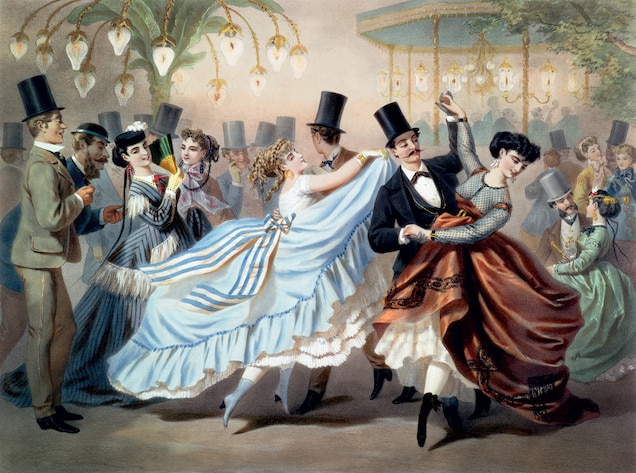
The print reveals the Waltz not as an abstract dance form but as a social technology of the nineteenth century: a prescribed frame for intimacy, gender relations, and class performance that required an audience to be meaningful. For dancers and historians, it documents how ballroom dance functioned simultaneously as private pleasure and public ceremony, and how visual representation of dance was shaped by the needs of print media and the ideology of elite domesticity.
What you are looking at
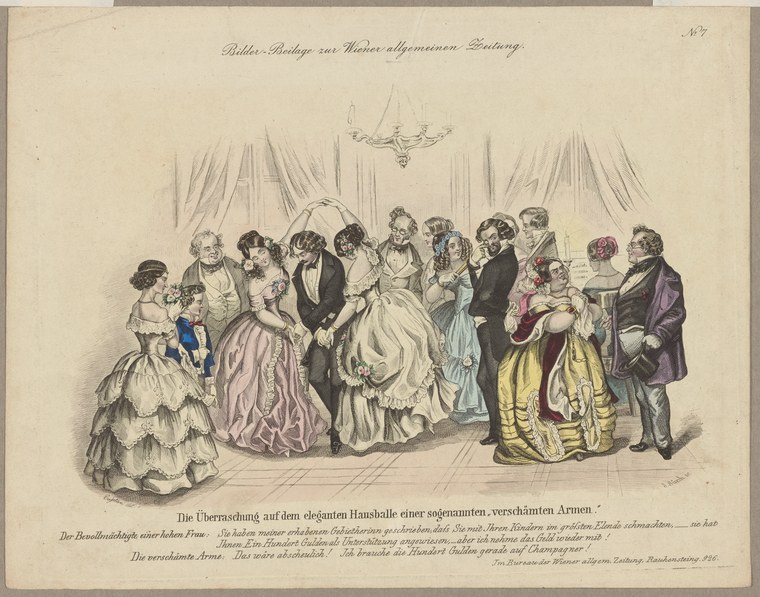
A formal ballroom scene depicts a social gathering of well-dressed figures in an elegant interior with tall draped curtains and a chandelier overhead. At the center, a couple in close embrace—the woman in a pink ball gown with voluminous skirts, the man in dark formal dress—appear to be dancing or about to dance, surrounded by onlookers in evening wear. The composition is dense with figures: women in elaborate gowns of pink, white, and pale yellow with full skirts and fitted bodices; men in black tailcoats and light-colored trousers; children in the foreground. The setting and dress suggest mid-nineteenth-century high society. The figures are arranged in a shallow theatrical space, some standing as observers, others clustered around the dancing pair, creating a sense of intimate social performance rather than open ballroom movement.
The dancing
The central couple holds each other in what appears to be a closed ballroom position, though the engraving's detail does not clearly render specific footwork. The woman's full skirt dominates visually, its volume suggesting either the Waltz or a similar turning dance popular in the period. Around them, standing figures watch with varied poses—some with hands clasped, others gesturing—suggesting the formal etiquette of ballroom spectatorship. The arrangement shows multiple generations: small children in the foreground, adults in the middle ground, and elderly figures at the edges, all positioned as witnesses to the central pair.
The dance depicted
This is almost certainly a Waltz or Viennese Waltz, the dominant ballroom dance of the mid-nineteenth century among European and North American elite society. The close embrace of the central couple, the woman's elaborate ball gown, the formal chandelier-lit setting, and the date suggested by costume all point to the Waltz as the most probable identification. The print documents the social context of ballroom dancing as a structured courtship ritual and public performance within aristocratic or upper-middle-class society. The presence of observers rather than multiple dancing couples emphasizes that this was a spectator sport as much as a participatory one.
How it was made
This is a hand-colored engraving or steel engraving, identifiable by the fine linear hatching, precise line work, and the application of watercolor or hand tinting to define garments and skin tones. The technique allowed for mass reproduction and circulation among the educated public; such prints were common in nineteenth-century newspapers, journals, and gift albums documenting social customs and fashionable life. The hand-coloring, applied in broad flat areas with careful attention to fabric texture and social signaling through dress, indicates this was a premium product intended for middle-class and aristocratic households. The inscription beneath in German script confirms European origin and points to a German-language publication.
About this work
This print documents an idealized moment of mid-nineteenth-century ballroom culture, capturing the Waltz as both a dance form and a ritualized social performance. The engraving freezes a moment of intimate couple-dance within the formal frame of aristocratic society, surrounded by observers whose presence transforms the dance into spectacle. It belongs in a dance gallery as evidence of how the Waltz was understood and visualized in its period of greatest fashionable dominance—not primarily as athletic movement but as courtship, elegance, and social hierarchy made visible through dress, proximity, and the gaze of witnesses.
How to look at it
Attend to the careful gradation of social position visible in the print: the central dancing pair as the focus of the composition, the ring of standing observers as witnesses, the children and elderly at the margins. Note how the engraver has used line and tone to distinguish between the swaying, closed bodies of the dancers and the more rigid, upright postures of those watching. The woman's enormous skirt—rendered in delicate parallel lines—is as much the subject as the dance itself; the fabric is the visible marker of wealth, status, and femininity. The chandelier and tall curtains frame the scene as interior theater, emphasizing that this is a staged moment of social performance.
The artist
The artist is not recorded in the catalogue. The style and technique are consistent with mid-nineteenth-century German and Austrian satirical and social-documentary printmaking, in which scenes of contemporary manners and fashions were a staple. The hand-coloring and fine detail suggest a commercial workshop rather than a singular named artist; such prints were often collaborative works, designed by one hand and engraved by another.
The period
The Waltz reached its height of fashion among European aristocracy and upper-middle classes between the 1820s and 1880s. It was controversial on its arrival—critics objected to the close embrace and rapid turning—but became the defining ballroom dance of the era, celebrated in music (Strauss), literature, and visual culture. By the mid-century date suggested by this print's costume, the Waltz was thoroughly established as the marker of refined society and was disseminated through illustrated journals, fashion plates, and social-conduct literature aimed at newly prosperous middle classes. The print's composition—formal gathering, careful dress, observed ritual—reflects the nineteenth-century obsession with documenting and codifying proper social behavior.
Where it lives
The work is held in the New York Public Library collection. The German inscription and professional hand-coloring suggest it was published as a commercial print in a German-language periodical or as a standalone social-commentary sheet, likely mid-nineteenth century. Its presence in an American library collection indicates the circulation of European social imagery in North America and the appetite for illustrated documentation of fashionable life.
Dance in this work
Questions about this work
What is the couple doing?
The couple is performing a Waltz, the dominant ballroom dance of the mid-nineteenth century. The man holds the woman in a closed embrace, and they are shown in the moment before or during a turn, the woman's full skirt suggesting the characteristic spinning motion of the dance. The formal setting, evening dress, and watching crowd indicate this is a public social performance, not a private lesson.
Why are so many people watching?
In nineteenth-century ballroom culture, dancing was a public performance and a ritual of courtship and social hierarchy, not merely private pleasure. The presence of observers—often including parents, chaperones, and the socially ambitious—was essential to the meaning of the dance. A couple dancing in front of witnesses was a public statement of social standing, eligibility, and refinement.
What does the woman's dress tell us?
The enormous, carefully constructed ball gown with its full skirt, fitted bodice, and delicate fabric is the visible marker of wealth, leisure, and social class. The dress required servants to construct and maintain, an expensive framework of petticoats and corsetry, and the ability to move only in prescribed ways. For women of this class, the dress itself was the primary statement made by dancing; the body inside it was constrained and displayed in equal measure.
Where and when was this made?
The print is a hand-colored engraving in German, likely published in a German-language periodical or as a standalone sheet in the mid-nineteenth century. The costume, chandelier, and formal interior suggest a Central European ballroom of the 1840s–1860s. It reached the New York Public Library collection, reflecting the circulation of European social imagery in North America.
More Ballroom artwork