35 works in this view — arrow keys or swipe to move between them.
Dance in Art · 2019
Ballroom dancing
Unknown artist
- Medium:
- Dance:
- Ballroom
- Source:
- New York Public Library
- Rights:
- Public domain — free to use, share and adapt.
- Recorded as:
- public_domain
This image is a valuable historical record of how ballroom dancing was understood and valued by the educated public in the early 20th century. It shows the formal conventions of frame, posture, and presentation that governed the dance, and it documents the gown styles and ballroom interiors that shaped how the dance was performed and experienced. For dancers today, it provides visual evidence of the technical standard and aesthetic ideal of the period.
What you are looking at
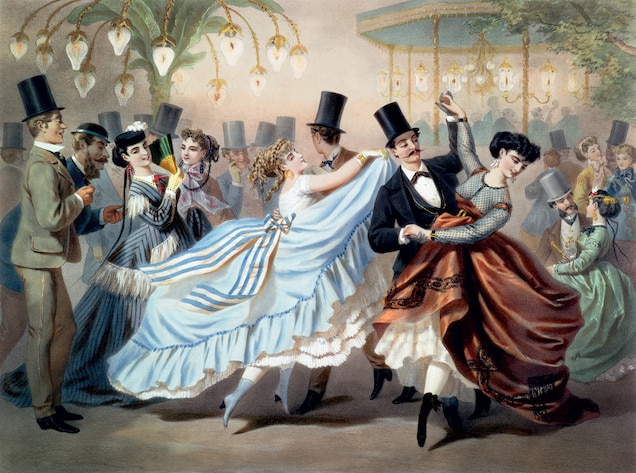
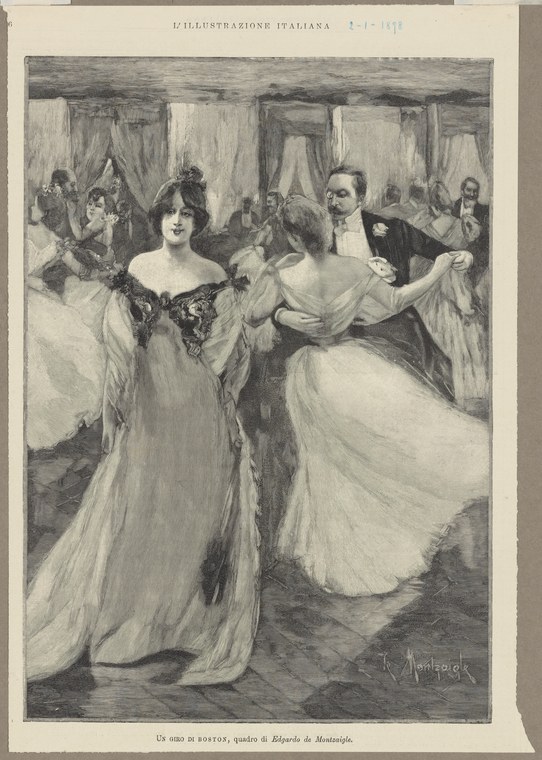
An elegant ballroom scene rendered in monochrome print, showing multiple couples dancing in formal evening dress. The composition is crowded and atmospheric, with figures in the background partially obscured by the busy scene. In the foreground, two women in flowing white gowns dominate the frame—one viewed from behind, her gown's train sweeping dramatically across the floor, the other in three-quarter view facing left. A man in dark formal wear stands between them. The women wear low-cut bodices with off-shoulder sleeves in the fashion of the early 20th century. The ballroom interior is suggested by tall draped windows or curtains in the background, and the overall mood is one of refined social occasion—formal, crowded, and intimate despite the number of figures. The lighting and technique create a luminous quality to the white fabrics, which contrasts sharply with the darker tones of the men's clothing and the architectural elements.
The dancing
The dancers are in closed or near-closed ballroom holds, moving through the space with the formal posture expected of couples in a formal dance. The woman in the foreground displays the characteristic backward lean and extended frame of a follower in standard ballroom position, while her partner supports her frame. The trailing train of her gown suggests forward motion and turning. Other couples visible in the background maintain similar formal positioning—upright spines, proper distance between partners, and the contained arm positions typical of early 20th-century ballroom dancing. The artist has captured the dignity and restraint of the form rather than exuberant movement.
The dance depicted
This depicts social ballroom dancing of the Edwardian or early 1920s era, most likely a waltz or foxtrot given the formal evening setting and the dancers' posture. The women's gown styles—high-waisted, flowing skirts, and fitted bodices—date to approximately 1910–1920, and this type of ballroom scene was a conventional subject in European and American illustration during that period. The print captures the strict social conventions of partnered ballroom dancing, where frame, posture, and decorum were as important as footwork. The crowded ballroom setting suggests this is a major social event rather than a casual dance.
How it was made
This is a monochrome print, most likely a photogravure, engraving, or lithograph given the tonal range and the fine detail visible in the rendering of fabric and faces. The technique allows for soft gradations between light and shadow, particularly in the handling of the white fabrics, which appear luminous against darker surroundings. The signature visible in the lower right corner suggests this is a reproduction or editorial illustration rather than an original artwork; it may be from a European periodical of the early 20th century. The technique and finish are consistent with high-quality editorial illustration for magazines or newspapers of that era, suggesting it was intended for a broad educated audience interested in social reportage.
About this work
This print depicts a formal ballroom scene from the Edwardian or early 1920s era, capturing the aesthetic and social conventions of upper-class social dancing at its height. The composition emphasizes elegance and propriety, with carefully posed figures in correct ballroom position, moving through an ornate interior space. The work belongs in a dance history collection as a primary document of how ballroom dancing was visualized and celebrated in the period when it was the dominant form of social dancing in Europe and America. It shows not only the physical form of the dance but also the social ritual surrounding it—the formal dress, the crowded ballroom, the pairing of men and women in prescribed roles.
How to look at it
Observe the precise positioning of the dancers' bodies—the way the woman's weight is supported by her partner, the alignment of their frames, and the formal distance maintained between them. Look at the trailing train of the foreground woman's gown and how it traces the arc of movement across the floor, suggesting the continuity of the dance despite the static nature of the print. Notice how the artist has rendered the background figures as a soft, atmospheric crowd, which creates depth while focusing attention on the foreground couple. The play of light on the white fabrics gives the scene an almost luminous quality, emphasizing the elegance and formality of the occasion.
The artist
The catalogue record does not identify the artist. The signature in the lower right corner, while visible, does not clearly resolve to a known name in reproduction. The quality and style of the print suggest it was created by a professional illustrator working for a European magazine or newspaper, possibly German given the Italian-language caption and the style of illustration.
The period
In the early 20th century, ballroom dancing—particularly the waltz and foxtrot—was the dominant form of fashionable social dancing in Europe and America. The formal ballroom scene was a popular subject in contemporary periodicals, capturing a society increasingly focused on visual documentation of social life. The aesthetic of the illustration reflects the values of the Belle Époque and Edwardian eras: elegance, restraint, and an emphasis on proper form. At the same time, ballroom dancing was undergoing significant change, with American innovations like the foxtrot entering European practice and challenging older conventions.
Where it lives
This print is held in the New York Public Library collection. It is catalogued as a print from a periodical, most likely L'Illustrazione Italiana, a major Italian illustrated magazine. The Italian-language caption beneath the image indicates it was published for an Italian audience, though the subject matter—formal ballroom dancing in the Edwardian style—would have been equally familiar and fashionable in Italy at the time.
Dance in this work
Questions about this work
What dance are they doing?
The formal dress, posture, and ballroom setting suggest this is a waltz or foxtrot, the dominant social dances of the Edwardian and early 1920s era. The exact dance cannot be determined from the image alone, but the couple's closed ballroom position and upright frame are consistent with either dance.
When was this made?
The women's gown styles—high-waisted skirts, fitted bodices, and off-shoulder sleeves—date this to approximately 1910–1920. The catalogue record does not provide a specific publication date, but the style of the illustration and fashion suggest an Edwardian or early 1920s origin.
Why is the woman's gown so prominent?
In formal ballroom dancing of this era, the woman's gown was a crucial element of the spectacle. Designers created elaborate trailing skirts and flowing fabrics that would move dramatically as the couple danced. The artist has emphasized this by showing the gown's train sweeping across the floor, making the fabric itself an active element of the composition.
Is this a real dance or an imaginative scene?
This appears to be a representative scene rather than a documented event. It shows the conventions and ideals of ballroom dancing in the period, not a specific occasion. The crowded ballroom and varied couples suggest a composite image meant to capture the essence of formal social dancing rather than a particular moment.
More Ballroom artwork