26 works in this view — arrow keys or swipe to move between them.
Dance in Art
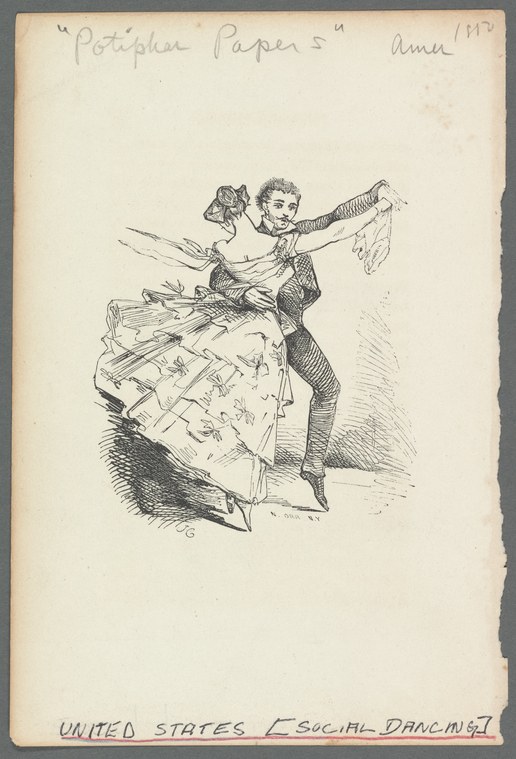
Dancing couple, with penciled notation "Potiphar Papers"
Unknown artist
- Medium:
- Drawing/Sketch
- Dance:
- Notation/Choreography
- Source:
- New York Public Library
- Rights:
- Public domain — free to use, share and adapt.
- Recorded as:
- public_domain
This sketch preserves a moment of ballroom technique and aesthetics from a crucial period when social dancing was becoming increasingly theatrical and display-oriented. The image shows how turn-of-the-century dancers understood the body's extension, lift, and presentation—values that shaped both ballroom and theatrical dance for decades. The 'Potiphar Papers' reference suggests that ballroom dancing was understood as inherently dramatic and seductive, not merely technical, a framework that persists in how we understand competitive ballroom today.
What you are looking at
A man in formal dress—dark coat and light trousers—lifts a woman in a ballroom pose, her body arched backward in his arms. She wears a full skirt with a decorative pattern, her body weight entirely supported by his frame. The sketch is executed in ink with careful cross-hatching for shadow and volume, particularly in the folds of her skirt and the planes of their bodies. The composition is tightly cropped on the figures, with minimal setting suggested; a single vertical line indicates the edge of a wall or doorway behind them. The artist has captured a moment of suspension—the woman's arms are raised and extended, creating an open, lifted line through her torso, while the man's posture shows controlled strength. The drawing style is rapid but assured, with confident line work defining the contours of their bodies and clothing.
The dancing
The couple are in a closed ballroom frame, but with pronounced vertical lift and display: the man stands firmly, supporting the woman's weight as she reclines deeply in his arms. Her body is extended and arched, with one arm raised and the other extended outward, creating an elongated diagonal line. The man's frame is upright and controlled, his arms bearing her weight while maintaining an open chest. Their positioning suggests a moment of dramatic extension rather than active stepping—this is a figure of balance and display rather than locomotion. The woman's raised leg is suggested beneath her full skirt.
The dance depicted
This appears to be social ballroom dancing from the late nineteenth or early twentieth century, most likely a waltz or similar closed-position dance of that era, captured at a moment of dramatic lift and display. The deep arch and lifted frame are characteristic of Edwardian-era ballroom technique, when dancers favored pronounced body extension and theatrical presentation. However, the image could also depict a theatrical or vaudeville dance number rather than a ballroom competition dance—the exaggerated lift and the artist's emphasis on dramatic gesture suggest performance rather than social dancing. The penciled notation 'Potiphar Papers' (a reference to the Biblical scene of seduction) may indicate this is meant to evoke theatrical or romantic drama rather than a record of actual ballroom technique.
How it was made
This is an ink drawing or sketch on paper, executed with pen and cross-hatching for tone and volume. The technique allows for rapid, assured linework while building form through directional hatching—particularly visible in the woman's skirt and in the shadows defining the bodies. The style suggests this may be an illustration, possibly for a periodical or book, rather than a fine-art drawing made for its own sake. The confident, economical line work is characteristic of late nineteenth-century illustrative practice, where artists needed to work quickly and with clarity suitable for reproduction.
About this work
A sketch of a ballroom couple in a moment of dramatic lift, executed in ink with cross-hatching for form. The man supports the woman as she arches backward in an open, extended pose characteristic of Edwardian ballroom dancing. The image is labeled 'Potiphar Papers'—a reference to seduction and drama—which may suggest this depicts theatrical dance or a romanticized scene rather than a technical study of ballroom form. The work sits at the intersection of social dance documentation and theatrical illustration, capturing both the technique and the spectacle of turn-of-the-century ballroom culture.
How to look at it
Notice how the artist has frozen the moment at maximum extension and display rather than in a traveling step—this is deliberate, choosing to show the couple at a moment of suspended, theatrical lift. Observe the woman's arched spine and raised arms: these are not ballroom mechanics but theatrical presentation. The cross-hatching builds volume and three-dimensionality, making the bodies read as substantial and weighty despite the flowing skirt. The minimal setting forces attention entirely onto the bodies and their relationship, a compositional choice that emphasizes the emotional and dramatic content of the moment rather than the social context.
The period
This sketch dates from a period when ballroom dancing was undergoing rapid transformation. In the late nineteenth and early twentieth centuries, social ballroom dances—waltzes, polkas, and the emerging foxtrot—were becoming increasingly formalized and theatrical. Dancers began emphasizing body extension, lift, and dramatic presentation, influenced by both vaudeville performance and the emerging competitive ballroom culture. The 'Potiphar Papers' reference places this work in a tradition of illustrated literature and periodicals that used dance imagery to suggest romance, seduction, and social drama. Illustrated publications of this era frequently featured dance scenes as markers of modernity, sexuality, and social aspiration.
Where it lives
This sketch is held in the New York Public Library collection. It is catalogued as a drawing or sketch, possibly an illustration from or related to 'The Potiphar Papers,' a periodical or publication. The New York Public Library's holding suggests this was part of a broader documentary or illustrative practice, possibly connected to periodical publication.
Dance in this work
Questions about this work
Is this a waltz?
The closed frame and the moment of deep arch and lift are consistent with Edwardian-era waltz technique, but the image could also depict other closed-position dances of the period such as a one-step or slow foxtrot. The emphasis on dramatic display rather than technical footwork makes definitive identification difficult from the sketch alone.
Why is the label 'Potiphar Papers'?
The Potiphar Papers is a reference to the Biblical scene in which Potiphar's wife attempts to seduce Joseph—a story associated with temptation and seduction. This suggests the image is meant to evoke romantic or erotic drama, placing ballroom dancing within a narrative of desire and spectacle rather than treating it as purely social or technical.
Could this be from a theatrical performance?
Yes—the exaggerated arch, the raised arms, and the emphasis on dramatic display are all consistent with vaudeville or musical-theater dance of the period. The 'Potiphar Papers' reference suggests this may depict a theatrical interpretation of ballroom dancing rather than a record of social-dance practice.
What does the cross-hatching technique tell us?
Cross-hatching was a standard technique in late nineteenth-century illustration, allowing artists to build tone and volume quickly while maintaining clarity for print reproduction. This sketch was likely made for publication in a periodical or book rather than as a fine-art drawing.
More Notation/Choreography artwork