49 works in this view — arrow keys or swipe to move between them.
Dance in Art
Ballets and theatrical dances
Unknown artist
- Medium:
- Dance:
- Ballet
- Source:
- New York Public Library
- Rights:
- Public domain — free to use, share and adapt.
- Recorded as:
- public_domain
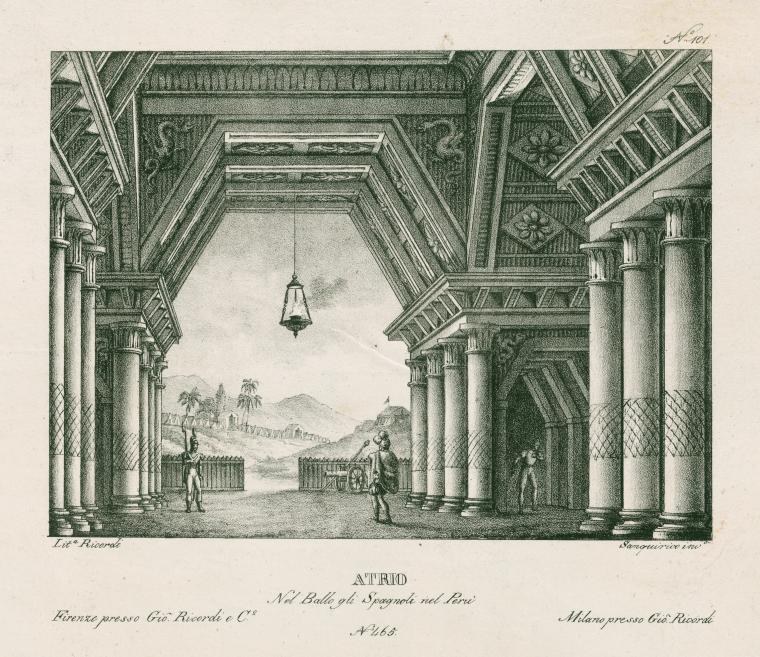
The work documents the physical and social context in which early nineteenth-century dance took place: the monumental architecture, the formal dress, the mixing of performance and ceremony. It shows dance not as an isolated movement practice but as one element within elaborate theatrical and architectural display. For historians of theatre and dance costume, it provides precise visual evidence of how performers dressed and how bodies were positioned within operatic or courtly space.
What you are looking at
An engraving presents an architectural interior of monumental proportions: a vast hall with a coffered barrel vault, supported by colossal columns in pairs receding toward the distance. The perspective is calculated to draw the eye through the colonnade toward an open loggia framing a classical landscape—mountains, palm trees, and figures in the middle distance. The foreground is animated by dancers and attendants in eighteenth-century dress. At least two figures in the immediate foreground wear court costume; others populate the space in small groups between the columns. The hanging lantern suspended from the vault's center casts light across the scene. The engraving's fine hatching and crisp lines render architectural detail with precision—fluting on the columns, coffers in the ceiling, a decorative dado—while the dancers remain smaller, less detailed, almost incidental to the grandeur of the setting.
The dancing
The dancers are rendered at small scale within the enormous architectural frame, making their specific movement difficult to assess. What can be distinguished: figures in late eighteenth-century court dress—breeches, coats, and skirts—arranged in loose groups rather than in a tight formation. A few appear to be in conversation or social grouping rather than executing precise choreography. The upright posture and distance preclude clear reading of arm frame or footwork. The composition suggests a processional or social gathering rather than a formal dance set piece, though the theatrical setting implies performance.
The dance depicted
The work is titled *Atrio* (vestibule) and appears to depict a theatrical scene set in an Italian opera house of the early nineteenth century, most likely from a printed libretto or architectural record. The dancers are performers in period court costume, placed within an architectural fantasy that would have been familiar to educated audiences of the era through printed designs and architectural treatises. The scale and setting suggest this is either a processional moment or an entr'acte gathering rather than a formal ballet or dance number. The theatrical nature of the scene and the eighteenth-century court dress point toward **theatrical-ballet** or possibly **historic-baroque** conventions of court performance, though no specific named dance can be identified from the composition.
How it was made
This is an engraving, executed with fine parallel hatching lines to create tone and depth. The technique is characteristic of architectural and theatrical prints produced in Italy and distributed across Europe in the late eighteenth and early nineteenth centuries. The precision and scale suggest it was created for publication—possibly as part of a libretto, architectural treatise, or collected designs. The use of light hatching for atmospheric perspective and the careful rendering of architectural detail indicate a skilled printmaker working in a tradition of reproductive engraving rather than original artistic expression. Such prints circulated widely among educated audiences interested in theatre design, architecture, and the culture of the opera house.
About this work
This engraving depicts a theatrical scene set in an enormous vaulted hall, populated by figures in eighteenth-century court dress. The work captures a moment of spectacle: dancers or performers are distributed across the foreground of a monumental colonnade, their small figures framed within architectural grandeur. The print belongs to a tradition of Italian theatrical and architectural design documentation—works created to record and disseminate the spectacular settings of opera and court entertainment. For a gallery devoted to dance in art, the work is valuable less as a record of specific choreography than as evidence of the relationship between dance, architecture, and social spectacle in the period when ballet was becoming a major theatrical art form.
How to look at it
Note how the artist uses perspective to create spatial grandeur: the converging lines of the colonnade pull the eye toward the distant loggia and landscape, making the dancers in the foreground appear small and almost dwarfed. The work is as much about architecture and spatial composition as about the dancers themselves. The hanging lantern provides a central focal point in the ceiling. Look at how the figures are dressed in precise period costume but are themselves less finely rendered than the architectural detail—suggesting that the spectacle of the setting was as important as the spectacle of the performance.
The artist
The artist is not recorded. The print carries inscriptions indicating it was published by Ricordi in Milan and Strada in Paris, with the notation "Composizione Arch." (architectural composition), suggesting it may have been designed by an architect rather than a painter. The style is consistent with Italian architectural prints of the early nineteenth century, a genre in which precision of line and atmospheric perspective were highly valued.
The period
The image dates to the era when Italian opera houses were being rebuilt and redesigned, and when theatrical spectacle—of which dance was an increasingly important part—was understood as an architectural and visual as well as musical and choreographic phenomenon. The fashion of the figures (late eighteenth-century court dress) and the classicizing architecture reflect Neoclassical taste. In this period, ballet was transitioning from court performance to public theatre, and the monumental spaces shown here represent the new scale and prestige of the opera house as a civic institution.
Where it lives
The print is held in the New York Public Library collection. It bears publication marks for Ricordi (Milan) and Strada (Paris), indicating it was a commercial print distributed across Europe. Such prints were collected by architects, theatre aficionados, and educated amateurs interested in the latest European designs.
Dance in this work
Questions about this work
Is this a record of an actual performance?
Likely not. The print is probably an architectural fantasy or imagined scene designed to display the artist's or architect's ideas about theatrical space. The published format and the idealized composition suggest it was created for circulation among educated audiences rather than as a documentary record.
Can you identify the dancers' movements?
No. The figures are rendered too small and at too much distance for specific choreography to be discerned. What can be seen is their dress and general positioning within the space, which suggests a moment of gathering or procession rather than a formal dance set piece.
What would dancers have been performing in spaces like this?
In early nineteenth-century Italian opera houses, dancers performed ballets as entr'actes or as parts of operas themselves. They would have executed movements rooted in the ballet vocabulary of the era—positions, pirouettes, jumps, and supported movements in pairs. The monumental space shown here would have demanded clear, large gestures and formal arrangement to be visible to distant audience members.
More Ballet artwork