34 works in this view — arrow keys or swipe to move between them.
Dance in Art · 1900
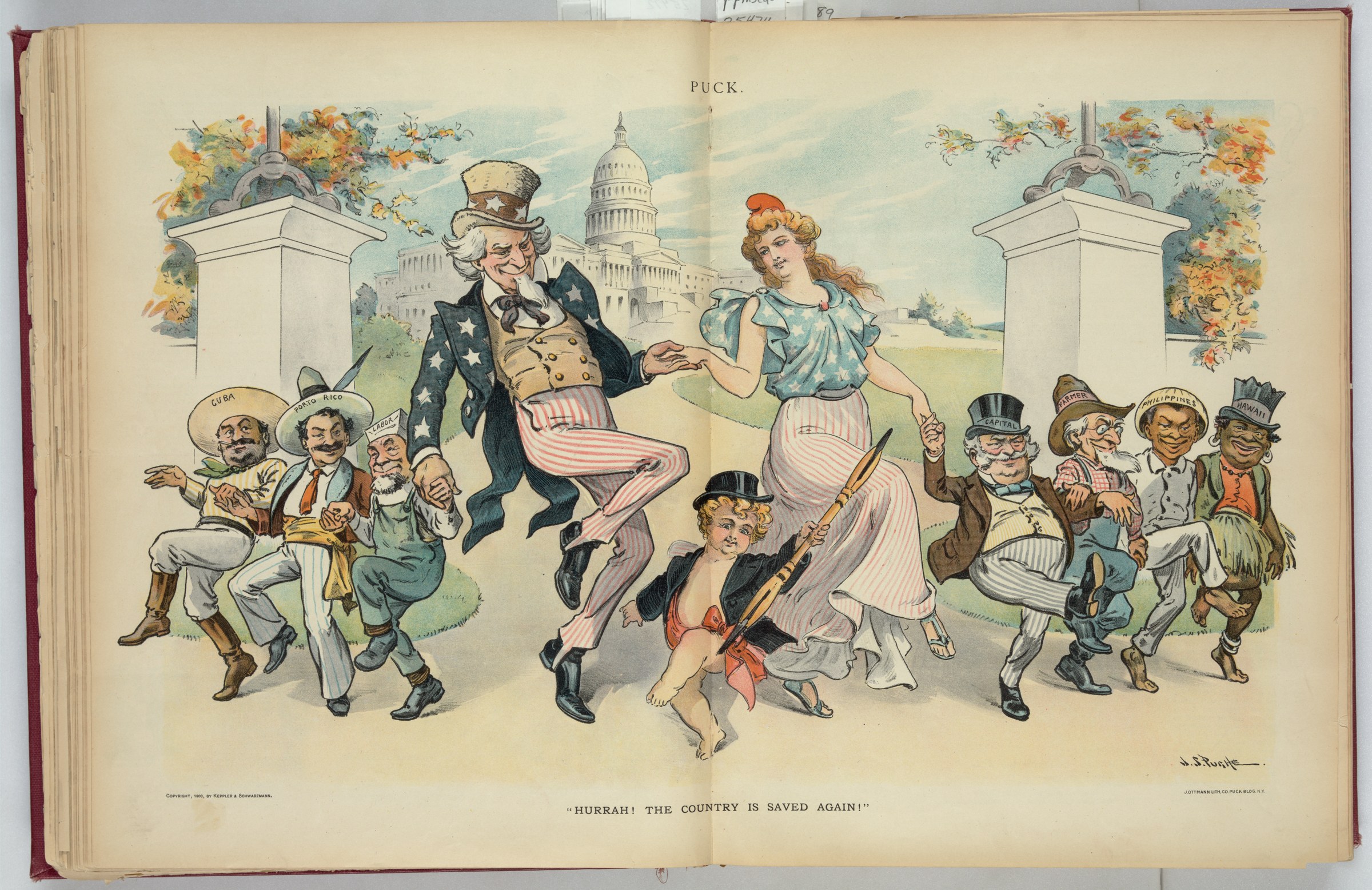
"Hurrah! The country is saved again!" - J.S. Pughe. LCCN2010651346
Pughe, J. S. (John S.), 1870-1909, artist
- Medium:
- Lithograph
- Era:
- 1900-1920 (Ragtime/Early Jazz)
- Source:
- Wikimedia Commons
- Rights:
- Public domain — free to use, share and adapt.
- Recorded as:
- Public Domain
This image documents how dance and bodily spectacle were central to American political mythology and the visual language of imperial power around 1900. For historians of dance and visual culture, it reveals the deep entanglement of dance imagery with racism, nationalism, and the politics of bodily representation—showing how caricature, exaggeration, and the motif of the celebratory dance were deployed to naturalize hierarchies of race and nation. Understanding such images is essential to decolonizing the history of dance and recognizing how the body has always been a contested political arena.
What you are looking at
A chromolithograph satirizing American politics as a dance, with Uncle Sam—recognizable by his distinctive starred jacket, top hat, and whiskered face—capering with a bare-legged allegorical female figure (likely representing Liberty or the Nation) in the center foreground. The pair are surrounded by caricatured ethnic and political figures in exaggerated costume: men in Mexican sombreros and other stereotyped dress are arranged on either side in postures of celebration or submission. The Capitol building sits prominently in the background, rendered in pale blue under bright sky. Two stone pedestals frame the composition on the left and right, topped with sculptural urns and flowering vines, creating a neoclassical stage set. The title "Hurrah! The country is saved again!" appears below, signaling this as a commentary on recent political victory—likely related to an election or foreign policy achievement. The composition is crowded and frenetic, with figures in various states of motion: some dancing, some gesturing, some looking on. The hand of the artist—J. S. Pughe, recognizable from the signature—is evident in the sharp linework and expressive caricature typical of Puck magazine editorial illustration.
The dancing
Uncle Sam is depicted in a high-kicked, almost vaudeville pose—knees up, weight forward, arms gesturing broadly in a cartoonish celebration. The female figure beside him reaches toward him in a receptive pose, her body angled toward his, her skirts swept up by the motion. Neither figure exhibits the controlled frame or posture of ballroom dance; instead, both are caught in exaggerated, almost slapstick movement. The surrounding figures—smaller in scale and rendered as caricatures—are in varied poses: some with arms raised, others in profile showing profile-view kicks or marching strides. There is no paired or partnered structure; this is a crowd in celebratory disarray rather than synchronized or formally partnered dancing.
The dance depicted
This is not a depiction of an actual social or theatrical dance form, but rather a political cartoon that weaponizes the visual language of dance—exaggeration, high spirits, bodily abandon—to satirize American jingoism and electoral triumph. The image borrows the visual vocabulary of late 19th-century popular entertainment (vaudeville, music hall) and applies it to political allegory. The "dance" is a metaphor for national celebration and the hegemonic display of power over subjugated ethnic and political "others." No actual dance technique or tradition is depicted; rather, dance is used as a register of uncouth jubilation.
How it was made
Chromolithograph, a color printing process that allowed for rapid mass production and wide circulation. This technique is characteristic of Puck magazine, a satirical weekly founded in 1876 that specialized in political cartoons and commentary. The bright, flat colors and bold outlines are typical of chromolithographic printing, which could achieve vivid hues and fine detail at scale, making it ideal for editorial humor aimed at a broad, middle-class readership. The medium's reproducibility meant that such images shaped public opinion and visual culture on topical issues.
About this work
This 1900 chromolithograph is a political cartoon published in Puck magazine, using the visual excess and bodily freedom of dance as a metaphor for triumphalist American celebration. Uncle Sam and an allegorical female figure dance in exaggerated postures before the Capitol, surrounded by caricatured ethnic and political figures in a crowded, chaotic scene. The work exemplifies how fin-de-siècle American political humor weaponized the body and dance imagery to represent national power, racial hierarchy, and electoral victory. It belongs in a dance gallery not because it depicts an actual dance practice, but because it is an important record of how dance imagery—the spectacle of bodily freedom and celebration—was conscripted into the service of political ideology and imperial expansion at a crucial moment in American history.
How to look at it
Attend first to the central pair: the arrested moment of Uncle Sam's high kick and the female figure's receptive pose. This is not a moment of elegant partnering or formal dance technique, but rather a frozen instant of uncontrolled exuberance designed to signal both triumph and vulgarity. Note the scale gradient: Uncle Sam and Liberty dominate the foreground, while the ethnic caricatures are smaller and less individually articulated, pushing them to the periphery even as they surround the central figures. The Capitol in the background anchors the political meaning—this celebration happens in the seat of power. Finally, observe the chromolithographic flatness and bright, almost acidic color palette: this is propaganda rendered as entertainment, a style calculated to catch the eye and lodge in the memory.
The artist
J. S. Pughe (John S. Pughe, 1870–1909) was an Irish-born cartoonist and illustrator who became one of the most prominent contributors to Puck magazine in the 1890s and early 1900s. He was known for sharp political satire, expert caricature, and a gift for rendering complex crowded scenes with clarity and wit. His work appeared regularly in Puck and influenced American political cartooning of the period. He died in 1909 at age 39, limiting his output but securing his reputation as a master of editorial illustration.
The period
In 1900, American politics was dominated by the aftermath of the Spanish-American War (1898), the annexation of Hawaii and Puerto Rico, and ongoing debates over American imperial expansion. The McKinley administration had just secured re-election, and the nation was in a mood of triumphalist expansion. In dance history, this period saw the rise of vaudeville and music hall as dominant forms of popular entertainment, with exaggerated, high-energy movement styles and ethnic caricature as standard comedic conventions. The visual language of dance—particularly its associations with bodily freedom, sexuality, and transgression—was regularly borrowed by cartoonists and satirists to represent both celebration and moral panic.
Where it lives
The work is held as part of the Library of Congress collection (LCCN 2010651346) and is publicly available via Wikimedia Commons. It appears to be an original chromolithographic print from Puck magazine or a related publication, part of the extensive archive of American political cartoons at the Library of Congress.
Dance in this work
Questions about this work
Who are all these figures supposed to be?
Uncle Sam (center, in the starred jacket) represents the United States. The female figure represents Liberty or the Nation. The caricatured men around them represent conquered territories, ethnic minorities, or political opponents—the labeling on their hats (visible in the print) would clarify the specific references. Without those labels clearly legible here, we can only say that the composition treats them as subjugated or subordinate to American dominance.
Is this actually a dance, or just people moving around?
It is not a depiction of any actual dance form or social dance practice. Rather, it is a political cartoon that uses dance-like exaggeration and bodily abandon as a visual metaphor for celebration and national triumph. The 'dance' is a rhetorical device, not an ethnographic record.
Why would Puck publish something so crude and racist?
Puck was a satirical magazine oriented toward a white, middle-class readership, and its humor regularly relied on ethnic caricature and racist imagery, which was normalized in American popular culture of the period. The magazine used caricature as its primary tool, often without ironic intent. By modern standards, such imagery is deeply offensive and a painful document of the racism embedded in turn-of-the-century American culture.
What does the Capitol building in the background signify?
The Capitol anchors the scene in the seat of American political power, making clear that this celebration is authorized by and emanates from the federal government. The neoclassical stone pedestals and urns frame the scene as a kind of state spectacle or official pageantry, elevating political victory to the level of high ceremony.
More dance artwork